


KCET · Physics · Dual Nature of Matter
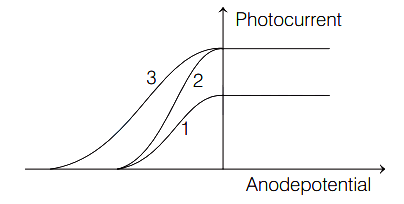
The following graph represents the variation of photocurrent with anode potential for a metal surface. Here \(I_{1}, I_{2}\) and \(I_{3}\) represents intensities and \(\gamma_{1}, \gamma_{2}, \gamma_{3}\) represent frequency for curves 1,2 and 3 respectively, then
- A \(\gamma_{1}=\gamma_{2}\) and \(I_{1} \neq I_{2}\)
- B \(\gamma_{1}=\gamma_{3}\) and \(I_{1} \neq I_{3}\)
- C \(\gamma_{1}=\gamma_{2}\) and \(I_{1}=I_{2}\)
- D \(\gamma_{2}=\gamma_{3}\) and \(I_{1}=I_{3}\)
Answer & Solution
Correct Answer
(A) \(\gamma_{1}=\gamma_{2}\) and \(I_{1} \neq I_{2}\)
Step-by-step Solution
Detailed explanation
The given figure can be shown as
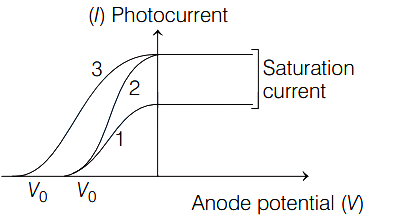
From figure, we can see that the stopping potential \(\left(V_{0}\right)\) is same for curve 1 and 2. But for curve 3 , it is greater than that for land 2 .
As, we know that, \(e V_{0}=E_{\max }=h \gamma-\phi_{0}\)
where, \(\phi_{0}\) is the work function.
Since, \(V_{0}\) is same for 1 and 2, so from above equation, we have \(r_{1}=r_{2}\)
Thus, for 1,2 and 3
\(\gamma_{1}=\gamma_{2} \neq \gamma_{3}\)
Also, the saturation current of curve 2 is greater than of curve 1 . But for curve 2 and 3 it is equal, so,
\(I_{1} \neq I_{2}=I_{3}\)
From figure, we can see that the stopping potential \(\left(V_{0}\right)\) is same for curve 1 and 2. But for curve 3 , it is greater than that for land 2 .
As, we know that, \(e V_{0}=E_{\max }=h \gamma-\phi_{0}\)
where, \(\phi_{0}\) is the work function.
Since, \(V_{0}\) is same for 1 and 2, so from above equation, we have \(r_{1}=r_{2}\)
Thus, for 1,2 and 3
\(\gamma_{1}=\gamma_{2} \neq \gamma_{3}\)
Also, the saturation current of curve 2 is greater than of curve 1 . But for curve 2 and 3 it is equal, so,
\(I_{1} \neq I_{2}=I_{3}\)
See the Complete Solution
Get step-by-step explanations for this and 2.5 Lakh+ more JEE, NEET & CET questions.
- Unlock all solutions
- Practice the full chapter
- Track accuracy across PYQs
4.8 rated on Google Play · 14,000+ reviews
More questions from Physics
- Two capacitors of \( 10 \mathrm{pF} \) and \( 20 \mathrm{pF} \) are connected to \( 200 \mathrm{~V} \) and \( 100 \mathrm{~V} \) sources respectively. If
they are connected by the wire, what is the common potential of the capacitors ?KCET 2014 Medium - The Curie temperature of cobalt and iron are \(1400 \mathrm{~K}\) and \(1000 \mathrm{~K}\) respectively. At \(T=1600 \mathrm{~K}\), the ratio of magnetic susceptibility of cobalt to that of iron isKCET 2023 Easy
- A mass M is hung with a light inextensible string as shown in figure. Find the tension of the horizontal string.
 KCET 2026 Medium
 - A pendulum oscillates simple harmonically and only if
I. the sizer of the bob of pendulum is negligible in comparison with the length of the pendulum.
II. the angular amplitude is less than \(10^{\circ}\).
Choose the correct option.KCET 2021 Easy - In the following equation representing \(\beta^{-}\) decay, the number of neutrons in the nucleus \(X\) is
\({ }_{83}^{210} \mathrm{Bi} \longrightarrow X+e^{-1}+\bar{v}\)KCET 2023 Easy - A certain prism is found to produce a minimum deviation of \( 38^{\circ} . \) It produces a deviation of \( 44^{\circ} \)
when the angle of incidence is either \( 42^{\circ} \) or \( 62^{\circ} \). What is the angle of incidence when it is
undergoing minimum deviation?KCET 2019 Easy
More PYQs from KCET
- Lactational amenorrheaKCET 2016 Hard
- Reactions in Zeolite catalyst depend on,KCET 2016 Easy
- Two objects are projected at an angle \(\theta^{\circ}\) and \(\left(90-\theta^{\circ}\right)\), to the horizontal with the same speed. The ratio of their maximum vertical heights isKCET 2022 Medium
- Sum of the squares of the order and degree (if defined) of a differential equation \(2 y^{\prime}+\left(y^{\prime \prime}\right)^2=\sqrt{y^{\prime \prime}-3}\) isKCET 2026 Medium
- The I-V graphs for two different electrical appliances \( \mathrm{P} \) and \( \mathrm{Q} \) are shown in diagram . If \( R_{p} \) and
\( R_{Q} \) be the resistances of the devices, then KCET 2018 Easy
 - \(50 \mathrm{~cm}^{3}\) of \(0.2 \mathrm{~N} \mathrm{HCl}\) is titrated against \(0.1 \mathrm{~N}\) \(\mathrm{NaOH}\) solution. The titration was discontinued after adding \(50 \mathrm{~cm}^{3}\) of \(\mathrm{NaOH}\). The remaining titration is completed by adding \(0.5 \mathrm{~N} \mathrm{KOH}\). The volume of \(\mathrm{KOH}\) required for completing the titration isKCET 2011 Medium