


KCET · Chemistry · Redox Reactions
\(50 \mathrm{~cm}^{3}\) of \(0.2 \mathrm{~N} \mathrm{HCl}\) is titrated against \(0.1 \mathrm{~N}\) \(\mathrm{NaOH}\) solution. The titration was discontinued after adding \(50 \mathrm{~cm}^{3}\) of \(\mathrm{NaOH}\). The remaining titration is completed by adding \(0.5 \mathrm{~N} \mathrm{KOH}\). The volume of \(\mathrm{KOH}\) required for completing the titration is
- A \(12 \mathrm{~cm}^{3}\)
- B \(10 \mathrm{~cm}^{3}\)
- C \(21.0 \mathrm{~cm}^{3}\)
- D \(16.2 \mathrm{~cm}^{3}\)
Answer & Solution
Correct Answer
(B) \(10 \mathrm{~cm}^{3}\)
Step-by-step Solution
Detailed explanation
No. of equivalent of \(\mathrm{HCl}\) remaining after adding
\[
\begin{aligned}
50 \mathrm{~cm}^{3} \text { of } 0.1 \mathrm{~N} \mathrm{NaOH} &=\frac{0.2 \times 50-0.1 \times 50}{100} \\
&=\frac{0.5}{100}
\end{aligned}
\]
\(\therefore\) Volume of \(0.5 \mathrm{~N} \mathrm{KOH}\) required \(\frac{0.5}{100} \mathrm{eq}\)
\[
\begin{aligned}
& \equiv \frac{V \times 0.5}{1000} \\
V &=\frac{0.5}{100} \times \frac{1000}{0.5} \\
&=10 \mathrm{~cm}^{3}
\end{aligned}
\]
\[
\begin{aligned}
50 \mathrm{~cm}^{3} \text { of } 0.1 \mathrm{~N} \mathrm{NaOH} &=\frac{0.2 \times 50-0.1 \times 50}{100} \\
&=\frac{0.5}{100}
\end{aligned}
\]
\(\therefore\) Volume of \(0.5 \mathrm{~N} \mathrm{KOH}\) required \(\frac{0.5}{100} \mathrm{eq}\)
\[
\begin{aligned}
& \equiv \frac{V \times 0.5}{1000} \\
V &=\frac{0.5}{100} \times \frac{1000}{0.5} \\
&=10 \mathrm{~cm}^{3}
\end{aligned}
\]
See the Complete Solution
Get step-by-step explanations for this and 2.5 Lakh+ more JEE, NEET & CET questions.
- Unlock all solutions
- Practice the full chapter
- Track accuracy across PYQs
4.8 rated on Google Play · 14,000+ reviews
More questions from Chemistry
- The reaction between sodium and water can be made less vigorous byKCET 2012 Medium
- Cannizzaro's reaction is an example of auto oxidationKCET 2017 Easy
- A colloidal solution is subjected to an electric field than colloidal particles more towards anode. The amount of electrolytes of \(\mathrm{BaCl}_{2}, \mathrm{AlCl}_{3}\) and \(\mathrm{NaCl}\) required to coagulate the given colloid is in the orderKCET 2021 Medium
- The correct order of match between column \(X\) and column \(Y\) is
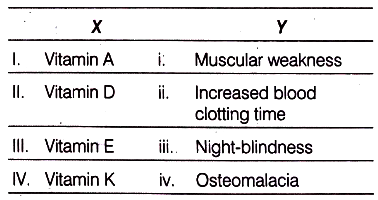 KCET 2023 Hard
 - Formic acid is a stronger acid than acetic acid.
This can be explained usingKCET 2011 Medium - Which metal has a greater tendency to form metal oxide?KCET 2008 Easy
More PYQs from KCET
- Match the stages of prophase I given in Column-I with their features in Column-II and choose the correct options from the choices given below:
Column I Column II A. Leptotene i. Exchange of genetic materials between nonsister chromatids of the homologous chromo-somes. B. Zygotene ii. Chromosomes visible under light microscope C. Pachytene iii. Dissolution of synaptonemal complex D. Diplotene iv. Chromosomes start pairing to-gether E. Diakinesis v. Terminalisation of chiasmata KCET 2025 Medium - The overlapping of orbitals in benzene is of the typeKCET 2008 Easy
- Which of the following statements are true about \(\left[\mathrm{NiCl}_4\right]^{2-}\) ?
(a) The complex has tetrahedral geometry
(b) Co-ordination number of Ni is 2 and oxidation state is +4
(c) The complex is \(\mathrm{sp}^3\) hybridised
(d) It is a high spin complex
(e) The complex is paramagneticKCET 2025 Medium - Binomial nomenclature is introduced byKCET 2022 Medium
- One of the following statements is incorrect with reference to biodiversity. Identify it.KCET 2014 Easy
- Which of the following aqueous solutions should have the highest boiling point?KCET 2018 Medium