


KCET · Physics · Atomic Physics
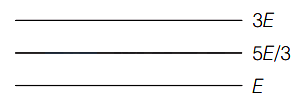
The figure shows the energy level of certain atom. When the electron de excites from \(3 E\) to \(E\), an electromagentic wave of wavelength \(\lambda\) is emitted. What is the wavelength of the electromagnetic wave emitted when the electron de excites from \(\frac{5 E}{3}\) to \(E\) ?
- A \(3 \lambda\)
- B \(2 \lambda\)
- C \(5 \lambda\)
- D \(\frac{3 \lambda}{5}\)
Answer & Solution
Correct Answer
(A) \(3 \lambda\)
Step-by-step Solution
Detailed explanation
As electron de excites from \(3 E \rightarrow E\)
\(\begin{aligned} & \therefore & h v &=3 E-E \\ & \text { or } & \frac{h c}{\lambda} &=2 E ...(i)\end{aligned}\)
When electron de excites from \(\frac{5 E}{3} \rightarrow E\)
\(\frac{h c}{\lambda^{\prime}}=\frac{5 E}{3}-E=\frac{2 E}{3}...(ii)\)
Substituting the value of \(E\) from Eq. (i) in above equation
\(\begin{aligned}
\frac{h c}{\lambda^{\prime}} &=\frac{2}{3}\left(\frac{h c}{\lambda_{2}}\right) \\
\Rightarrow \quad \lambda^{\prime} &=3 \lambda
\end{aligned}\)
\(\begin{aligned} & \therefore & h v &=3 E-E \\ & \text { or } & \frac{h c}{\lambda} &=2 E ...(i)\end{aligned}\)
When electron de excites from \(\frac{5 E}{3} \rightarrow E\)
\(\frac{h c}{\lambda^{\prime}}=\frac{5 E}{3}-E=\frac{2 E}{3}...(ii)\)
Substituting the value of \(E\) from Eq. (i) in above equation
\(\begin{aligned}
\frac{h c}{\lambda^{\prime}} &=\frac{2}{3}\left(\frac{h c}{\lambda_{2}}\right) \\
\Rightarrow \quad \lambda^{\prime} &=3 \lambda
\end{aligned}\)
See the Complete Solution
Get step-by-step explanations for this and 2.5 Lakh+ more JEE, NEET & CET questions.
- Unlock all solutions
- Practice the full chapter
- Track accuracy across PYQs
4.8 rated on Google Play · 14,000+ reviews
More questions from Physics
- If the linear momentum of a body is increased by \(50 \%\), then the kinetic energy of that body increases byKCET 2010 Medium
- What is the energy of the electron revolving in third orbit expressed in \( \mathrm{eV} \) ?KCET 2014 Easy
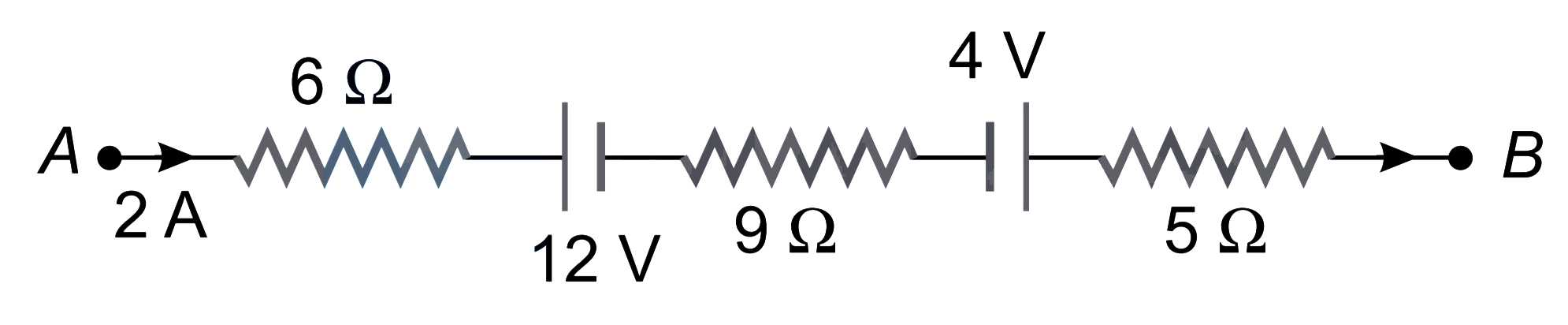
- The potential difference between and in the following figure is
 KCET 2008 Hard
 - A parallel plate capacitor is charged and then isolated. The effect of increasing the plate separation on charge, potential and capacitance respectively areKCET 2015 Easy
- A point object is moving at a constant speed of \(1 \mathrm{~ms}^{-1}\) along the principal axis of a convex lens of focal length \(10 \mathrm{~cm}\). The speed of the image is also \(1 \mathrm{~ms}^{-1}\), when the object is at \(\mathrm{cm}\) from the optical centre of the lens.KCET 2023 Hard
- The current in a coil changes from \(2 \mathrm{~A}\) to \(5 \mathrm{~A}\) in \(0.3 \mathrm{~s}\). The magnitude of emf induced in the coil is \(1.0 \mathrm{~V}\). The value of self-inductance of the coil isKCET 2023 Easy
More PYQs from KCET
- Let \(A=\{x, y, z, u\}\) and \(B=\{a, b\}\). A function \(f: A \rightarrow B\) is selected randomly. The probability that the function is an onto function isKCET 2023 Easy
- On bombarding \(\mathrm{U}^{235}\) by slow neutron, \(200 \mathrm{MeV}\) energy is released. If the power output of atomic reactor is \(1.6 \mathrm{MW}\), then the rate of fission will beKCET 2008 Medium
- In a given direction, the intensities of the scattered light by a scattering substance for two beams of light are in the ratio of \(256: 81\). The ratio of the frequency of the first beam to the frequency of the second beam isKCET 2010 Medium
- The co-ordination number and the oxidation state of the element ' \( M \) ' in the complex
\( \left[\mathrm{M}(\mathrm{en})_{2}\left(\mathrm{C}_{2} \mathrm{O}_{4}\right)\right] \mathrm{NO}_{2} \) [where (en) is ethan-1,2 - diamine] are respectivelyKCET 2017 Easy - A galvanometer of resistance \(50 \Omega\) is connected to a battery \(3 \mathrm{~V}\) along with a resistance \(2950 \Omega\) in series. A full scale deflection of 30 divisions is obtained in the galvanometer. In order to reduce this deflection to 20 divisions, the resistance in series should beKCET 2022 Hard
- The number of atoms in \( 2.4 \mathrm{~g} \) of body centred cubic crystal with edge length \( 200 \mathrm{pm} \) is (density
\( =10 \mathrm{~g} \mathrm{~cm}^{-3}, \mathrm{NA}=6 \times 10^{23} \) atoms \( / \mathrm{mol} \) )KCET 2019 Easy