


KCET · Physics · Wave Optics
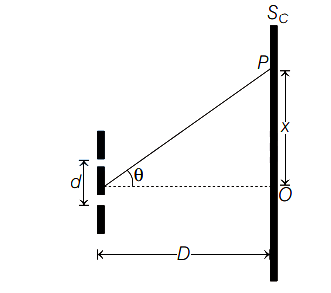
In the Young's double slit experiment a monochromatic source of wavelength \(\lambda\) is used. The intensity of light passing through each slit is \(I_{0}\). The intensity of light reaching the screen \(S_{C}\) at a point \(P\), a distance \(x\) from \(O\) is given by (Take, \(d< < D\) )
- A \(I_{0} \cos ^{2}\left(\frac{\pi D}{\lambda d} x\right)\)
- B \(4 I_{0} \cos ^{2}\left(\frac{\pi d}{\lambda D} x\right)\)
- C \(I_{0} \sin ^{2}\left(\frac{\pi d}{2 \lambda D} x\right)\)
- D \(4 I_{0} \cos \left(\frac{\pi d}{2 \lambda D} x\right)\)
Answer & Solution
Correct Answer
(B) \(4 I_{0} \cos ^{2}\left(\frac{\pi d}{\lambda D} x\right)\)
Step-by-step Solution
Detailed explanation
Path difference, \(\Delta x=\frac{x d}{D}\)
So, corresponding phase difference, \(\phi=\frac{2 \pi}{\lambda}(\Delta x)\)
\(=\frac{2 \pi}{\lambda}\left(\frac{x d}{D}\right)\)
The resultant intensity at \(P\) is
\(\begin{aligned}
I_{P} &=4 I_{0} \cos ^{2}\left(\frac{\phi}{2}\right) \\
&=4 I_{0} \cos ^{2}\left(\frac{2 \pi}{\lambda} \frac{x d}{D} \times \frac{1}{2}\right)=4 I_{0} \cos ^{2}\left(\frac{\pi d x}{\lambda D}\right)
\end{aligned}\)
So, corresponding phase difference, \(\phi=\frac{2 \pi}{\lambda}(\Delta x)\)
\(=\frac{2 \pi}{\lambda}\left(\frac{x d}{D}\right)\)
The resultant intensity at \(P\) is
\(\begin{aligned}
I_{P} &=4 I_{0} \cos ^{2}\left(\frac{\phi}{2}\right) \\
&=4 I_{0} \cos ^{2}\left(\frac{2 \pi}{\lambda} \frac{x d}{D} \times \frac{1}{2}\right)=4 I_{0} \cos ^{2}\left(\frac{\pi d x}{\lambda D}\right)
\end{aligned}\)
See the Complete Solution
Get step-by-step explanations for this and 2.5 Lakh+ more JEE, NEET & CET questions.
- Unlock all solutions
- Practice the full chapter
- Track accuracy across PYQs
4.8 rated on Google Play · 14,000+ reviews
More questions from Physics
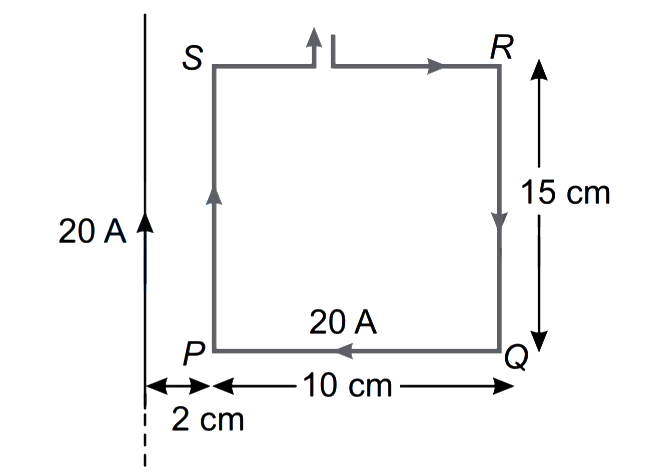
- The resultant force on the current loop due to a long current carrying conductor will be
 KCET 2008 Hard
 - Which of the following statements is incorrect with reference of 'Nuclear force'?KCET 2025 Medium
- Match the following types of nuclei with examples shown
\(\begin{array}{|l|l|}
\hline \text { Column-I } & \text { Column-II } \\
\hline \text { A. Isotopes } & \text { i. } \mathrm{Li}^7, \mathrm{Be}^7 \\
\hline \text { B. Isobars } & \text { ii. }{ }_8 \mathrm{O}^{18},{ }_9 \mathrm{~F}^{19} \\
\hline \text { C. Isotones } & \text { iii }{ }_1 \mathrm{H}^1,{ }_1 \mathrm{H}^2 \\
\hline
\end{array}\)KCET 2025 Easy - Pick out the correct statement from the following.KCET 2010 Easy
- Moment of inertia of a body about two perpendicular axes \( X \) and \( Y \) in the plane of lamina are \( 20 \mathrm{Kg} m^{2} \) and \( 25 \mathrm{Kg} m^{2} \) respectively. Its moment of inertia about an axis perpendicular to the plane of the lamina and passing through the point of intersection of \( X \) and \( Y \) axes isKCET 2018 Easy
- Two fixed charges A and B of \(5 \mu \mathrm{C}\) each are separated by a distance of \(6 \mathrm{~m}\). \(\mathrm{C}\) is the mid point of the line joining \(A\) and \(B\). A charge \(Q\) of \(-5 \mu \mathrm{C}\) is shot perpendicular to the line joining A and \(B\) through \(C\) with a kinetic energy of \(0.06 \mathrm{~J}\). The charge \(\mathrm{Q}\) comes to rest at a point D. The distance \(C D\) isKCET 2012 Hard
More PYQs from KCET
- A parallel beam of light of wavelength \(6000 Å\) gets diffracted by a single slit of width \(0.3 \mathrm{~mm}\). The angular position of the first minima of diffracted light isKCET 2011 Easy
- If \(x+i y=(-1+i \sqrt{3})^{2010}\), then \(x\) isKCET 2010 Easy
- An element \( X \) decays into element \( Z \) by two-step process.
\[
\begin{array}{l}
X \rightarrow Y+4 e \\
Y \rightarrow Z+2 e^{-} \text {then }:
\end{array}
\]KCET 2016 Medium - Current flowing through a wire decreases linearly from \(10\) A to zero in \(4\) s as shown in the graph. Find the total charge flowing through the wire in the given time interval.
 KCET 2026 Easy
 - The tangent to a given curve \(y=f(x)\) is perpendicular to the \(x\)-axis, ifKCET 2009 Easy
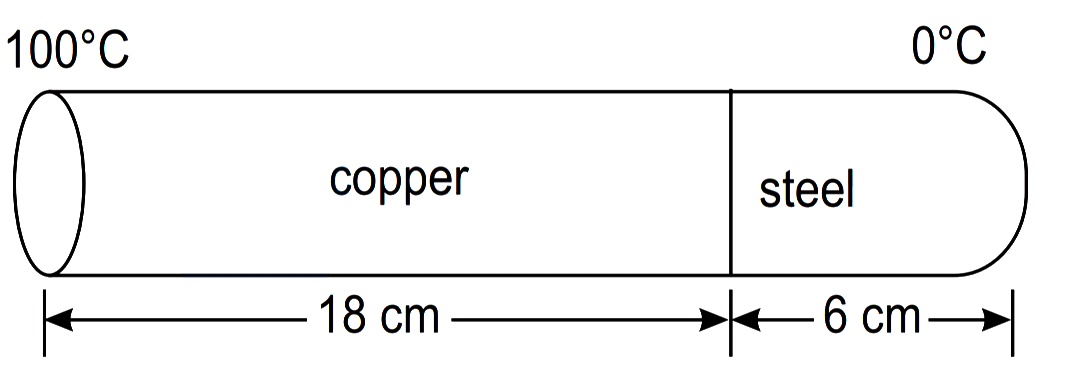
- The coefficient of thermal conductivity of copper is 9 times that of steel. In the composite cylindrical bar shown in the figure, what will be the temperature at the junction of copper and steel?
 KCET 2008 Medium