


KCET · Maths · Complex Number
If \(x+i y=(-1+i \sqrt{3})^{2010}\), then \(x\) is
- A \(-2^{2010}\)
- B \(2^{2010}\)
- C 1
- D \(-1\)
Answer & Solution
Correct Answer
(B) \(2^{2010}\)
Step-by-step Solution
Detailed explanation
\(x+i y=(-1+i \sqrt{3})^{2010}\)
\(\Rightarrow \quad x+i y=(2)^{2010}\left(\frac{-1+i \sqrt{3}}{2}\right)^{2010}\)
\(\Rightarrow \quad(x+i y)=(2)^{2010} \omega^{2010} \quad\left(\because \omega=\frac{-1+i \sqrt{3}}{2}\right)\)
\(\Rightarrow \quad(x+i y)=(2)^{2010}\left(\omega^{3}\right)^{670} \quad\left(\because \omega^{3}=1\right)\)
\(\Rightarrow \quad(x+i y)=(2)^{2010}(1)^{670}=2^{2010}+i \cdot 0\)
On comparing real part
\(\Rightarrow \quad \quad x=2010\)
\(\Rightarrow \quad x+i y=(2)^{2010}\left(\frac{-1+i \sqrt{3}}{2}\right)^{2010}\)
\(\Rightarrow \quad(x+i y)=(2)^{2010} \omega^{2010} \quad\left(\because \omega=\frac{-1+i \sqrt{3}}{2}\right)\)
\(\Rightarrow \quad(x+i y)=(2)^{2010}\left(\omega^{3}\right)^{670} \quad\left(\because \omega^{3}=1\right)\)
\(\Rightarrow \quad(x+i y)=(2)^{2010}(1)^{670}=2^{2010}+i \cdot 0\)
On comparing real part
\(\Rightarrow \quad \quad x=2010\)
See the Complete Solution
Get step-by-step explanations for this and 2.5 Lakh+ more JEE, NEET & CET questions.
- Unlock all solutions
- Practice the full chapter
- Track accuracy across PYQs
4.8 rated on Google Play · 14,000+ reviews
More questions from Maths
- \( [\vec{a}+2 \vec{b}-\vec{c}, \vec{a}-\vec{b}, \vec{a}-\vec{b}-\vec{c}]= \)KCET 2019 Medium
- If \(\lim\limits_{x \to 3}\left(\dfrac{x^2 - ax - 3b}{x - 3}\right) = 5\), then \(a + b = \)KCET 2026 Medium
- \(\int_0^1 \log \left(\frac{1}{x}-1\right) d x\) isKCET 2025 Medium
- The value of \(\int_{-\pi / 2}^{\pi / 2} \frac{\cos x}{1+e^{x}} d x\) isKCET 2020 Easy
- \(\sin ^{2} 17.5^{\circ}+\sin ^{2} 72.5^{\circ}\) is equal toKCET 2007 Easy
- Consider an infinite geometric series with first term ' \( a \) ' and common ratio ' \( r \) '. If the sum is \( 4 \) and
the second term is \( \frac{3}{4} \), thenKCET 2014 Hard
More PYQs from KCET
- The puffed-up appearance of dough is due to fermentation by bacteria. Identify the gas liberated during the process.KCET 2016 Medium
- Two dice are thrown simultaneously, the probability of obtaining a total score of \( 5 \) isKCET 2016 Medium
- Identify the types of aestivation in corolla labelled as 'A', 'B', 'C' and 'D
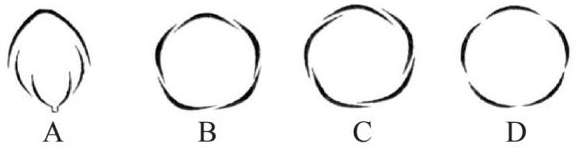 KCET 2025 Medium
 - The maximum area of a rectangle that can be inscribed in a circle of radius 2 units isKCET 2013 Hard
- The ninth term of the expansion \(\left(3 x-\frac{1}{2 x}\right)^{8}\) isKCET 2007 Easy
- At \(300 \mathrm{~K}\), a gaseous reaction \(\mathrm{A} \longrightarrow \mathrm{B}+\mathrm{C}\) was found to follow first order kinetics. Starting with pure \(A\), the total pressure at the end of \(20 \mathrm{~min}\) was \(100 \mathrm{~mm}\) of \(\mathrm{Hg}\). The total pressure after the completion of the reaction is \(180 \mathrm{~mm}\) of \(\mathrm{Hg}\). The partial pressure of \(A\) (in \(\mathrm{mm}\) of \(\mathrm{Hg}\) ) isKCET 2012 Medium