


KCET · Maths · Application of Derivatives
If \(\quad 2 x^{2}+2 y^{2}+4 x+5 y+1=0 \quad\) and \(3 x^{2}+3 y^{2}+6 x-7 y+3 k=0 \quad\) are orthogonal, then value of \(k\) is
- A \(\frac{17}{12}\)
- B \(\frac{12}{17}\)
- C \(-\frac{12}{17}\)
- D \(-\frac{17}{12}\)
Answer & Solution
Correct Answer
(D) \(-\frac{17}{12}\)
Step-by-step Solution
Detailed explanation
Given equation of circles
\[
\begin{aligned}
2 x^{2}+2 y^{2}+4 x+5 y+1 &=0 \\
\Rightarrow \quad x^{2}+y^{2}+2 x+5 / 2 y+1 / 2 &=0 \quad \ldots \text { (i) } \\
3 x^{2}+3 y^{2}+6 x-7 y+3 k &=0 \\
\Rightarrow \quad x^{2}+y^{2}+2 x+7 / 3+k &=0 \quad \ldots \text { (ii) }
\end{aligned}
\]
Centre and radius of first circle and second circle
\[
\begin{gathered}
C_{1} \rightarrow(-1,-5 / 4), \\
R_{1} \rightarrow \sqrt{1+\frac{25}{16}-1 / 2}=\frac{\sqrt{16+25-8}}{16}=\sqrt{\frac{33}{16}} \\
C_{2} \rightarrow(-1,7 / 6), \\
R_{2} \rightarrow \sqrt{1+\frac{49}{36}-k}=\sqrt{\frac{85-36 k}{36}}
\end{gathered}
\]
Now, condition for orthogonality of two circles
\[
\begin{aligned}
\left(C_{1} C_{2}\right)^{2} &=R_{1}{ }^{2}+R_{2}{ }^{2} \\
(-1+1)^{2}+(7 / 6+5 / 4)^{2} &=\frac{33}{16}+\frac{85-36 k}{36} \\
0+\left(\frac{29}{12}\right)^{2} &=\frac{33}{16}+\frac{85-36 k}{36}
\end{aligned}
\]
\(\begin{aligned} \frac{841}{144} &=\frac{33}{16}+\frac{85-36 k}{36} \\ 841 &=297+340-144 k \\ 144 k &=637-841=-204 \\ k &=-\frac{17}{12} \end{aligned}\)
\[
\begin{aligned}
2 x^{2}+2 y^{2}+4 x+5 y+1 &=0 \\
\Rightarrow \quad x^{2}+y^{2}+2 x+5 / 2 y+1 / 2 &=0 \quad \ldots \text { (i) } \\
3 x^{2}+3 y^{2}+6 x-7 y+3 k &=0 \\
\Rightarrow \quad x^{2}+y^{2}+2 x+7 / 3+k &=0 \quad \ldots \text { (ii) }
\end{aligned}
\]
Centre and radius of first circle and second circle
\[
\begin{gathered}
C_{1} \rightarrow(-1,-5 / 4), \\
R_{1} \rightarrow \sqrt{1+\frac{25}{16}-1 / 2}=\frac{\sqrt{16+25-8}}{16}=\sqrt{\frac{33}{16}} \\
C_{2} \rightarrow(-1,7 / 6), \\
R_{2} \rightarrow \sqrt{1+\frac{49}{36}-k}=\sqrt{\frac{85-36 k}{36}}
\end{gathered}
\]
Now, condition for orthogonality of two circles
\[
\begin{aligned}
\left(C_{1} C_{2}\right)^{2} &=R_{1}{ }^{2}+R_{2}{ }^{2} \\
(-1+1)^{2}+(7 / 6+5 / 4)^{2} &=\frac{33}{16}+\frac{85-36 k}{36} \\
0+\left(\frac{29}{12}\right)^{2} &=\frac{33}{16}+\frac{85-36 k}{36}
\end{aligned}
\]
\(\begin{aligned} \frac{841}{144} &=\frac{33}{16}+\frac{85-36 k}{36} \\ 841 &=297+340-144 k \\ 144 k &=637-841=-204 \\ k &=-\frac{17}{12} \end{aligned}\)
See the Complete Solution
Get step-by-step explanations for this and 2.5 Lakh+ more JEE, NEET & CET questions.
- Unlock all solutions
- Practice the full chapter
- Track accuracy across PYQs
4.8 rated on Google Play · 14,000+ reviews
More questions from Maths
- The area of the quadrilateral \(A B C D\) when \(A(0,4,1), B(2,3,-1), C(4,5,0)\) and \(D(2,6,2)\) is equal toKCET 2021 Easy
- The differential coefficient of \( \log _{10} x \) with respect to \( \log _{x} 10 \) isKCET 2016 Easy
- The value of \(\tan 1^{\circ} \tan 2^{\circ} \tan 3^{\circ} \ldots \tan 89^{\circ}\) isKCET 2021 Medium
- If \( x=2+3 \cos \theta \) and \( y=1-3 \sin \theta \) represent a circle then the centre and radius isKCET 2016 Medium
- The value of \(\int e^{x}\left(x^{5}+5 x^{4}+1\right) \cdot d x\) isKCET 2007 Easy
- The shaded region in the figure given is the solution of which of the inequations?
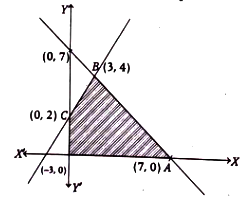 KCET 2023 Easy
More PYQs from KCET
- DNA polymerase of Thermus aquaticus isKCET 2024 Hard
- Which of the following pair contains \( 2 \) lone pair of electrons on the central atom?KCET 2019 Easy
- Which of the following hormones are secreted in large quantities during pregnancy in women?KCET 2014 Easy
- In an \(\mathrm{AC}\) circuit, \(V\) and \(I\) are given by \(V=150 \sin (150 t) \) volt and \(I=150 \sin \left(150 t+\frac{\pi}{3}\right)\) amp. The power dissipated in the circuit isKCET 2011 Easy
- Identify the DNA segment which is not a palindromic sequence.KCET 2014 Hard
- Match the months listed in Column I with the organogenesis of foetus in Column II.
Column I Column II (A) First month (i) Separation of eyelids (B) Second month (ii) Hairs on head (C) Fifth month (iii) Heart (D) Sixth month (iv) Limbs and digits KCET 2020 Easy