


KCET · Physics · Electrostatics
If there are only one type of charge in the universe, then (\( \vec{E} \) Electric field, \( \vec{d} s \rightarrow \) Area vector\()\)
- A \( \oint \vec{E} \cdot \overrightarrow{d_{S}} \neq 0 \) on any surface
- B \( \oint \vec{E} \cdot \vec{d} s \) could not be defined
- C \( \oint \vec{E} \cdot d s=\infty \) if charge is inside
- D \( \oint \vec{E} \cdot d s=0 \) if charge is outside, \( =\frac{q}{\varepsilon_{0}} \) if charge is inside
Answer & Solution
Correct Answer
(D) \( \oint \vec{E} \cdot d s=0 \) if charge is outside, \( =\frac{q}{\varepsilon_{0}} \) if charge is inside
Step-by-step Solution
Detailed explanation
If there are only one type of charge in the universe, then by Gauss Law:
if charge is outside the surface then charge enclosed by gaussian surface is zero. Therefore, \( \oint \vec{E} \cdot d \vec{s}=0 \)
If charge is inside the gaussian surface, then flux \( \phi \) is given by \( \oint \vec{E} \cdot d \vec{s}=\frac{q}{\varepsilon_{0}} \)
if charge is outside the surface then charge enclosed by gaussian surface is zero. Therefore, \( \oint \vec{E} \cdot d \vec{s}=0 \)
If charge is inside the gaussian surface, then flux \( \phi \) is given by \( \oint \vec{E} \cdot d \vec{s}=\frac{q}{\varepsilon_{0}} \)
See the Complete Solution
Get step-by-step explanations for this and 2.5 Lakh+ more JEE, NEET & CET questions.
- Unlock all solutions
- Practice the full chapter
- Track accuracy across PYQs
4.8 rated on Google Play · 14,000+ reviews
More questions from Physics
- An inductor of inductance \( L \) and resistor \( R \) are joined together in series and connected by a source of frequency \( \omega \). The power dissipated in the circuit isKCET 2019 Easy
- The trajectory of a projectile projected from origin is given by the equation \( y=x-\frac{2 x^{2}}{5} \). The initial velocity of the projectile isKCET 2019 Hard
- Two bulbs rated \(25 \mathrm{W}-220 \mathrm{V}\) and \(100 \mathrm{W}-220 \mathrm{V}\) are connected in series to a 440 V supply. The,KCET 2007 Medium
- A body of mass \(4 \mathrm{~kg}\) is accelerated upon by a constant force, travels a distance of \(5 \mathrm{~m}\) in the first second and a distance of \(2 \mathrm{~m}\) in the third second. The force acting on the body isKCET 2008 Easy
- A body is initially at rest. It undergoes one-dimensional motion with constant acceleration. The power delivered to it at time \(t\) is proportional toKCET 2020 Easy
- Calculate the focal length of a reading glass of a person if his distance of distinct vision is \( 75 \) \( \mathrm{cm} \).KCET 2015 Hard
More PYQs from KCET
- The equivalent capacitance between \( A \) and \( B \) is,
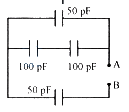 KCET 2019 Easy
 - Ernst Chain and Howard Florey's contribution wasKCET 2015 Medium
- A toroid has \( 500 \) turns per metre length. If it carries a current of \( 2 \mathrm{~A} \), the magnetic energy density inside the toroid isKCET 2019 Medium
- The number of chain isomers possible for the hydrocarbon with molecular formula \(\text{C}_5\text{H}_{12}\) isKCET 2026 Easy
- A cylindrical tube of length \(0.2 \mathrm{~m}\) and radius \(R\) with sugar solution of concentration \(C\) produce a rotation of \(\theta\) in the plane of vibration of a plane polarized light. The same sugar solution is transferred to
another tube of length \(0.3 \mathrm{~m}\) of same radius. The remaining gap is filled by distilled water. Now the optical rotation produced isKCET 2013 Medium - The IUPAC name of the given organic compound is
\(\mathrm{HC} \equiv \mathrm{C}-\mathrm{CH}=\mathrm{CH}-\mathrm{CH}=\mathrm{CH}_2\)KCET 2025 Easy