


KCET · Physics · Magnetic Effects of Current
Biot-Savart law indicates that an electron moving with a velocity \(\vec{V}\) produces a magnetic field \(\vec{B}\) around it such that
- A \(\vec{B}\) is parallel to \(\vec{V}\)
- B \(\vec{B}\) is perpendicular to \(\vec{V}\)
- C \(\vec{B}\) is anti-parallel to \(\vec{V}\)
- D \(\vec{B}\) is inclined to \(\vec{V}\) by \(45^\circ\)
Answer & Solution
Correct Answer
(B) \(\vec{B}\) is perpendicular to \(\vec{V}\)
Step-by-step Solution
Detailed explanation
According to the Biot-Savart law, the magnetic field \(\vec{B}\) produced by a charge \(q\) moving with velocity \(\vec{V}\) at a position vector \(\vec{r}\) is given by
\(\vec{B} = \dfrac{\mu_0}{4\pi} \dfrac{q(\vec{V} \times \vec{r})}{r^3}\)
The direction of the magnetic field \(\vec{B}\) is determined by the cross product \(\vec{V} \times \vec{r}\).
By the properties of the cross product, the resulting vector \(\vec{B}\) is always perpendicular to both the velocity vector \(\vec{V}\) and the position vector \(\vec{r}\).
Therefore, \(\vec{B}\) is perpendicular to \(\vec{V}\).
Answer: \(\vec{B}\) is perpendicular to \(\vec{V}\)
\(\vec{B} = \dfrac{\mu_0}{4\pi} \dfrac{q(\vec{V} \times \vec{r})}{r^3}\)
The direction of the magnetic field \(\vec{B}\) is determined by the cross product \(\vec{V} \times \vec{r}\).
By the properties of the cross product, the resulting vector \(\vec{B}\) is always perpendicular to both the velocity vector \(\vec{V}\) and the position vector \(\vec{r}\).
Therefore, \(\vec{B}\) is perpendicular to \(\vec{V}\).
Answer: \(\vec{B}\) is perpendicular to \(\vec{V}\)
See the Complete Solution
Get step-by-step explanations for this and 2.5 Lakh+ more JEE, NEET & CET questions.
- Unlock all solutions
- Practice the full chapter
- Track accuracy across PYQs
4.8 rated on Google Play · 14,000+ reviews
More questions from Physics
- Two spheres carrying charges \( +6 \mu \mathrm{C} \) and \( +9 \mu \mathrm{C} \). separated by a distance \( \mathrm{d} \), experiences a
force of repulsion \( F \). When a charge of \( -3 \mu \mathrm{C} \) is given to both the sphere and kept at the same
distance as before, the new force of repulsion isKCET 2015 Medium - In a common emitter amplifier the input signal is applied acrossKCET 2009 Easy
- The torque acting on a magnetic dipole placed in uniform magnetic field is zero, when the angle between the dipole axis and the magnetic field isKCET 2023 Easy
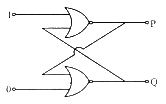
- In the following circuit, what are \( P \) and \( Q \) ?
 KCET 2019 Easy
 - The de-Broglie wavelength of the electron in the ground state of the hydrogen atom is ..... (radius of the first orbit of hydrogen atom \(=0.53 Å\) ).KCET 2010 Easy
- The maximum range of a gun on horizontal plane is \(16 \mathrm{~km}\). If \(g=10 \mathrm{~ms}^{-2}\), then muzzle velocity of a shell isKCET 2021 Medium
More PYQs from KCET
- The photoelectric threshold wavelength for silver is \(\lambda_{0}\). The energy of the electron ejected from the surface of silver by an incident wavelength \(\lambda\left(\lambda < \lambda_{0}\right)\) will beKCET 2011 Hard
- The value of \( \tan \frac{\pi}{8} \) is equal toKCET 2016 Easy
- \( 25 \mathrm{~cm}^{3} \) of oxalic acid completely neutralized \( 0.064 \mathrm{~g} \) of sodium hydroxide. Molarity of the
oxalic acid solution isKCET 2014 Medium - The order of the differential equation obtained by eliminating arbitrary constants in the family of curves \(c_{1} y=\left(c_{2}+c_{3}\right) e^{x+c_{4}}\) isKCET 2020 Medium
- The elements in which electrons are progressively filled in \( 4 \mathrm{f} \) orbital are calledKCET 2019 Easy
- A girl after attaining sexual maturity shoes development of growing ovarian follicles, development of mammary glands and high pitch of voice. These changes are attributed to __________ hormones.KCET 2020 Medium