


KCET · Physics · Thermal Properties of Matter
Two spheres carrying charges \( +6 \mu \mathrm{C} \) and \( +9 \mu \mathrm{C} \). separated by a distance \( \mathrm{d} \), experiences a
force of repulsion \( F \). When a charge of \( -3 \mu \mathrm{C} \) is given to both the sphere and kept at the same
distance as before, the new force of repulsion is
- A \( F \)
- B \( 3 \mathrm{~F} \)
- C \( \mathrm{F} / 3 \)
- D \( \mathrm{F} / \mathrm{g} \)
Answer & Solution
Correct Answer
(C) \( \mathrm{F} / 3 \)
Step-by-step Solution
Detailed explanation
Given, charge \(q_{1}=+6 \mu C=6 \times 10^{-6} C ;\) charge \(q_{2}=+9 \mu C\)
\(=9 \times 10^{-6} C\) seperation \(=d\)
Force between charges is given as
\(F=\frac{1}{4 \Pi \varepsilon_{0}} \frac{q_{1} q_{2}}{d^{2}} \propto \frac{q_{1} q_{2}}{d^{2}}=\frac{6 \times 10^{-6} \times 9 \times 10^{-6}}{d^{2}} \rightarrow(1)\)
When a charge of \(+3 \mu C\) is given to both and separation \(=d\), then
\(q_{1}=+6 \mu C-3 \mu C=3 \mu C=3 \times 10^{-6} C\)
\(q_{2}=+9 \mu C-3 \mu C=6 \mu C=6 \times 10^{-6} C\)
The force between charges is given as
\(F^{\prime}=\frac{1}{4 \Pi \varepsilon_{0}} \frac{q_{1}^{\prime} q_{2}^{\prime}}{d^{2}} \propto \frac{q_{1}^{\prime} q_{2}^{\prime}}{d^{2}}=\frac{3 \times 10^{-6} \times 6 \times 10^{-6}}{d^{2}} \rightarrow(2)\)
Dividing Eq. \((1)\) by Eq. \((2)\), we get
\(\frac{F}{F}=\frac{6 \times 10^{-6} \times 9 \times 10^{-6}}{3 \times 10^{-6} \times 6 \times 10^{-6}}=3\)
\(\Rightarrow F^{\prime}=\frac{F}{3}\) Therefore, the new force of repulsion is \(\frac{F}{3}\)
\(=9 \times 10^{-6} C\) seperation \(=d\)
Force between charges is given as
\(F=\frac{1}{4 \Pi \varepsilon_{0}} \frac{q_{1} q_{2}}{d^{2}} \propto \frac{q_{1} q_{2}}{d^{2}}=\frac{6 \times 10^{-6} \times 9 \times 10^{-6}}{d^{2}} \rightarrow(1)\)
When a charge of \(+3 \mu C\) is given to both and separation \(=d\), then
\(q_{1}=+6 \mu C-3 \mu C=3 \mu C=3 \times 10^{-6} C\)
\(q_{2}=+9 \mu C-3 \mu C=6 \mu C=6 \times 10^{-6} C\)
The force between charges is given as
\(F^{\prime}=\frac{1}{4 \Pi \varepsilon_{0}} \frac{q_{1}^{\prime} q_{2}^{\prime}}{d^{2}} \propto \frac{q_{1}^{\prime} q_{2}^{\prime}}{d^{2}}=\frac{3 \times 10^{-6} \times 6 \times 10^{-6}}{d^{2}} \rightarrow(2)\)
Dividing Eq. \((1)\) by Eq. \((2)\), we get
\(\frac{F}{F}=\frac{6 \times 10^{-6} \times 9 \times 10^{-6}}{3 \times 10^{-6} \times 6 \times 10^{-6}}=3\)
\(\Rightarrow F^{\prime}=\frac{F}{3}\) Therefore, the new force of repulsion is \(\frac{F}{3}\)
See the Complete Solution
Get step-by-step explanations for this and 2.5 Lakh+ more JEE, NEET & CET questions.
- Unlock all solutions
- Practice the full chapter
- Track accuracy across PYQs
4.8 rated on Google Play · 14,000+ reviews
More questions from Physics
- A system of two charges separated by a certain distance apart stores electrical potential energy. If the distance between them is increased, the potential energy of the system,KCET 2019 Easy
- Seven identical discs are arranged in a planar pattern, so as to touch each other as shown in the figure. Each disc has mass \(m\) radius \(R\). What is the moment of inertia of system of six discs about an axis passing through the centre of central disc and normal to plane of all discs?
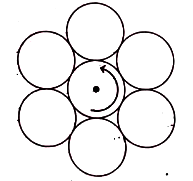 KCET 2023 Easy
 - "Heat cannot be flow itself from a body at lower temperature to a body at higher temperature". This statement corresponds toKCET 2022 Easy
- One mole of \( 4 \) gas is heated at constant pressure starting at \( 27{ }^{\circ} \mathrm{C} . \) How much energy must be added to the gas as heat to double its volume?KCET 2019 Medium
- The correct Biot- Savart law in vector form isKCET 2018 Easy
- The quantities of heat required to raise the temperatures of two copper spheres of radii \(r_{1}\) and \(r_{2}\left(r_{1}=1.5 r_{2}\right)\) through \(1 \mathrm{~K}\) are in the ratio ofKCET 2011 Medium
More PYQs from KCET
- If \(\int_{0}^{1} f(x) d x=5\), then the value of ...+100 \(\int_{0}^{1} \mathrm{x}^{9} \mathrm{f}\left(\mathrm{x}^{10}\right) \mathrm{dx}\) is equal toKCET 2009 Medium
- Following is the substitution reaction in which \(-\mathrm{CN}\) replaces \(-\mathrm{Cl}\).
\(R-\mathrm{Cl}+\underset{\text { (alcoholic) }}{\mathrm{KCN}} \underset{\Delta}{\longrightarrow}-\mathrm{CN}+\mathrm{KCl}\)
To obtain propanenitrile, \(R-\mathrm{Cl}\) should beKCET 2011 Easy - In Argand's plane, the point corresponding to \(\frac{(1-i \sqrt{3})(1+i)}{(\sqrt{3}+i)}\) lies inKCET 2011 Easy
- Which of the following aqueous solution has highest freezing point?KCET 2017 Hard
- In a circuit containing a pure resistor connected to an AC source,KCET 2026 Easy
- A crystalline solid \( X Y_{3} \) has ccp arrangement for its element \( Y . X \) occupiesKCET 2014 Medium