


KCET · Physics · Current Electricity
Two cells of internal resistance \( r_{1} \) and \( r_{2} \) and of same emf are connected in series across a resistor of resistance \( R \). If the terminal potential difference across the cells of internal resistance \( r_{1} \) is zero, then the value of \( \mathrm{R} \) is
- A \( \left(R=2 r_{1}+r_{2}\right) \)
- B \( R=r_{2}-r_{1} \)
- C \( R=r_{1}-r_{2} \)
- D \( \left(R=2 r_{1}-r_{2}\right) \)
Answer & Solution
Correct Answer
(C) \( R=r_{1}-r_{2} \)
Step-by-step Solution
Detailed explanation
Since the two cells are connected in series, therefore, total emf is \( E=E_{1}+E_{2} \)
Since the emf is same, therefore, \( E=2 E\left[\because E_{1}=E_{2}=E(\right. \) say \( \left.)\right] \)
Total resistance \( =R+r_{1}+r_{2} \)
Thus, current in circuit, \( I=\frac{2 E}{R+r_{1}+r_{2}} \)
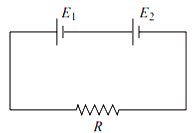
Now, terminal potential difference across cell of internal resistance \( r_{1} \) is \( E-I r_{1} \)
Given, this terminal potential difference is zero, therefore,
\(E-I r_{1}=0 \)
\(E-\frac{2 E}{R+r_{1}+r_{2}} \times r_{1}=0 \)
\(\Rightarrow E=\frac{2 E r_{1}}{R+r_{1}+r_{2}} \)
\(\Rightarrow R+r_{1}+r_{2}=2 r \)
\(\Rightarrow R=2 r_{1}-r_{1}-r_{2} \)
\(\Rightarrow R=r_{1}-r_{2}\)
Since the emf is same, therefore, \( E=2 E\left[\because E_{1}=E_{2}=E(\right. \) say \( \left.)\right] \)
Total resistance \( =R+r_{1}+r_{2} \)
Thus, current in circuit, \( I=\frac{2 E}{R+r_{1}+r_{2}} \)
Now, terminal potential difference across cell of internal resistance \( r_{1} \) is \( E-I r_{1} \)
Given, this terminal potential difference is zero, therefore,
\(E-I r_{1}=0 \)
\(E-\frac{2 E}{R+r_{1}+r_{2}} \times r_{1}=0 \)
\(\Rightarrow E=\frac{2 E r_{1}}{R+r_{1}+r_{2}} \)
\(\Rightarrow R+r_{1}+r_{2}=2 r \)
\(\Rightarrow R=2 r_{1}-r_{1}-r_{2} \)
\(\Rightarrow R=r_{1}-r_{2}\)
See the Complete Solution
Get step-by-step explanations for this and 2.5 Lakh+ more JEE, NEET & CET questions.
- Unlock all solutions
- Practice the full chapter
- Track accuracy across PYQs
4.8 rated on Google Play · 14,000+ reviews
More questions from Physics
- A space station is at a height equal to the radius of the Earth. If ' \( V_{E} \) ' is the escape velocity on the surface of the Earth, the same on the space station is __ times \( V_{E} \).KCET 2018 Medium
- A conducting wire carrying current is arranged as shown. The magnetic field at ' \( O \) '
 KCET 2016 Hard
 - An element \( X \) decays into element \( Z \) by two-step process.
\[
\begin{array}{l}
X \rightarrow Y+4 e \\
Y \rightarrow Z+2 e^{-} \text {then }:
\end{array}
\]KCET 2016 Medium - Pick out the wrong statement.KCET 2012 Easy
- A capacitor of capacitance \( C \) charged by an amount \( Q \) is connected in parallel with an
uncharged capacitor of capacitance 2C. The final charges on the capacitors areKCET 2019 Hard - Decay constants of two radio-active samples A and \(\mathrm{B}\) are \(15 \mathrm{x}\) and \(3 \mathrm{x}\) respectively. They have equal number of initial nuclei. The ratio of the number of nuclei left in \(\mathrm{A}\) and \(\mathrm{B}\) after a time \(\frac{1}{6 \mathrm{x}}\) isKCET 2012 Medium
More PYQs from KCET
- Consider the following statements Statement 1 : \(\lim _{x \rightarrow 1} \frac{a x^{2}+b x+c}{c x^{2}+b x+a}\) is 1 (where \(a+b+c \neq 0\) ).
Statement \(2: \lim _{x \rightarrow 2} \frac{\frac{1}{x}+\frac{1}{2}}{x+2}\) is \(\frac{1}{4}\).KCET 2021 Medium - A metal rod of length \(10 \mathrm{~cm}\) and a rectangular cross-section of \(1 \mathrm{~cm} \times \frac{1}{2} \mathrm{~cm}\) is connected to a battery across opposite faces. The resistance will beKCET 2020 Hard
- A plant is provided with ideal conditions for photosynthesis and supplied with isotope \({ }^{14} CO _2\). When the products of the process are analysed carefully, what would be the nature of products?KCET 2016 Hard
- \(\int \frac{1}{x\left[6(\log x)^2+7 \log x+2\right]} d x\) isKCET 2024 Medium
- The ratio of heats liberated at \( 298 \mathrm{~K} \) from the combustion of one \( \mathrm{kg} \) of coke and by burning
water gas obtained from \( 1 \mathrm{~kg} \) of coke is
(Assume coke to be \( 100 \% \) carbon.)
(Given enthalpies of combustion of \( \mathrm{CO}_{2}, \mathrm{CO} \) and \( \mathrm{H}_{2} \) as \( 393.5 \mathrm{~kJ}, 285 \mathrm{~kJ}, 285 \mathrm{~kJ} \) respectively
all at \( 298 \) K.)KCET 2014 Hard - The rate of the reaction, \(\mathrm{CH}_3 \mathrm{COOC}_2 \mathrm{H}_5+\mathrm{NaOH} \longrightarrow \mathrm{CH}_3 \mathrm{COONa}+\mathrm{C}_2 \mathrm{H}_5 \mathrm{OH}\) is given by the equation, rate \(=k\left[\mathrm{CH}_3 \mathrm{COOC}_2 \mathrm{H}_5\right][\mathrm{NaOH}]\). If concentration is expressed in \(\mathrm{mol}^{-1}\), the unit of \(k\) isKCET 2022 Easy