


KCET · Physics · Electrostatics
A spherical shell of radius \( 10 \mathrm{~cm} \) is carrying a charge \( \mathrm{q} \). If the electric potential at distances \( 5 \) \( \mathrm{cm}, 10 \mathrm{~cm} \) and \( 15 \mathrm{~cm} \) from the centre of the spherical shell is \( V_{1}, V_{2} \) and \( V_{3} \) respectively, then
- A \( V_{1}>V_{2}>V_{3} \)
- B \( V_{1} < V_{2} < V_{3} \)
- C \( V_{1}=V_{2}>V_{3} \)
- D \( V_{1}=V_{2} < V_{3} \)
Answer & Solution
Correct Answer
(C) \( V_{1}=V_{2}>V_{3} \)
Step-by-step Solution
Detailed explanation
It is given,
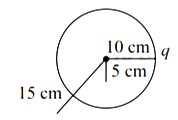
electric potential at \( 5 \mathrm{~cm}=V_{1} \)
electric potential at \( 10 \mathrm{~cm}=V_{2} \)
electric potential at \( 15 \mathrm{~cm}=V_{3} \)
We know potential inside a conductor is same everywhere, therefore electric potential at \( 5 \mathrm{~cm} \) and \( 10 \mathrm{~cm} \) distance will be
same, that is, \( V_{1}=V_{2} \)
Now, electric potential is given as
\(V=\frac{1}{4 \Pi \varepsilon_{0}} \frac{q}{R} \Rightarrow V \propto \frac{1}{R} \)
\(\Rightarrow V_{3}>V_{1}=V_{2}\)
Thus, electric potential at \( 5 \mathrm{~cm}, 10 \mathrm{~cm} \) and \( 15 \mathrm{~cm} \) are
\(V_{1}=V_{2}>V_{3}\)
electric potential at \( 5 \mathrm{~cm}=V_{1} \)
electric potential at \( 10 \mathrm{~cm}=V_{2} \)
electric potential at \( 15 \mathrm{~cm}=V_{3} \)
We know potential inside a conductor is same everywhere, therefore electric potential at \( 5 \mathrm{~cm} \) and \( 10 \mathrm{~cm} \) distance will be
same, that is, \( V_{1}=V_{2} \)
Now, electric potential is given as
\(V=\frac{1}{4 \Pi \varepsilon_{0}} \frac{q}{R} \Rightarrow V \propto \frac{1}{R} \)
\(\Rightarrow V_{3}>V_{1}=V_{2}\)
Thus, electric potential at \( 5 \mathrm{~cm}, 10 \mathrm{~cm} \) and \( 15 \mathrm{~cm} \) are
\(V_{1}=V_{2}>V_{3}\)
See the Complete Solution
Get step-by-step explanations for this and 2.5 Lakh+ more JEE, NEET & CET questions.
- Unlock all solutions
- Practice the full chapter
- Track accuracy across PYQs
4.8 rated on Google Play · 14,000+ reviews
More questions from Physics
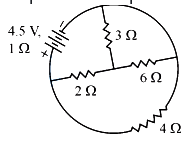
- The power dissipated in \( 3 \Omega \) resistance in the following circuit is
 KCET 2017 Easy
 - A solenoid of inductance \( 2 \mathrm{H} \) carries a current of \( 1 \mathrm{~A} \). What is the magnetic energy stored in a solenoid?KCET 2014 Medium
- During an adiabatic process, the cube of the pressure is found to be inversely proportional to the fourth power of the volume. Then the ratio of specific heats isKCET 2007 Medium
- Maximum diffraction takes place in a given slit forKCET 2008 Easy
- Two resistors of resistances \( 2 \Omega \) and \( 6 \Omega \) are connected in parallel. This combination is then connected to a battery of emf \( 2 \mathrm{~V} \) and internal resistance \( 0.5 \Omega \). What is the current flowing through the battery?KCET 2014 Easy
- Two capacitors of \( 3 \mu \mathrm{F} \) and \( 6 \mu \mathrm{F} \) are connected in series and a potential difference of \( 900 \mathrm{~V} \) is applied across the combination. They are then disconnected and reconnected in parallel. The potential difference across the combination isKCET 2018 Medium
More PYQs from KCET
- Identify the incorrect statement from the following.KCET 2014 Medium
- An element \( X \) decays into element \( Z \) by two-step process.
\[
\begin{array}{l}
X \rightarrow Y+4 e \\
Y \rightarrow Z+2 e^{-} \text {then }:
\end{array}
\]KCET 2016 Medium - If \(2 \mathbf{i}+3 \mathbf{j}, \mathbf{i}+\mathbf{j}+\mathbf{k}\) and \(\lambda \mathbf{i}+4 \mathbf{j}+2 \mathbf{k}\) taken in an order are coterminous edges of a parallelopiped of volume \(2 \mathrm{cu}\) units, then value of \(\lambda\) isKCET 2011 Medium
- Let \(P \equiv(-1,0), Q \equiv(0,0)\) and \(R=(3,3)\) be three points. The equation of the bisector of the angle PQR isKCET 2010 Hard
- Acceleration of a charged particle of charge \(q\) and mass moving in a uniform electric field of strength \(\mathrm{E}\) isKCET 2012 Easy
- The sequence of nitrogen bases in a portion of a coding segment of DNA was AAT GCT TAG GCA. What will be the sequence of nitrogen bases in the corresponding re-gion of the transcripted mRNA?KCET 2005 Medium