


KCET · Physics · Capacitance
Two capacitors of \( 3 \mu \mathrm{F} \) and \( 6 \mu \mathrm{F} \) are connected in series and a potential difference of \( 900 \mathrm{~V} \) is applied across the combination. They are then disconnected and reconnected in parallel. The potential difference across the combination is
- A Zero
- B \( 100 \mathrm{~V} \)
- C \( 200 \mathrm{~V} \)
- D \( 400 \mathrm{~V} \)
Answer & Solution
Correct Answer
(C) \( 200 \mathrm{~V} \)
Step-by-step Solution
Detailed explanation
If \( Q \) is charge on capacitor and \( C \) is capacitance then, potential difference \( V=\frac{Q}{C} \)
When two capacitors are connected in series, then equivalent capacitance is
\(\frac{1}{C}=\frac{1}{C_{1}}+\frac{1}{C_{2}}=\frac{1}{3 \mu F}+\frac{1}{6 \mu F} \)
\(\Rightarrow C=\frac{6 \times 3}{3+6}=2 \mu F \)
Now, \(\mathrm{Q}=C \times V \)
Given, \(\mathrm{V}=900 \mathrm{~V}\)
Therefore, \(Q=2 \times 900=1800 \mu C\)
When two capacitors are connected in parallel, then equivalent capacitance is
\(C=C_{1}+C_{2}=3 \mu F+6 \mu F=9 \mu F \)
Therefore \(V=\frac{Q}{C}=\frac{1800 \mu C}{9 \mu F}=200 \mathrm{~V}\)
Thus, potential difference across the combination is \( 200 \mathrm{~V} \)
When two capacitors are connected in series, then equivalent capacitance is
\(\frac{1}{C}=\frac{1}{C_{1}}+\frac{1}{C_{2}}=\frac{1}{3 \mu F}+\frac{1}{6 \mu F} \)
\(\Rightarrow C=\frac{6 \times 3}{3+6}=2 \mu F \)
Now, \(\mathrm{Q}=C \times V \)
Given, \(\mathrm{V}=900 \mathrm{~V}\)
Therefore, \(Q=2 \times 900=1800 \mu C\)
When two capacitors are connected in parallel, then equivalent capacitance is
\(C=C_{1}+C_{2}=3 \mu F+6 \mu F=9 \mu F \)
Therefore \(V=\frac{Q}{C}=\frac{1800 \mu C}{9 \mu F}=200 \mathrm{~V}\)
Thus, potential difference across the combination is \( 200 \mathrm{~V} \)
See the Complete Solution
Get step-by-step explanations for this and 2.5 Lakh+ more JEE, NEET & CET questions.
- Unlock all solutions
- Practice the full chapter
- Track accuracy across PYQs
4.8 rated on Google Play · 14,000+ reviews
More questions from Physics
- \(100 \mathrm{~g}\) of ice at \(0^{\circ} \mathrm{C}\) is mixed with \(100 \mathrm{~g}\) of water at \(100^{\circ} \mathrm{C}\). The final temperature of the mixture is
[Take, \(L_f=3.36 \times 10^5 \mathrm{~J} \mathrm{~kg}^{-1}\) and \(\left.S_w=4.2 \times 10^3 \mathrm{~J} \mathrm{~kg}^{-1} \mathrm{~K}^{-1}\right]\)KCET 2023 Easy - Wavefront is the locus of all points, where the particles of the medium vibrate with the sameKCET 2011 Easy
- A source of sound is moving with a velocity of \( 50 \mathrm{~ms}^{-1} \) towards a stationary observer. The observer measures the frequency of sound as \( 500 \mathrm{~Hz} \). The apparent frequency of sound as heard by the observer when source is moving away from him with the same speed is (Speed of sound at room temperature \( 350 \mathrm{~ms}^{-1} \))KCET 2016 Medium
- If we consider an electron and a photon of same de-Broglie wavelength, then they will have sameKCET 2025 Easy
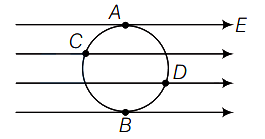
- A uniform electric field in the plane of the paper as shown. Here \(A, B, C\) and \(D\) are the ponits on the circle. \(V_{1}, V_{2}, V_{3}\) and \(V_{4}\) are the potentials at those points respectively. Then
 KCET 2013 Easy
 - A pendulum oscillates simple harmonically and only if
I. the sizer of the bob of pendulum is negligible in comparison with the length of the pendulum.
II. the angular amplitude is less than \(10^{\circ}\).
Choose the correct option.KCET 2021 Easy
More PYQs from KCET
- The distance of the point \( (1,2,1) \) from the line \( \frac{x-1}{2}=\frac{y-2}{1}=\frac{z-3}{2} \) isKCET 2019 Easy
- The process of conversation of non-motile spermatids into motile spermatozoa is calledKCET 2018 Medium
- During the electrolysis of brine, by using inert electrodes,KCET 2023 Medium
- The locus of a point which moves such that the sum of its distances from two fixed points is a constant, isKCET 2008 Easy
- A positively charged glass rod is brought near uncharged metal sphere, which is mounted on an insulated stand. If the glass rod is removed, the net charge on the metal sphere isKCET 2023 Easy
- The equation of two circles which touch the \(Y\)-axis at \((0,3)\) and make an intercept of 8 units on \(X\)-axis areKCET 2007 Medium