


KCET · Maths · Straight Lines
Let \(P \equiv(-1,0), Q \equiv(0,0)\) and \(R=(3,3)\) be three points. The equation of the bisector of the angle PQR is
- A \(x-\sqrt{3} y=0\)
- B \(\sqrt{3} \mathrm{x}-\mathrm{y}=0\)
- C \(\mathrm{x}+\sqrt{3} \mathrm{y}=0\)
- D \(\sqrt{3} x+y=0\)
Answer & Solution
Correct Answer
(D) \(\sqrt{3} x+y=0\)
Step-by-step Solution
Detailed explanation
\(\begin{array}{ll}\text { Given that, } & \mathrm{P}=(-1,0) \\ \text { and } & \mathrm{Q}=(0,0) \\ & \mathrm{R}=(3,3 \sqrt{3})\end{array}\)
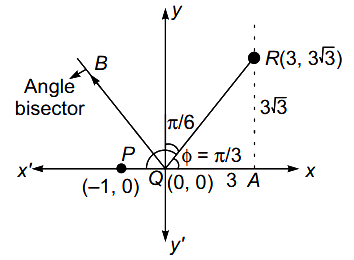
In \(\triangle \mathrm{AQR}\),
\(
\begin{aligned}
\tan \phi &=\frac{3 \sqrt{3}}{3} \\
\Rightarrow \quad \tan \phi &=\sqrt{3}
\end{aligned}
\)
\(
\begin{aligned}
\Rightarrow & & \tan \phi &=\tan 60^{\circ} \\
\Rightarrow & \phi &=\frac{\pi}{3}
\end{aligned}
\)
Slope of line QR
\(\mathrm{m}_{1}=\frac{3 \sqrt{3}-0}{3-0}=\sqrt{3}\) \(\Rightarrow \quad \mathrm{m}_{1}=\sqrt{3}\) Slope of line \(\mathrm{QP}\) \(\mathrm{m}_{2}=\frac{0-0}{-1-0}=0 \Rightarrow \mathrm{m}_{2}=0\)
Slope of line QP
\(
\mathrm{m}_{2}=\frac{0-0}{-1-0}=0 \Rightarrow \mathrm{m}_{2}=0
\)
Let the angle between PQR is \(\theta\), then
\(
\begin{aligned}
\tan \theta &=\left|\frac{\mathrm{m}_{1}-\mathrm{m}_{2}}{1+\mathrm{m}_{1} \cdot \mathrm{m}_{2}}\right| \\
\Rightarrow \quad \tan \theta &=\left|\frac{\sqrt{3}-0}{1+0}\right|=\sqrt{3} \text { or }-\sqrt{3} \\
\Rightarrow \quad & \tan \theta=\tan \frac{2 \pi}{3} \Rightarrow \theta=\frac{2 \pi}{3} \\
& {[\because(\tan \theta \neq \sqrt{3}) \text { from figure }] }
\end{aligned}
\)
Hence, \(\quad \angle \mathrm{RQB}=\frac{\theta}{2}=\frac{2 \pi}{6}=\frac{\pi}{3}\)
So, the angle bisector making an angle with (+) ive \(x\)-axis, is \(\frac{\pi}{3}+\frac{\pi}{3}=\frac{2 \pi}{3}\)
The equation of angle bisector is
\(
\begin{array}{ll}
\Rightarrow & \mathrm{y}=\mathrm{mx}=\tan \frac{2 \pi}{3} \cdot \mathrm{x} \\
\Rightarrow & \mathrm{y}=-\sqrt{3} \cdot \mathrm{x} \Rightarrow \sqrt{3} \cdot \mathrm{x}+\mathrm{y}=0
\end{array}
\)
In \(\triangle \mathrm{AQR}\),
\(
\begin{aligned}
\tan \phi &=\frac{3 \sqrt{3}}{3} \\
\Rightarrow \quad \tan \phi &=\sqrt{3}
\end{aligned}
\)
\(
\begin{aligned}
\Rightarrow & & \tan \phi &=\tan 60^{\circ} \\
\Rightarrow & \phi &=\frac{\pi}{3}
\end{aligned}
\)
Slope of line QR
\(\mathrm{m}_{1}=\frac{3 \sqrt{3}-0}{3-0}=\sqrt{3}\) \(\Rightarrow \quad \mathrm{m}_{1}=\sqrt{3}\) Slope of line \(\mathrm{QP}\) \(\mathrm{m}_{2}=\frac{0-0}{-1-0}=0 \Rightarrow \mathrm{m}_{2}=0\)
Slope of line QP
\(
\mathrm{m}_{2}=\frac{0-0}{-1-0}=0 \Rightarrow \mathrm{m}_{2}=0
\)
Let the angle between PQR is \(\theta\), then
\(
\begin{aligned}
\tan \theta &=\left|\frac{\mathrm{m}_{1}-\mathrm{m}_{2}}{1+\mathrm{m}_{1} \cdot \mathrm{m}_{2}}\right| \\
\Rightarrow \quad \tan \theta &=\left|\frac{\sqrt{3}-0}{1+0}\right|=\sqrt{3} \text { or }-\sqrt{3} \\
\Rightarrow \quad & \tan \theta=\tan \frac{2 \pi}{3} \Rightarrow \theta=\frac{2 \pi}{3} \\
& {[\because(\tan \theta \neq \sqrt{3}) \text { from figure }] }
\end{aligned}
\)
Hence, \(\quad \angle \mathrm{RQB}=\frac{\theta}{2}=\frac{2 \pi}{6}=\frac{\pi}{3}\)
So, the angle bisector making an angle with (+) ive \(x\)-axis, is \(\frac{\pi}{3}+\frac{\pi}{3}=\frac{2 \pi}{3}\)
The equation of angle bisector is
\(
\begin{array}{ll}
\Rightarrow & \mathrm{y}=\mathrm{mx}=\tan \frac{2 \pi}{3} \cdot \mathrm{x} \\
\Rightarrow & \mathrm{y}=-\sqrt{3} \cdot \mathrm{x} \Rightarrow \sqrt{3} \cdot \mathrm{x}+\mathrm{y}=0
\end{array}
\)
See the Complete Solution
Get step-by-step explanations for this and 2.5 Lakh+ more JEE, NEET & CET questions.
- Unlock all solutions
- Practice the full chapter
- Track accuracy across PYQs
4.8 rated on Google Play · 14,000+ reviews
More questions from Maths
- If \(y=a \sin ^3 t, x=a \cos ^3 t\), then \(\frac{d y}{d x}\) at \(t=\frac{3 \pi}{4}\) isKCET 2025 Medium
- If the parametric equation of curve is given by \(x=\cos \theta+\log \tan \frac{\theta}{2}\) and \(y=\sin \theta\), then the points for which \(\frac{d y}{d x}=0\) are given byKCET 2021 Medium
- If \(A\) and \(B\) are square matrices of same order and \(B\) is a skew symmetric matrix, then \(A^{\prime} B A\) isKCET 2020 Medium
- If \(\left|\begin{array}{ccc}1+\sin ^{2} \theta & \cos ^{2} \theta & 4 \sin 2 \theta \\ \sin ^{2} \theta & 1+\cos ^{2} \theta & 4 \sin 2 \theta \\ \sin ^{2} \theta & \cos ^{2} \theta & 4 \sin 2 \theta-1\end{array}\right|=0\) and \(0 < \theta < \frac{\pi}{2}\), then \(\cos 4 \theta\) is equal toKCET 2009 Hard
- If \(y=e^{\sqrt{x \sqrt{x} \sqrt{x}} \ldots,} x>1\), then \(\frac{d^2 y}{d x^2}\) at \(x=\log _e 3\) isKCET 2022 Hard
- If \( A \) and \( B \) are finite sets and \( A \subset B \), thenKCET 2017 Easy
More PYQs from KCET
- A galvanometer coil has a resistance of \( 50 \Omega \) and the meter shows full scale deflection for a current of \( 5 \mathrm{~mA} \), This galvanometer is converted into voltmeter of range \( 0-20 \mathrm{~V} \) by connectingKCET 2016 Medium
- The rate of change of volume of a sphere with respect to its surface area when the radius is \( 4 \)
\( \mathrm{cm} \) isKCET 2017 Easy - Auxins: Apical dominance:: Gibberellins: __________KCET 2024 Medium
- Which of the following is not a green house gas?KCET 2020 Easy
- The nitrogen base found only in DNA is also calledKCET 2015 Easy
- Generally, the first ionisation energy increases along a period. But there are some exceptions. The one which is not an exception isKCET 2011 Easy