


KCET · Physics · Electrostatics
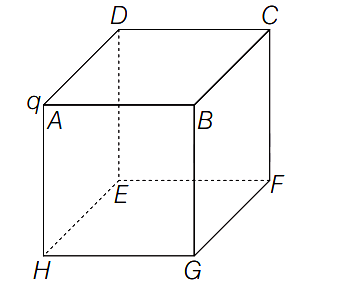
A point charge \(q\) is placed at the corner of a cube of side \(a\) as shown in the figure. What is the electric flux through the face \(A B C D\) ?
- A 0
- B \(\frac{q}{24 \varepsilon_{0}}\)
- C \(\frac{q}{6 \varepsilon_{0}}\)
- D \(\frac{q}{72 \varepsilon_{0}}\)
Answer & Solution
Correct Answer
(B) \(\frac{q}{24 \varepsilon_{0}}\)
Step-by-step Solution
Detailed explanation
If charge is placed at the one corner of a cube, then it can be shared further by 8 cubes.
\(\therefore\) Charge on one cube \(=\frac{q}{8}\)
Now, in any given cube this charge will be touching 3 out of 9 of cube faces. So, the area vector of that side and the electric field vector will be perpendicular. So, flux through those 3 sides will be zero. However, equal amount of flux will flow from other 3 sides.
So, flux through one side \(=\left(\frac{q / 8}{3}\right) \cdot \frac{1}{\varepsilon_{0}}=\frac{q}{24 \varepsilon_{0}}\) Hence, flux through one face \((A B C D)=\frac{q}{24 \varepsilon_{0}}\)
\(\therefore\) Charge on one cube \(=\frac{q}{8}\)
Now, in any given cube this charge will be touching 3 out of 9 of cube faces. So, the area vector of that side and the electric field vector will be perpendicular. So, flux through those 3 sides will be zero. However, equal amount of flux will flow from other 3 sides.
So, flux through one side \(=\left(\frac{q / 8}{3}\right) \cdot \frac{1}{\varepsilon_{0}}=\frac{q}{24 \varepsilon_{0}}\) Hence, flux through one face \((A B C D)=\frac{q}{24 \varepsilon_{0}}\)
See the Complete Solution
Get step-by-step explanations for this and 2.5 Lakh+ more JEE, NEET & CET questions.
- Unlock all solutions
- Practice the full chapter
- Track accuracy across PYQs
4.8 rated on Google Play · 14,000+ reviews
More questions from Physics
- According to the quark model, it is possible to build all the hadrons usingKCET 2009 Medium
- Two capacitors of \( 10 \mathrm{pF} \) and \( 20 \mathrm{pF} \) are connected to \( 200 \mathrm{~V} \) and \( 100 \mathrm{~V} \) sources respectively. If
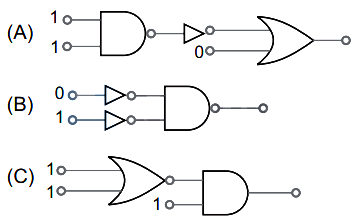
they are connected by the wire, what is the common potential of the capacitors ?KCET 2014 Medium - In the following combinations of logic gates, the outputs of \(A, B\) and \(C\) are respectively
 KCET 2009 Medium
 - In an oscillating \(L C\)-circuit, \(L=3 \mathrm{mH}\) and \(C=2.7 \mu \mathrm{F}\). At \(t=0\), the charge on the capacitor is zero and the current is \(2 \mathrm{~A}\). The maximum charge that will appear on the capacitor will beKCET 2021 Medium
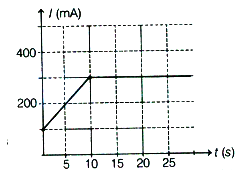
- The electric current flowing through a given conductor varies with time as shown in the graph below. The number of free electrons which flow through a given cross-section of the conductor in the time interval \(0 \leq t \leq 20 \mathrm{~s}\) is
 KCET 2024 Easy
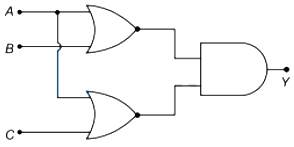
 - The output of given logic circuit is
 KCET 2011 Medium
More PYQs from KCET
- Equation of the plane perpendicular to the line \( \frac{x}{1}=\frac{y}{2}=\frac{z}{3} \) and passing through the point \( (2, \),
\( 3,4) \) isKCET 2014 Easy - An organic compound \(X\) on treatment with PCC in dichloromethane gives the compound \(Y\). Compound \(Y\) reacts with \(\mathrm{I}_{2}\) and alkali to form yellow precipitate of triiodomethane. The compound \(X\) isKCET 2021 Easy
- Four identical cells of emf \( E \) and internal resistance \( r \) are to be connected in series. Suppose if one of the cell is connected wrongly, the equivalent emf and effective internal resistance of the combination isKCET 2015 Hard
- Match the compounds given in column-I with the number of carbon atoms present in them which are listed under column-II. Choose the answer which shows the correct combination of alphabets of the two column.
Column I Column II A. Oxaloacetate p. 6-C compound B. Phosphogly-ceraldehyde q. 5-C compound C. Isocitrate r. 4-C compound D. \(\alpha\)-Ketoglutrate s. 3-C compound t. 2-C compound KCET 2009 Hard - The number of terms in the expansion of \((x+y+z)^{10}\) isKCET 2020 Easy
- Two identical conducting balls \(A\) and \(B\) have positive charges \(\mathrm{q}_{1}\) and \(\mathrm{q}_{2}\) respectively but \(\mathrm{q}_{1} \neq \mathrm{q}_{2}\). The balls are brought together so that they touch each other and then kept in their original positions. The force between them isKCET 2010 Hard