


KCET · Chemistry · Aldehydes and Ketones
An organic compound \(X\) on treatment with PCC in dichloromethane gives the compound \(Y\). Compound \(Y\) reacts with \(\mathrm{I}_{2}\) and alkali to form yellow precipitate of triiodomethane. The compound \(X\) is
- A \(\mathrm{CH}_{3} \mathrm{CHO}\)
- B \(\mathrm{CH}_{3} \mathrm{COCH}_{3}\)
- C \(\mathrm{CH}_{3} \mathrm{CH}_{2} \mathrm{OH}\)
- D \(\mathrm{CH}_{3} \mathrm{COOH}\)
Answer & Solution
Correct Answer
(C) \(\mathrm{CH}_{3} \mathrm{CH}_{2} \mathrm{OH}\)
Step-by-step Solution
Detailed explanation
Compound \((Y)\) gives iodoform test, that means it contains acetyl group
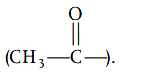
PCC is an oxidising agent which oxidised the alcohol to aldehyde or ketone (depends upon the reactant alcohol). That means \(X\) is an alcohol.
From the given information, it is concluded that the compound \(X\) is an alcohol (which contain two carbon). Thus, the alcohol is \(\mathrm{CH}_{3} \mathrm{CH}_{2} \mathrm{OH}\).
The reaction involves are as follows:

PCC is an oxidising agent which oxidised the alcohol to aldehyde or ketone (depends upon the reactant alcohol). That means \(X\) is an alcohol.
From the given information, it is concluded that the compound \(X\) is an alcohol (which contain two carbon). Thus, the alcohol is \(\mathrm{CH}_{3} \mathrm{CH}_{2} \mathrm{OH}\).
The reaction involves are as follows:
See the Complete Solution
Get step-by-step explanations for this and 2.5 Lakh+ more JEE, NEET & CET questions.
- Unlock all solutions
- Practice the full chapter
- Track accuracy across PYQs
4.8 rated on Google Play · 14,000+ reviews
More questions from Chemistry
- How many Coulombs of electricity are required for the oxidation of one mol of water to
dioxygen?KCET 2015 Medium - The energy of electron in the \( n^{\text {th }} \) Bohr orbit of H-atom isKCET 2016 Easy
- In the given sequence of reactions, identify \({ }^{\prime} P^{\prime}, ' Q{ }^{\prime}, R^{\prime}\) and ' \(S\) respectively.
\(\mathrm{CH}_2= \underset{\underset{}{\Large | ~~~~} \atop \huge \mathrm{Br}}{\mathrm{CH}_2}-\underset{\underset{}{\Large | ~~~~} \atop \huge \mathrm{Br}}{\mathrm{CH}_2} \xrightarrow{Q}\)
\(\mathrm{CH}_2=\mathrm{CH}-\mathrm{Br} \xrightarrow{R} \mathrm{CH} \equiv \mathrm{CH} \xrightarrow{s} \mathrm{C}_6 \mathrm{H}_6\)KCET 2024 Easy - Geometrical isomerism is shown byKCET 2007 Hard
- Which of the following is not a colligative property?KCET 2016 Easy
- The value of ' \(A\) ' in the equation \(\lambda_{\mathrm{m}}=\lambda_{\mathrm{m}}^{\circ}-A \sqrt{C}\) is same for the pairKCET 2024 Medium
More PYQs from KCET
- The vector equation of the plane which is at a distance of \( \frac{3}{\sqrt{14}} \) from the origin and the normal
from the origin is \( 2 \hat{i}-3 \hat{j}+\hat{k} \) isKCET 2016 Medium - The de-Broglie wavelength of a particle of kinetic energy \(K\) is \(\lambda\), the wavelength of the particle, if its kinetic energy \(\frac{K}{4}\) isKCET 2022 Easy
- The maximum value of \( \left(\frac{1}{x}\right)^{x} \) isKCET 2018 Hard
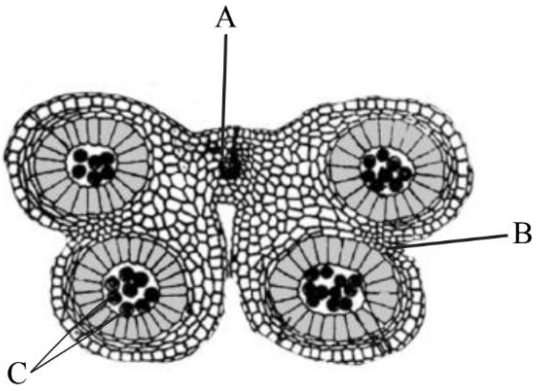
- The following is the diagram of T.S of anther. Identify the parts labelled A, B and C.
 KCET 2011 Hard
 - The function \(f(x)=[x]\), where \([x]\) denotes the greatest integer not greater than \(x\), isKCET 2010 Easy
- The image formed by an objective lens of a compound microscope isKCET 2025 Easy