


KCET · Physics · Oscillations
A force \( \vec{F}=5 \hat{i}+2 \hat{j}-5 \hat{k} \) acts on a particle whose position vector is \( \vec{r}=\hat{i}-2 \hat{j}+\hat{k} \).
What is the torque about the origin ?
- A \( 8 \hat{i}+10 \hat{j}+12 \hat{k} \)
- B \( 8 \hat{i}+10 \hat{j}-12 \hat{k} \)
- C \( 8 \hat{i}-10 \hat{j}-8 \hat{k} \)
- D \( 10 \hat{i}-10 \hat{j}-\hat{k} \)
Answer & Solution
Correct Answer
(A) \( 8 \hat{i}+10 \hat{j}+12 \hat{k} \)
Step-by-step Solution
Detailed explanation
Given \( \vec{F}=5 \hat{i}+2 \hat{j}-5 \hat{k} ; \vec{r}=\hat{i}-2 \hat{j}+\hat{k} \)
We know torque
\(\tau=\vec{r} \times \vec{F}=\left|\begin{array}{ccc}\hat{i} & \hat{j} & \hat{k} \\1 & -2 & 1 \\5 & 2 & -5\end{array}\right|\)
Therefore,
\(\tau=\hat{i}(10-2)-\hat{j}(-5-5)+\hat{k}(2+10) \)
\(\Rightarrow \tau=8 \hat{i}+10 \hat{j}+12 \hat{k}\)
Thus, torque about origin is \( 8 \hat{i}+10 \hat{j}+12 \hat{k} \)
We know torque
\(\tau=\vec{r} \times \vec{F}=\left|\begin{array}{ccc}\hat{i} & \hat{j} & \hat{k} \\1 & -2 & 1 \\5 & 2 & -5\end{array}\right|\)
Therefore,
\(\tau=\hat{i}(10-2)-\hat{j}(-5-5)+\hat{k}(2+10) \)
\(\Rightarrow \tau=8 \hat{i}+10 \hat{j}+12 \hat{k}\)
Thus, torque about origin is \( 8 \hat{i}+10 \hat{j}+12 \hat{k} \)
See the Complete Solution
Get step-by-step explanations for this and 2.5 Lakh+ more JEE, NEET & CET questions.
- Unlock all solutions
- Practice the full chapter
- Track accuracy across PYQs
4.8 rated on Google Play · 14,000+ reviews
More questions from Physics
- In the three parts of a transistor, 'Emitter' is ofKCET 2017 Medium
- In a common emitter amplifier the input signal is applied acrossKCET 2009 Easy
- The work done by a force acting on a body is as shown in the graph. The total work done in covering an initial distance of \(20 \mathrm{~m}\) is
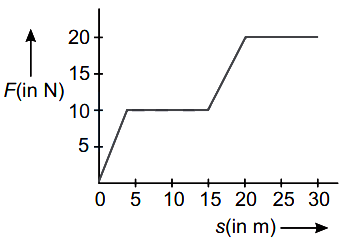 KCET 2009 Medium
 - A candle placed \( 25 \mathrm{~cm} \) from a lens forms an image on a screen placed \( 75 \mathrm{~cm} \) on the other side
of the lens. The focal length and type of the lens should beKCET 2018 Medium - A \( 100 \mathrm{~W} \) bulb is connected to an \( \mathrm{AC} \) source of \( 220 \mathrm{~V}, 50 \mathrm{~Hz} \). Then the current flowing through the bulb isKCET 2018 Easy
- A stationary point source of sound emits sound uniformly in all directions in a non-absorbing medium. Two points \(P\) and \(Q\) are at a distance of \(4 \mathrm{~m}\) and \(9 \mathrm{~m}\) respectively from the source. The ratio of amplitudes of the waves at \(P\) and \(Q\) isKCET 2009 Hard
More PYQs from KCET
- The minimum area of the triangle formed by the variable line \(3 \cos \theta \cdot x+4 \sin \theta \cdot y=12\) and the coordinate axes isKCET 2013 Hard
- The angle of elevation of the top of a TV tower from three points A, B and \(C\) in a straight line through the foot of the tower are \(\alpha, 2 \alpha\) and \(3 \alpha\)
respectively. If \(A B=a\), then height of the tower isKCET 2008 Hard - In a group \((G, *)\), for some element \(a\) of \(G\), if \(a^{2}=e\), where \(e\) is the identity element, thenKCET 2013 Medium
- In a CE amplifier, the input ac signal to be amplified is applied acrossKCET 2018 Medium
- \( \int_{0}^{\frac{\pi}{2}} \frac{\sin ^{1000} x d x}{\sin ^{1000} x+\cos ^{1000} x} \) is equal toKCET 2016 Easy
- The angle between the lines whose direction ratios are \(a, b, c\) and \(b - c, c - a, a - b\) isKCET 2026 Easy