


KCET · Physics · Electrostatics
A dipole moment \(p\) and moment of inertia \(I\) is placed in a uniform electric field \(\mathbf{E}\). If it is displaced slightly from its stable equilibrium position, the period of oscillation of dipole is
- A \(\sqrt{\frac{p E}{I}}\)
- B \(2 \pi \sqrt{\frac{I}{p E}}\)
- C \(\frac{1}{2 \pi} \sqrt{\frac{p E}{I}}\)
- D \(\pi \sqrt{\frac{I}{p E}}\)
Answer & Solution
Correct Answer
(B) \(2 \pi \sqrt{\frac{I}{p E}}\)
Step-by-step Solution
Detailed explanation
Torque on electric dipole placed in uniform electric field \(E\),
where, \(p=\) electric dipole moment.
For small angle \(\theta, \sin \theta=\theta...(i)\)
\(\therefore\) From Eq. (i), we have
\(\tau=p E \theta...(ii)\)
but \(\tau=I \times \alpha...(iii)\)
where \(\alpha\) is angular acceleration.
From Eqs. (ii) and (iii), we have
\(I \alpha=p E \theta\)
\(\alpha=\frac{p E}{I} \cdot \theta \Rightarrow \frac{\theta}{\alpha}=\frac{I}{p E}...(iv)\)
\(\therefore\) Time period for the oscillation of dipole,
\(T=2 \pi \sqrt{\frac{\theta}{\alpha}}=2 \pi \sqrt{\frac{I}{p E}}\)
where, \(p=\) electric dipole moment.
For small angle \(\theta, \sin \theta=\theta...(i)\)
\(\therefore\) From Eq. (i), we have
\(\tau=p E \theta...(ii)\)
but \(\tau=I \times \alpha...(iii)\)
where \(\alpha\) is angular acceleration.
From Eqs. (ii) and (iii), we have
\(I \alpha=p E \theta\)
\(\alpha=\frac{p E}{I} \cdot \theta \Rightarrow \frac{\theta}{\alpha}=\frac{I}{p E}...(iv)\)
\(\therefore\) Time period for the oscillation of dipole,
\(T=2 \pi \sqrt{\frac{\theta}{\alpha}}=2 \pi \sqrt{\frac{I}{p E}}\)
See the Complete Solution
Get step-by-step explanations for this and 2.5 Lakh+ more JEE, NEET & CET questions.
- Unlock all solutions
- Practice the full chapter
- Track accuracy across PYQs
4.8 rated on Google Play · 14,000+ reviews
More questions from Physics
- Two protons are kept at a separation of \( 10 \mathrm{~nm} \). Let Fn and Fe be the nuclear force and the
electromagnetic force between themKCET 2019 Easy - According to Einstein's photoelectric equation, the graph of \(\mathrm{KE}\) of the photoelectron emitted from the metal versus the frequency of the incident radiation gives a straight line graph, whose slopeKCET 2010 Easy
- Coersivity of a magnet where the ferromagnet gets completely demagnetized is \( 3 \times 10^{3} \mathrm{Am}^{-1} \)
The minimum current required to be passed in a solenoid having \( 1000 \) turns per metre, so
that the magnet gets completely demagnetized when placed inside the solenoid isKCET 2019 Hard - The period of revolution of an electron in the ground state of hydrogen atom is \( T \). The period of
revolution of the electron in the first excited state isKCET 2018 Medium - An ideal gas is taken path as shown in figure. The net work done in the whole cycle is
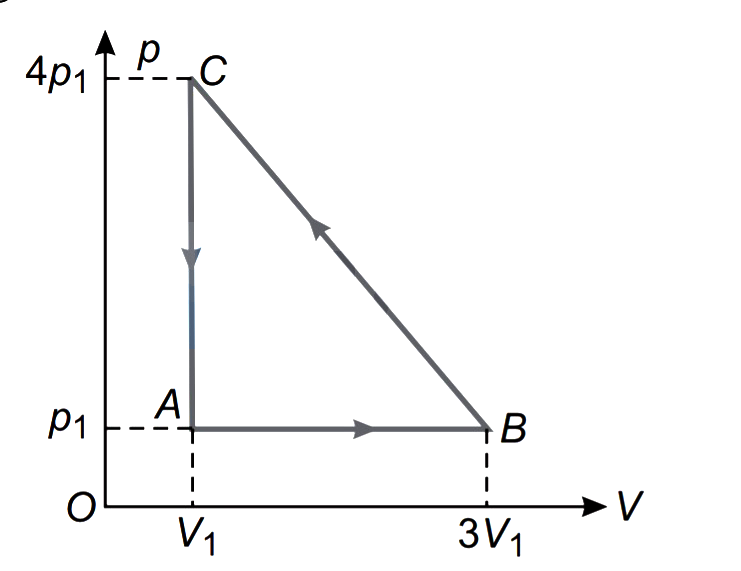 KCET 2008 Medium
 - Hot water cools from \(60^{\circ} \mathrm{C}\) to \(50^{\circ} \mathrm{C}\) in the first \(10 \mathrm{~min}\) and to \(42^{\circ} \mathrm{C}\) in the next \(10 \mathrm{~min}\). Then the temperature of the surroundings isKCET 2010 Easy
More PYQs from KCET
- Five capacitance each of value \(l \mu \mathrm{F}\) are connected as shown in the figure. The equivalent capacitance between \(A\) and \(B\) is
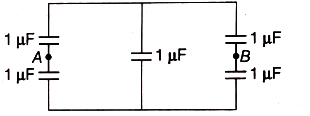 KCET 2023 Easy
 - If \( y=\left(\tan ^{-1} x\right)^{2} \), then \( \left(x^{2}+1\right)^{2} y_{2}+2 x\left(x^{2}+1\right) y_{1} \) is equal toKCET 2014 Easy
- The general solution of the differential equation \( \frac{d y}{d x}+\frac{y}{x}=3 x \) isKCET 2014 Easy
- If \(\cos \alpha+2 \cos \beta+3 \cos \gamma=0\),
\(\sin \alpha+2 \sin \beta+3 \sin \gamma=0\) and \(\alpha+\beta+\gamma=\pi\), then \(\sin 3 \alpha+8 \sin 3 \beta+27 \sin 3 \gamma\) is equal toKCET 2012 Medium - If \(\mu_{0}\) is permeability of free space and \(\varepsilon_{0}\) is permittivity of free space, the speed of light in vacuum is given byKCET 2008 Easy
- The efficiency of Carnot's heat engine is \(0.5\) when the temperature of the source is \(\mathrm{T}_{1}\) and that of \(\operatorname{sink}\) is \(\mathrm{T}_{2}\). The efficiency of another Carnot's heat engine is also 0.5. The temperatures of source and sink of the second engine are respectivelyKCET 2010 Medium