


KCET · Physics · Thermal Properties of Matter
Hot water cools from \(60^{\circ} \mathrm{C}\) to \(50^{\circ} \mathrm{C}\) in the first \(10 \mathrm{~min}\) and to \(42^{\circ} \mathrm{C}\) in the next \(10 \mathrm{~min}\). Then the temperature of the surroundings is
- A \(20^{\circ} \mathrm{C}\)
- B \(30^{\circ} \mathrm{C}\)
- C \(15^{\circ} \mathrm{C}\)
- D \(10^{\circ} \mathrm{C}\)
Answer & Solution
Correct Answer
(D) \(10^{\circ} \mathrm{C}\)
Step-by-step Solution
Detailed explanation
According to Newton's law of cooling
\(\frac{\theta_{2}-\theta_{1}}{\mathrm{t}}=\mathrm{K}\left[\frac{\theta_{1}+\theta_{2}}{2}-\theta_{\mathrm{s}}\right]\)
where, \(\theta_{s}\) is the temperature of the surroundings.
\(\frac{60-50}{10} =K\left[\frac{60+50}{2}-\theta_{s}\right] \)
\(1 =K\left[55-\theta_{s}\right] \text{...(i)}\)
Similarly, \(\frac{50-42}{10}=\mathrm{K}\left(46-\theta_{\mathrm{s}}\right)\)
\(\frac{8}{10}=K\left(46-\theta_{s}\right) \text{...(ii)}\)
Dividing Eq. (i) by Eq. (ii), we get
\(\begin{aligned}&\frac{10}{8}=\frac{K\left(55-\theta_{s}\right)}{K\left(46-\theta_{s}\right)} \\&\theta_{s}=10^{\circ} \mathrm{C}\end{aligned}\)
\(\Rightarrow \theta_{\mathrm{s}}=10^{\circ} \mathrm{C}\)
\(\frac{\theta_{2}-\theta_{1}}{\mathrm{t}}=\mathrm{K}\left[\frac{\theta_{1}+\theta_{2}}{2}-\theta_{\mathrm{s}}\right]\)
where, \(\theta_{s}\) is the temperature of the surroundings.
\(\frac{60-50}{10} =K\left[\frac{60+50}{2}-\theta_{s}\right] \)
\(1 =K\left[55-\theta_{s}\right] \text{...(i)}\)
Similarly, \(\frac{50-42}{10}=\mathrm{K}\left(46-\theta_{\mathrm{s}}\right)\)
\(\frac{8}{10}=K\left(46-\theta_{s}\right) \text{...(ii)}\)
Dividing Eq. (i) by Eq. (ii), we get
\(\begin{aligned}&\frac{10}{8}=\frac{K\left(55-\theta_{s}\right)}{K\left(46-\theta_{s}\right)} \\&\theta_{s}=10^{\circ} \mathrm{C}\end{aligned}\)
\(\Rightarrow \theta_{\mathrm{s}}=10^{\circ} \mathrm{C}\)
See the Complete Solution
Get step-by-step explanations for this and 2.5 Lakh+ more JEE, NEET & CET questions.
- Unlock all solutions
- Practice the full chapter
- Track accuracy across PYQs
4.8 rated on Google Play · 14,000+ reviews
More questions from Physics
- First overtone frequency of a closed pipe of length ' \( l_{1}{ }^{\prime} \) is equal to \( 2^{\text {nd }} \) hormonic frequency of an open pipe of length ' \( l_{2} \) '. The ratio \( \frac{l_{1}}{l_{2}} \) isKCET 2018 Medium
- The binding energy/nucleon of deuteron \(\left({ }_{1} \mathrm{H}^{2}\right)\) and the helium atom \(\left({ }_{2} \mathrm{He}^{4}\right)\) are \(1.1 \mathrm{MeV}\) and \(7 \mathrm{MeV}\) respectively. If the two deuteron atoms fuse to form a single helium atom, then the energy released isKCET 2013 Medium
- The accurate measurement of emf can be obtained usingKCET 2009 Easy
- A piece of copper is to be shaped into a conducting wire of maximum resistance. The suitable length and diameter are and respectively.KCET 2017 Hard
- The horizontal component of Earth's magnetic field at a place is \(3 \times 10^{-5} \mathrm{~T}\). If the dip at that place is \(45^{\circ}\), the resultant magnetic field at that place isKCET 2023 Easy
- A certain current on passing through a galvanometer produces a deflection of 100 divisions. When a shunt of one ohm is connected, the deflection reduces to 1 division. The galvanometer resistance isKCET 2008 Easy
More PYQs from KCET
- Two monochromatic light waves of amplitudes \(3 \mathrm{~A}\) and \(2 \mathrm{~A}\) interfering at a point have a phase difference of \(60^{\circ}\). The intensity at that point will be proportional toKCET 2011 Medium
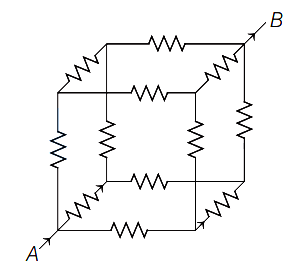
- Each resistance in the given cubical network has resistance of \(1 \Omega\) and equivalent resistance between \(A\) and \(B\) is
 KCET 2020 Medium
 - If \( \tan x=\frac{3}{4}, \Pi < x < \frac{3 \Pi}{2} \), then the value of \( \cos \frac{x}{2} \) isKCET 2014 Medium
- Which of the following element forms \( p \Pi-p_{\Pi} \) bond with itself ?KCET 2017 Easy
- Phosphorus pentachlorideKCET 2020 Medium
- The surface temperature of the sun which has maximum energy emission at \(500 \mathrm{~nm}\) is \(6000 \mathrm{~K}\). The temperature of a star which has maximum energy emission at \(400 \mathrm{~nm}\) will beKCET 2007 Easy