


KCET · Physics · Thermal Properties of Matter
A cup of tea cools from \( 65.5^{\circ} \mathrm{C} \) to \( 62.5^{\circ} \mathrm{C} \) in one minute in a room at
\( 22.5^{\circ} \mathrm{C} \). How long will it take to cool from \( 46.5^{\circ} \mathrm{C} \) to \( 40.5^{\circ} \mathrm{c} \) in the same room?
- A \( 4 \) minutes
- B \( 2 \) minutes
- C \( 1 \) minute
- D \( 3 \) minutes
Answer & Solution
Correct Answer
(A) \( 4 \) minutes
Step-by-step Solution
Detailed explanation
Given, cup of tea cools from \(65.5^{\circ} \mathrm{C}\) to \(62.5^{\circ} \mathrm{C}\) in 1 minute.
Room temperature \(=22.5^{\circ} \mathrm{C}\)
We know that \(\frac{d T}{d t}=k\left(\theta-\theta_{0}\right) \rightarrow(1)\)
For 1st case \(: \frac{d T}{d t}=\frac{65.5-62.5}{1 \mathrm{~min}}=\frac{3^{\circ} \mathrm{C}}{1}\)
Also,
\(\theta-\theta_{0}=\left(\frac{65.5+62.5}{2}\right)-22.5=64-22.5\)
\(\theta-\theta_{0}=41.5^{\circ} \mathrm{C}\)
Now, substituting in Eq. (1), we get
\(3=k(41.5)\)
\(\Rightarrow k=\frac{3}{41.5} \rightarrow(2)\)
For 2 nd case \(: \frac{d T}{d t}=\frac{46.5-40.5}{t}=\frac{6^{\circ} \mathrm{C}}{t}\)
Also,
\(\theta-\theta_{0}=\left(\frac{46.5+40.5}{2}\right)-22.5=43.5-22.5\)
\(\Rightarrow \theta-\theta_{0}=21^{\circ} \mathrm{C}\)
Again, substituting in Eq. (1), we get
\(\frac{6}{t}=k \times 21\)
Substitute value of k from Eq. (2), we get
\(\frac{6}{t}=\frac{3}{41.5} \times 21\)
\(\Rightarrow t=\frac{6 \times 41.5}{3 \times 21}=3.9523\)
Room temperature \(=22.5^{\circ} \mathrm{C}\)
We know that \(\frac{d T}{d t}=k\left(\theta-\theta_{0}\right) \rightarrow(1)\)
For 1st case \(: \frac{d T}{d t}=\frac{65.5-62.5}{1 \mathrm{~min}}=\frac{3^{\circ} \mathrm{C}}{1}\)
Also,
\(\theta-\theta_{0}=\left(\frac{65.5+62.5}{2}\right)-22.5=64-22.5\)
\(\theta-\theta_{0}=41.5^{\circ} \mathrm{C}\)
Now, substituting in Eq. (1), we get
\(3=k(41.5)\)
\(\Rightarrow k=\frac{3}{41.5} \rightarrow(2)\)
For 2 nd case \(: \frac{d T}{d t}=\frac{46.5-40.5}{t}=\frac{6^{\circ} \mathrm{C}}{t}\)
Also,
\(\theta-\theta_{0}=\left(\frac{46.5+40.5}{2}\right)-22.5=43.5-22.5\)
\(\Rightarrow \theta-\theta_{0}=21^{\circ} \mathrm{C}\)
Again, substituting in Eq. (1), we get
\(\frac{6}{t}=k \times 21\)
Substitute value of k from Eq. (2), we get
\(\frac{6}{t}=\frac{3}{41.5} \times 21\)
\(\Rightarrow t=\frac{6 \times 41.5}{3 \times 21}=3.9523\)
See the Complete Solution
Get step-by-step explanations for this and 2.5 Lakh+ more JEE, NEET & CET questions.
- Unlock all solutions
- Practice the full chapter
- Track accuracy across PYQs
4.8 rated on Google Play · 14,000+ reviews
More questions from Physics
- One end of a string of length \(l\) is connected to a particle of mass \(m\) and the other to a small peg on a smooth horizontal table. If the particle moves in a circle with speed \(v\), the net force on the particle (directed towards the centre) is ( \(T\) is the tension in the string)KCET 2020 Easy
- A horizontal force of \(5\) N is applied on a stationary body of mass \(5\) kg, which is initially at rest on a frictionless table. The change in kinetic energy of the body in \(10\) s isKCET 2026 Easy
- The maximum kinetic energy of the photo-electrons depends only onKCET 2014 Easy
- In Young's double slit experiment the source is white light. One slit is covered with red filter and
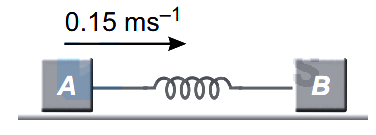
the other with blue filter. There shall beKCET 2016 Easy - Two rectangular blocks \(A\) and \(B\) of masses \(2 \mathrm{~kg}\) and \(3 \mathrm{~kg}\) respectively are connected by a spring of spring constant \(10.8 \mathrm{Nm}^{-1}\) and are placed on a frictionless horizontal surface. The block A was given an initial velocity of \(0.15 \mathrm{~ms}^{-1}\) in the direction shown in the figure. The maximum compression of the spring during the motion is
 KCET 2009 Hard
 - Match the following types of nuclei with examples shown
\(\begin{array}{|l|l|}
\hline \text { Column-I } & \text { Column-II } \\
\hline \text { A. Isotopes } & \text { i. } \mathrm{Li}^7, \mathrm{Be}^7 \\
\hline \text { B. Isobars } & \text { ii. }{ }_8 \mathrm{O}^{18},{ }_9 \mathrm{~F}^{19} \\
\hline \text { C. Isotones } & \text { iii }{ }_1 \mathrm{H}^1,{ }_1 \mathrm{H}^2 \\
\hline
\end{array}\)KCET 2025 Easy
More PYQs from KCET
- Hydrogen atom does not emit -rays becauseKCET 2008 Medium
- A \(2 \mathrm{~g}\) object, located in a region of uniform electric field \(\mathbf{E}=\left(300 \mathrm{NC}^{-1}\right) \hat{\mathbf{i}}\) carries a charge \(Q\). The object released from rest at \(x=0\), has a kinetic energy of \(0.12 \mathrm{~J}\) at \(x=0.5 \mathrm{~m}\). Then, \(Q\) isKCET 2021 Medium
- The value of \( \sqrt{24.99} \) isKCET 2019 Medium
- If \( \vec{a} \) and \( \vec{b} \) are unit vectors then what is the angle between \( \vec{a} \) and \( \vec{b} \) for \( \sqrt{3} \vec{a}-\vec{b} \) to be unit
vector?KCET 2016 Medium - Which of the following hormones are secreted in large quantities during pregnancy in women?KCET 2014 Easy
- For hydrogen - oxygen fuel cell at one atm and \( 298 \mathrm{~K} \)
\( \mathrm{H}_{2}(g)+\frac{1}{2} \mathrm{O}_{2(g)} \rightarrow \mathrm{H}_{2} \mathrm{O}(l) ; \Delta \mathrm{G}^{\circ}=-240 \mathrm{~kJ} \)
\( \mathrm{E}^{\circ} \) for the cell is approximately,
(Given \( \mathrm{F}=96,500 \mathrm{C} \) )KCET 2014 Medium