


KCET · Physics · Center of Mass Momentum and Collision
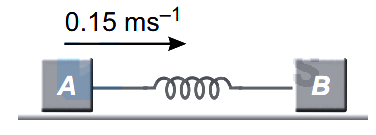
Two rectangular blocks \(A\) and \(B\) of masses \(2 \mathrm{~kg}\) and \(3 \mathrm{~kg}\) respectively are connected by a spring of spring constant \(10.8 \mathrm{Nm}^{-1}\) and are placed on a frictionless horizontal surface. The block A was given an initial velocity of \(0.15 \mathrm{~ms}^{-1}\) in the direction shown in the figure. The maximum compression of the spring during the motion is
- A \(0.01 \mathrm{~m}\)
- B \(0.02 \mathrm{~m}\)
- C \(0.05 \mathrm{~m}\)
- D \(0.03 \mathrm{~m}\)
Answer & Solution
Correct Answer
(C) \(0.05 \mathrm{~m}\)
Step-by-step Solution
Detailed explanation
As the block \(A\) moves with velocity \(0.15 \mathrm{~ms}^{-1}\), it compresses thespring which pushes \(B\) towards right. \(A\) goes on compressing the spring till the velocity acquired by \(B\) becomes equal to the velocity of \(A\), ie, \(0.15 \mathrm{~ms}^{-1}\). Let this velocity be v. Now, spring is in a state of maximum compression. Let \(x\) be the maximum compression at this stage.
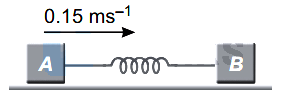
According to the law of conservation of linear momentum, we get
or
\(\mathrm{m}_{\mathrm{A}} \mathrm{u} =\left(\mathrm{m}_{\mathrm{A}}+\mathrm{m}_{\mathrm{B}}\right) \mathrm{v} \)
\( \mathrm{v} =\frac{\mathrm{m}_{\mathrm{A}} \mathrm{u}}{\mathrm{m}_{\mathrm{A}}+\mathrm{m}_{\mathrm{B}}} \)
\( =\frac{2 \times 0.15}{2+3}=0.06 \mathrm{~ms}^{-1}\)
According to the law of conservation of energy.
\(\frac{1}{2} \mathrm{~m}_{\mathrm{A}} \mathrm{u}^{2}=\frac{1}{2}\left(\mathrm{~m}_{\mathrm{A}}+\mathrm{m}_{\mathrm{B}}\right) \mathrm{v}^{2}+\frac{1}{2} \mathrm{kx}^{2} \)
\( \frac{1}{2} \mathrm{~m}_{\mathrm{A}} \mathrm{u}^{2}-\frac{1}{2}\left(\mathrm{~m}_{\mathrm{A}}+\mathrm{m}_{\mathrm{B}}\right) \mathrm{v}^{2}=\frac{1}{2} \mathrm{kx}^{2} \)
\( \frac{1}{2} \times 2 \times(0.15)^{2}-\frac{1}{2}(2+3)(0.06)^{2}=\frac{1}{2} \mathrm{kx}^{2} \)
\( 0.0225-0.009=\frac{1}{2} \mathrm{kx}^{2} \text { or } 0.0135=\frac{1}{2} \mathrm{kx}^{2} \)
\( \text {or } \quad \mathrm{x}=\sqrt{\frac{0.027}{\mathrm{k}}}=\sqrt{\frac{0.027}{10.8}}=0.05 \mathrm{~m}\)
According to the law of conservation of linear momentum, we get
or
\(\mathrm{m}_{\mathrm{A}} \mathrm{u} =\left(\mathrm{m}_{\mathrm{A}}+\mathrm{m}_{\mathrm{B}}\right) \mathrm{v} \)
\( \mathrm{v} =\frac{\mathrm{m}_{\mathrm{A}} \mathrm{u}}{\mathrm{m}_{\mathrm{A}}+\mathrm{m}_{\mathrm{B}}} \)
\( =\frac{2 \times 0.15}{2+3}=0.06 \mathrm{~ms}^{-1}\)
According to the law of conservation of energy.
\(\frac{1}{2} \mathrm{~m}_{\mathrm{A}} \mathrm{u}^{2}=\frac{1}{2}\left(\mathrm{~m}_{\mathrm{A}}+\mathrm{m}_{\mathrm{B}}\right) \mathrm{v}^{2}+\frac{1}{2} \mathrm{kx}^{2} \)
\( \frac{1}{2} \mathrm{~m}_{\mathrm{A}} \mathrm{u}^{2}-\frac{1}{2}\left(\mathrm{~m}_{\mathrm{A}}+\mathrm{m}_{\mathrm{B}}\right) \mathrm{v}^{2}=\frac{1}{2} \mathrm{kx}^{2} \)
\( \frac{1}{2} \times 2 \times(0.15)^{2}-\frac{1}{2}(2+3)(0.06)^{2}=\frac{1}{2} \mathrm{kx}^{2} \)
\( 0.0225-0.009=\frac{1}{2} \mathrm{kx}^{2} \text { or } 0.0135=\frac{1}{2} \mathrm{kx}^{2} \)
\( \text {or } \quad \mathrm{x}=\sqrt{\frac{0.027}{\mathrm{k}}}=\sqrt{\frac{0.027}{10.8}}=0.05 \mathrm{~m}\)
See the Complete Solution
Get step-by-step explanations for this and 2.5 Lakh+ more JEE, NEET & CET questions.
- Unlock all solutions
- Practice the full chapter
- Track accuracy across PYQs
4.8 rated on Google Play · 14,000+ reviews
More questions from Physics
- An object with mass \( 5 \mathrm{~kg} \) is acted upon by a force, \( \vec{F}=(-3 \hat{i}+4 \hat{j}) \mathrm{N} \). If its initial velocity at
\( \mathrm{t}=0 \) is \( \vec{v}=(6 \hat{i}-12 \hat{j}) \mathrm{ms}^{-1} \), the time at which it will just have a velocity along \( \mathrm{y} \)-axis isKCET 2019 Medium - A pendulum oscillates simple harmonically and only if
I. the sizer of the bob of pendulum is negligible in comparison with the length of the pendulum.
II. the angular amplitude is less than \(10^{\circ}\).
Choose the correct option.KCET 2021 Easy - A paramagnetic sample shows a net magnetisation of \(8 \mathrm{Am}^{-1}\) when placed in an external magnetic field of \(0.6 \mathrm{~T}\) at a temperature of \(4 \mathrm{~K}\). When the same sample is placed in an external magnetic field of \(0.2 \mathrm{~T}\) at a temperature of \(16 \mathrm{~K}\), the magnetisation will beKCET 2020 Medium
- A series resonant \(\mathrm{AC}\) circuit contains a capacitance \(10^{-6} \mathrm{~F}\) and an inductor of \(10^{-4} \mathrm{H}\). The frequency of electrical oscillations will beKCET 2022 Easy
- A current of \(5 \mathrm{~A}\) is passing through a metallic wire of cross-sectional area \(4 \times 10^{-6} \mathrm{~m}^{2}\) If the density of charge carriers of the wire is \(5 \times 10^{26} \mathrm{~m}^{-3}\) the drift velocity of the electronswill beKCET 2007 Easy
- The de Broglie wavelength of an electron accelerated to a potential of \( 400 \mathrm{~V} \) is approximatelyKCET 2016 Easy
More PYQs from KCET
- Two tangent galvanometers, which are identical except in their number of turns, are connected in parallel. The ratio of their resistances of the coils is 1 : 3 . If the deflections in the two tangent galvanometers are \(30^{\circ}\) and \(60^{\circ}\) respectively, then the ratio of their number of turns isKCET 2013 Hard
- For the reaction, \(A \rightleftharpoons B, E_a=50 \mathrm{~kJ} \mathrm{~mol}^{-1}\) and \(\Delta H=-20 \mathrm{~kJ} \mathrm{~mol}^{-1}\). When a catalyst is added \(E_a\) decreases by \(10 \mathrm{~kJ} \mathrm{~mol}^{-1}\). What is the \(E_a\) for the backward reaction in the presence of catalyst?KCET 2024 Medium
- Adsorption theory is applicable forKCET 2013 Easy
- IUPAC name of
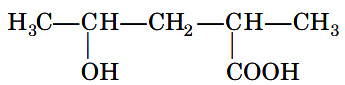
isKCET 2013 Easy - A solenoid of inductance \( 2 \mathrm{H} \) carries a current of \( 1 \mathrm{~A} \). What is the magnetic energy stored in a solenoid?KCET 2014 Medium
- XO type of sex determination and XY type of sex determination are the example ofKCET 2022 Hard