


KCET · Physics · Mechanical Properties of Fluids
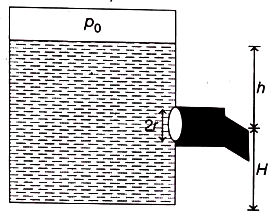
A closed water tank has cross-sectional area \(A\). It has a small hole at a depth of \(h\) from the free surface of water. The radius of the hole is \(r\) so that \(r \ll \sqrt{\frac{A}{\pi}}\). If \(p_o\) is the pressure inside the tank above water level and \(p_a\) is the atmospheric pressure, the rate of flow of the water coming out of the hole is ( \(\rho\) is density of water)
- A \(\pi r^2 \sqrt{2 g h}\)
- B \(\pi r^2 \sqrt{2 g h+\frac{2\left(p_o-p_a\right)}{\rho}}\)
- C \(\pi r^2 \sqrt{2 g H}\)
- D \(\pi r^2 \sqrt{g h+\frac{2\left(p_0-p_a\right)}{\rho}}\)
Answer & Solution
Correct Answer
(B) \(\pi r^2 \sqrt{2 g h+\frac{2\left(p_o-p_a\right)}{\rho}}\)
Step-by-step Solution
Detailed explanation
From Bernoulli's principle we have
\(\frac{1}{2} \rho v^2+p_0+\rho g h=\frac{1}{2} \rho v_A^2+p_A+\rho g(0) \)
\( p_0-p_A+\rho g h=\frac{1}{2} \rho v_A^2-\frac{1}{2} \rho v^2 \)
\( \Rightarrow v^2=\frac{2\left(p_0-p_A\right)}{\rho}+\frac{2 \rho g h}{P} \)
\( \Rightarrow v=\sqrt{\frac{2\left(p_0-p_A\right)}{\rho}+2 g h} (\because v=0 \text { at top }) \)
Water coming out of hole \(=\text {area} \times \text {velocity} \)
\( =\pi r^2 \sqrt{2 g h+\frac{2\left(p_0-p_A\right)}{\rho}}\)
\(\frac{1}{2} \rho v^2+p_0+\rho g h=\frac{1}{2} \rho v_A^2+p_A+\rho g(0) \)
\( p_0-p_A+\rho g h=\frac{1}{2} \rho v_A^2-\frac{1}{2} \rho v^2 \)
\( \Rightarrow v^2=\frac{2\left(p_0-p_A\right)}{\rho}+\frac{2 \rho g h}{P} \)
\( \Rightarrow v=\sqrt{\frac{2\left(p_0-p_A\right)}{\rho}+2 g h} (\because v=0 \text { at top }) \)
Water coming out of hole \(=\text {area} \times \text {velocity} \)
\( =\pi r^2 \sqrt{2 g h+\frac{2\left(p_0-p_A\right)}{\rho}}\)
See the Complete Solution
Get step-by-step explanations for this and 2.5 Lakh+ more JEE, NEET & CET questions.
- Unlock all solutions
- Practice the full chapter
- Track accuracy across PYQs
4.8 rated on Google Play · 14,000+ reviews
More questions from Physics
- Biot-Savart law indicates that an electron moving with a velocity \(\vec{V}\) produces a magnetic field \(\vec{B}\) around it such thatKCET 2026 Easy
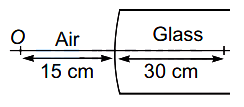
- A point object \(O\) is placed in front of a glass rod having spherical end of radius of curvature \(30 \mathrm{~cm}\). The image would be formed at
 KCET 2010 Easy
 - The magnetic dipole moment of a current loop is independent ofKCET 2009 Easy
- In Young's double slit experiment, an electron beam is used to produce interference fringes of width \(\beta_1\). Now the electron beam is replaced by a beam of protons with the same experimental set-up and same speed. The fringe width obtained is \(\beta_2\). The correct relation between \(\beta_1\) and \(\beta_2\) isKCET 2024 Hard
- A metal wire is subjected to a constant potential difference. When the temperature of the metal wire increases, the drift velocity of the electron in itKCET 2008 Medium
- The magnetic field at the center of a current carrying loop of radius \( 0.1 \mathrm{~m} \) is \( 5 \sqrt{5} \) times that at
a point along its axis. The distance of this point from the centre of the loop isKCET 2017 Easy
More PYQs from KCET
- Identify the incorrect statement from the following.KCET 2024 Medium
- A door \(1.6 \mathrm{~m}\) wide requires a force of \(1 \mathrm{~N}\) to be applied at the free end to open or close it. The force that is required at a point \(0.4 \mathrm{~m}\) distance from the hinges for opening or closing the door isKCET 2009 Medium
- The coordinates of the centre of the smallest circle passing through the origin and having \(\mathrm{y}=\mathrm{x}+1\) as a diameter areKCET 2009 Medium
- If \(f(x)=\sin \left[\pi^2\right] x-\sin \left[-\pi^2\right] x\), where \([x]=\) greatest integer \(\leq x\), then which of the following is not true?KCET 2025 Medium
- The Hardy-Weinberg principle cannot operate ifKCET 2012 Medium
- The contrapositive of the converse of the statement "If \( x \) is a prime number then \( x \) is odd" isKCET 2016 Medium