


KCET · Physics · Ray Optics
A body having a moment of inertia about its axis of rotation equal to \( 3 \mathrm{~kg} \mathrm{~m}^{2} \) is rotating with
angular velocity of \( 3 \mathrm{rad} s^{-1} \). Kinetic energy of this rotating body is same as that of a body of
mass \( 27 \mathrm{~kg} \) moving with velocity \( \mathrm{v} \). The value of \( \mathrm{v} \) is
- A \( 1 \mathrm{~ms}^{-1} \)
- B \( 0.5 \mathrm{~ms}^{-1} \)
- C O \( 2 \mathrm{~ms}^{-1} \)
- D \( 1.5 \mathrm{~ms}^{-1} \)
Answer & Solution
Correct Answer
(A) \( 1 \mathrm{~ms}^{-1} \)
Step-by-step Solution
Detailed explanation
Given, moment of Inertia, \( I=3 \mathrm{kgm}^{2} \); angular velocity, \( \omega=3 \mathrm{rads}^{-1} ; \) mass,, \( \mathrm{m}=27 \mathrm{~kg} \)
Now \( \frac{1}{2} m v^{2}=\frac{1}{2} I \omega^{2} \)
\( \Rightarrow m v^{2}=I \omega^{2} \Rightarrow v^{2}=\frac{I \omega^{2}}{m} \)
Therefore, \( v=\sqrt{\frac{I}{m}} \omega \)
Substituting the values, we get
\( v=\sqrt{\frac{3}{27}} \times 3=\sqrt{\frac{1}{9}} \times 3=\frac{1}{3} \times 3 \)
Thus, velocity of body is \( 1 \mathrm{~ms}^{-1} \)
Now \( \frac{1}{2} m v^{2}=\frac{1}{2} I \omega^{2} \)
\( \Rightarrow m v^{2}=I \omega^{2} \Rightarrow v^{2}=\frac{I \omega^{2}}{m} \)
Therefore, \( v=\sqrt{\frac{I}{m}} \omega \)
Substituting the values, we get
\( v=\sqrt{\frac{3}{27}} \times 3=\sqrt{\frac{1}{9}} \times 3=\frac{1}{3} \times 3 \)
Thus, velocity of body is \( 1 \mathrm{~ms}^{-1} \)
See the Complete Solution
Get step-by-step explanations for this and 2.5 Lakh+ more JEE, NEET & CET questions.
- Unlock all solutions
- Practice the full chapter
- Track accuracy across PYQs
4.8 rated on Google Play · 14,000+ reviews
More questions from Physics
- A Point object is moving uniformly towards the pole of a concave mirror of focal length \( 25 \mathrm{~cm} \)
along its axis as shown below. The speed of the object is \( 1 \mathrm{~ms}^{-1} \). At \( \mathrm{t}=0 \), the distance of the
object from the mirror is \( 50 \mathrm{~cm} \). The average velocity of theimage formed by the mirror
between time \( t=0 \) and \( t=0.25 \mathrm{~s} \) is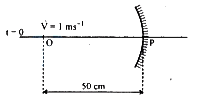 KCET 2019 Easy
 - See the diagram. Area of each plate is \(2.0 \mathrm{~m}^{2}\) and \(d=2 \times 10^{-3} \mathrm{~m}\). A charge of \(8.85 \times 10^{-8} \mathrm{C}\) is given to \(Q\). Then the potential of \(Q\) becomes
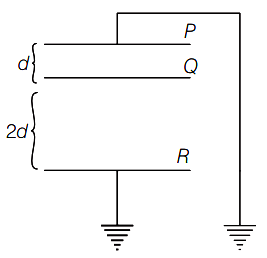 KCET 2013 Easy
 - A particle shows distance - time curve as shown in the figure. the maximum instantaneous velocity of the particle is around the point
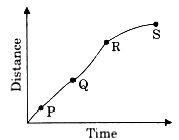 KCET 2018 Easy
 - The density of an electron -hole pair in a pure germanium is \( 3 \times 10^{16} \mathrm{~m}^{-3} \) at room temperature
. On doping with aluminium, the hole density increases to \( 4.5 \times 10^{(22)} \mathrm{m}^{-3} \). Now the electron
density \( \left(\right. \) in \( \left.m^{-3}\right) \) in doped germanium isKCET 2018 Medium - All components of the electromagnetic spectrum in vacuum have the sameKCET 2007 Easy
- The displacement-time graph of two moving particles make angles of \(30^{\circ}\) and \(45^{\circ}\) with the \(X\)-axis. The ratio of their velocities is
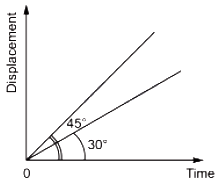 KCET 2011 Easy
More PYQs from KCET
- Which cleansing agent gets precipitated in hard water?KCET 2019 Hard
- The value of \(\tan ^{-1}\left(\frac{x}{y}\right)-\tan ^{-1}\left(\frac{x-y}{x+y}\right)\) (where, \(x, y>0\) ) isKCET 2013 Easy
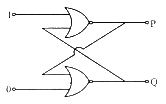
- In the following circuit, what are \( P \) and \( Q \) ?
 KCET 2019 Easy
 - Find the wrongly matched pair.KCET 2015 Medium
- The function \(x^x ; x\gt0\) is strictly increasing atKCET 2024 Easy
- The equation of straight line which passes through the point \(\left(a \cos ^{3} \theta, a \sin ^{3} \theta\right)\) and perpendicular to \(x \sec \theta+y \operatorname{cosec} \theta=a\) isKCET 2021 Medium