


KCET · Physics · Semiconductors
The density of an electron -hole pair in a pure germanium is \( 3 \times 10^{16} \mathrm{~m}^{-3} \) at room temperature
. On doping with aluminium, the hole density increases to \( 4.5 \times 10^{(22)} \mathrm{m}^{-3} \). Now the electron
density \( \left(\right. \) in \( \left.m^{-3}\right) \) in doped germanium is
- A \( 1 \times 10^{10} \)
- B \( 2 \times 10^{10} \)
- C \( 0.5 \times 10^{10} \)
- D \( 4 \times 10^{10} \)
Answer & Solution
Correct Answer
(B) \( 2 \times 10^{10} \)
Step-by-step Solution
Detailed explanation
Given, density of electron-hole pair in pure germanium \(=3 \times 10^{16} \mathrm{~m}^{-3}\)
On doping, hole density \(=4.5 \times 10^{22} \mathrm{~m}^{-3}\)
Electron density \(=?\)
We know \(n_{1}^{2}=n_{h} n_{e}\)
Where \(n_{i}\) is electron-hole density in pure semiconductor; \(n_{h}\) is hole density; \(n_{e}\) is electron density
\(\Rightarrow n_{e}=\frac{n_{i}^{2}}{n_{h}}=\frac{\left(3 \times 10^{16}\right)}{4.5 \times 10^{22}}=2 \times 10^{10} \mathrm{~m}^{-3}\)
Therefore, electron density in doped germanium will be \(2 \times 10^{10} \mathrm{~m}^{-3}\)
On doping, hole density \(=4.5 \times 10^{22} \mathrm{~m}^{-3}\)
Electron density \(=?\)
We know \(n_{1}^{2}=n_{h} n_{e}\)
Where \(n_{i}\) is electron-hole density in pure semiconductor; \(n_{h}\) is hole density; \(n_{e}\) is electron density
\(\Rightarrow n_{e}=\frac{n_{i}^{2}}{n_{h}}=\frac{\left(3 \times 10^{16}\right)}{4.5 \times 10^{22}}=2 \times 10^{10} \mathrm{~m}^{-3}\)
Therefore, electron density in doped germanium will be \(2 \times 10^{10} \mathrm{~m}^{-3}\)
See the Complete Solution
Get step-by-step explanations for this and 2.5 Lakh+ more JEE, NEET & CET questions.
- Unlock all solutions
- Practice the full chapter
- Track accuracy across PYQs
4.8 rated on Google Play · 14,000+ reviews
More questions from Physics
- A wire of a certain material is stretched slowly by \(10 \%\). Its new resistance and specific resistance becomes respectivelyKCET 2022 Medium
- A particle of mass \( m \) and charge \( q \) is placed at rest in uniform electric field \( E \) and then released. The kinetic energy attained by the particle after moving a distance \( y \) isKCET 2019 Easy
- Though the electron drift velocity is small and electron charge is very small, a conductor can
carry an appreciably large current becauseKCET 2019 Easy - Which of the following statements is not true?KCET 2025 Easy
- The velocity - time graph for two bodies A and B are shown. Then the acceleration of A and B are in the ratio:KCET 2015 Easy
- A ray of light is incident on a surface of glass slab at an angle \(45^{\circ}\). If the lateral shift produced per unit thickness is \(\frac{1}{\sqrt{3}} \mathrm{~m}\), the angle of refraction produced isKCET 2009 Hard
More PYQs from KCET
- Excess of \(\mathrm{PCl}_{5}\) reacts with concentrated \(\mathrm{H}_{2} \mathrm{SO}_{4}\) givingKCET 2013 Easy
- A \(220 \mathrm{~V}\) AC supply is connected between points \(A\) and \(B\) as shown in figure, what will be the potential difference \(V\) across the capacitor?
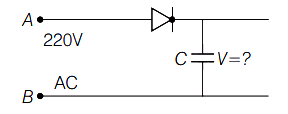 KCET 2020 Easy
 - The number of isomers possible for the octahedral complex \( \left[\mathrm{CoCl}_{2}(e n)\left(\mathrm{NH}_{3}\right)_{2}\right]^{+} \)is,KCET 2016 Medium
- In the following circuit, the terminal voltage across the cell is
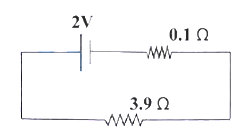 KCET 2025 Easy
 - Two parallel wires \( 1 \mathrm{~m} \) apart carry currents of \( 1 \mathrm{~A} \) and \( 3 \mathrm{~A} \) respectively in opposite directions. The force per unit length acting between these two wires isKCET 2015 Hard
- \( \left(\mathrm{CH}_{3}\right)_{3} \mathrm{SiCl} \) is used during polymerization of organosilicons becauseKCET 2018 Easy