


KCET · Maths · Continuity and Differentiability
Match the following:
In the following, \([\mathrm{x}]\) denotes the greatest integer less than or equal to x .
\begin{array}{|l|l|l|l|}\hline & \text{Column - I} & & \text{Column - II} \\\hline \text{a}. & \mathrm{x}|\mathrm{x}| & \text{(i)} & \text {continuous in (-1, 1)} \\\hline \text{b.} & \sqrt{|\mathrm{x}|} & \text{(ii)} & \text{differentiable in (-1, 1)} \\\hline \text{c.} & \mathrm{x}+[\mathrm{x}] & \text{(iii)} & \text{strictly increasing in (-1, 1)} \\\hline \text{d.} & |\mathrm{x}-1|+|\mathrm{x}+1| & \text{(iv)} & \text{not differentiable at, at least one point in (-1, 1)} \\\hline\end{array}
- A \(a-i, b-i i, c-i v, d-i i i\)
- B \(a-i v, b-i i i, c-i, d-i i\)
- C \(a-i i, b-i v, c-i i i, d-i\)
- D \(\mathrm{a}-\mathrm{iii}, \mathrm{b}-\mathrm{ii}, \mathrm{c}-\mathrm{iv}, \mathrm{d}-\mathrm{i}\)
Answer & Solution
Correct Answer
(C) \(a-i i, b-i v, c-i i i, d-i\)
Step-by-step Solution
Detailed explanation
\(\begin{aligned}
& \text { (a) } x|x| \\
& f(x)=\left\{\begin{array}{ll}
x^2, & x \geq 0 \\
-x^2 & x \lt 0
\end{array} \text { differentiable in }(-1,1)\right.
\end{aligned}\)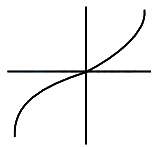
(b) \(\sqrt{|x|}=\left\{\begin{aligned} \sqrt{x}, & x \geq 0 \\ \sqrt{-x}, & x \lt 0\end{aligned} \quad\right.\) Not differentiable at \(x=0\)
(c) \(x+[x]\) strictly increasing in \((-1,1)\)
(d) \(|x-1|+|x+1|=\left\{\begin{array}{cc}-x+1-x-1 & x \lt -1 \\ -x+1+x+1 & -1 \lt x \lt 1 \\ x-1+x-1 & x\gt1\end{array}\right.\)
Continuous \((-1,1)=\left\{\begin{array}{ccc}-2 x & , & x \lt -1 \\ 2, & -1 \lt x \lt 1 \\ 2 x & , & x\gt1\end{array}\right.\)
& \text { (a) } x|x| \\
& f(x)=\left\{\begin{array}{ll}
x^2, & x \geq 0 \\
-x^2 & x \lt 0
\end{array} \text { differentiable in }(-1,1)\right.
\end{aligned}\)
(b) \(\sqrt{|x|}=\left\{\begin{aligned} \sqrt{x}, & x \geq 0 \\ \sqrt{-x}, & x \lt 0\end{aligned} \quad\right.\) Not differentiable at \(x=0\)
(c) \(x+[x]\) strictly increasing in \((-1,1)\)
(d) \(|x-1|+|x+1|=\left\{\begin{array}{cc}-x+1-x-1 & x \lt -1 \\ -x+1+x+1 & -1 \lt x \lt 1 \\ x-1+x-1 & x\gt1\end{array}\right.\)
Continuous \((-1,1)=\left\{\begin{array}{ccc}-2 x & , & x \lt -1 \\ 2, & -1 \lt x \lt 1 \\ 2 x & , & x\gt1\end{array}\right.\)
See the Complete Solution
Get step-by-step explanations for this and 2.5 Lakh+ more JEE, NEET & CET questions.
- Unlock all solutions
- Practice the full chapter
- Track accuracy across PYQs
4.8 rated on Google Play · 14,000+ reviews
More questions from Maths
- If \(y=\sin x \cdot \sin 2 x \cdot \sin 3 x \ldots \sin n x\), then \(y^{\prime}\) isKCET 2011 Medium
- If \(e^y+x y=e\) the ordered pair \(\left(\frac{d y}{d x}, \frac{d^2 y}{d x^2}\right)\) at \(x=0\) is equal toKCET 2022 Hard
- Let \( f: R \rightarrow R \) be defined by \( f(x)=\left\{\begin{array}{cc}2 x ; & x>3 \\ x^{2} ; & 1 < x \leq 3 \\ 3 x ; & x \leq 1\end{array}\right. \)
Then \( f(-1)+f(2)+f(4) \) isKCET 2018 Easy - The standard deviation of the numbers 31 , \(32,33 \ldots 46,47\) isKCET 2021 Easy
- The order and degree of the differential equation \( \left[1+\left(\frac{d y}{d x}\right)^{2}+\sin \left(\frac{d y}{d x}\right)\right]^{\frac{3}{4}}=\frac{d^{2} y}{d x^{2}} \)KCET 2016 Easy
- If \(\mathrm{x} \neq \mathrm{n} \pi, \mathrm{x} \neq(2 \mathrm{n}+1) \frac{\pi}{2}, \mathrm{n} \in \mathrm{Z}, \quad\) then \(\frac{\sin ^{-1}(\cos x)+\cos ^{-1}(\sin x)}{\tan ^{-1}(\cot x)+\cot ^{-1}(\tan x)}\) isKCET 2010 Hard
More PYQs from KCET
- Identity from the following, a hormone produced by the pituitary gland in both males and females but functional only in females.KCET 2005 Medium
- Which of the following statement is not true with reference to mitochondria?KCET 2005 Hard
- \(\int \frac{\sin x}{3+4 \cos ^2 x} d x\)KCET 2024 Medium
- Oxidation of Toluene with chromyl chloride followed by hydrolysis gives Benzaldehyde. This reaction is known as _____KCET 2025 Easy
- The intermediates in heteropolar reactions areKCET 2026 Easy
- If \(\mathrm{p}\) and \(\mathrm{q}_{2}\) are prime numbers satisfying the condition \(p^{2}-2 q^{2}=1\), then the value of \(p^{2}+2 q^{2}\) isKCET 2008 Medium