


KCET · Maths · Area Under Curves
Area lying between the curves \( y^{2}=2 x \) and \( y=x \)
- A \( \frac{2}{3} \) sq. units
- B \( \frac{1}{3} \) sq. units
- C \( \frac{1}{4} \) sq. units
- D \( \frac{3}{4} \) sq. units
Answer & Solution
Correct Answer
(A) \( \frac{2}{3} \) sq. units
Step-by-step Solution
Detailed explanation
Given curves,
\[
\begin{array}{l}
y^{2}=2 x \rightarrow(1) \\
y=x \rightarrow(2)
\end{array}
\]
At \(x=0\) and \(x=2\) we have two intersect points, that is, \((0,0),(2,2)\).
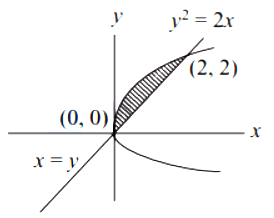
Therefore, required area is given by
\[
\begin{array}{l}
\int_{0}^{2}(\sqrt{2} \sqrt{x}-x) d x \\
=\left[\sqrt{2}\left(\frac{2}{3} x^{3 / 2}\right)-\frac{x^{2}}{2}\right]^{2} \\
=\left(\frac{2 \sqrt{2}}{3}\left(2^{3 / 2}\right)-\frac{4}{2}\right) \\
=\frac{2}{3} \cdot 2^{2}-2=\frac{2}{3} \text { sq. units }
\end{array}
\]
\[
\begin{array}{l}
y^{2}=2 x \rightarrow(1) \\
y=x \rightarrow(2)
\end{array}
\]
At \(x=0\) and \(x=2\) we have two intersect points, that is, \((0,0),(2,2)\).
Therefore, required area is given by
\[
\begin{array}{l}
\int_{0}^{2}(\sqrt{2} \sqrt{x}-x) d x \\
=\left[\sqrt{2}\left(\frac{2}{3} x^{3 / 2}\right)-\frac{x^{2}}{2}\right]^{2} \\
=\left(\frac{2 \sqrt{2}}{3}\left(2^{3 / 2}\right)-\frac{4}{2}\right) \\
=\frac{2}{3} \cdot 2^{2}-2=\frac{2}{3} \text { sq. units }
\end{array}
\]
See the Complete Solution
Get step-by-step explanations for this and 2.5 Lakh+ more JEE, NEET & CET questions.
- Unlock all solutions
- Practice the full chapter
- Track accuracy across PYQs
4.8 rated on Google Play · 14,000+ reviews
More questions from Maths
- If \(\int \frac{\sqrt{x}}{x(x+1)} d x=k \tan ^{-1} m\), then \((k, m)\) isKCET 2010 Easy
- \(A B C\) is a triangle with \(\angle A=30^{\circ}, B C=10 \mathrm{~cm}\). The area of the circumcircle of the triangle isKCET 2007 Medium
- Which of the following is not true?KCET 2010 Hard
- The value of \(\tan 1^{\circ} \tan 2^{\circ} \tan 3^{\circ} \ldots \tan 89^{\circ}\) isKCET 2021 Medium
- The ninth term of the expansion \(\left(3 x-\frac{1}{2 x}\right)^{8}\) isKCET 2007 Easy
- If \( \left(x_{1}, y_{1}\right),\left(x_{2}, y_{2}\right) \) and \( \left(x_{3}, y_{3}\right) \) are the vertices of a triangle whose area is ' \( k \) ' square units,
then
\[
\left|\begin{array}{ccc}
x_{1} & y_{1} & 4 \\
x_{2} & y_{2} & 4 \\
x_{3} & y_{3} & 4
\end{array}\right|^{2} \text { is }
\]KCET 2018 Medium
More PYQs from KCET
- A body is initially at rest. It undergoes one-dimensional motion with constant acceleration. The power delivered to it at time \(t\) is proportional toKCET 2020 Easy
- An electron in an excited state of \(\mathrm{Li}^{2+}\) ion has angular momentum \(\frac{3 h}{2 \pi}\). The de-Broglie wavelength of electron in this state is \(p \pi a_{0}\) (where, \(a_{0}=\) Bohr radius ). The value of \(p\) isKCET 2021 Medium
- The amount of energy released when one microgram of matter is annihilated isKCET 2009 Easy
- The concentric spheres of radii \(R\) and \(r\) have positive charges \(q_{1}\) and \(q_{2}\) with equal surface charge densities. What is the electric potential at their common centre?KCET 2013 Hard
- The given truth table is for
\(\begin{array}{|l|l|l|l|}
\hline Input & Input & Output \\
\hline A & B & Y \\
\hline 0 & 0 & 1 \\
\hline 0 & 1 & 1 \\
\hline 1 & 0 & 1 \\
\hline 1 & 1 & 0 \\
\hline
\end{array}\)KCET 2015 Easy - The angle between the pair of lines \(x^{2}+2 x y-y^{2}=0\) isKCET 2009 Easy