


KCET · Maths · Mathematical Reasoning
Which of the following is a subgroup of the group \(G=\left\{2^{n} \mid n \in Z\right\}\) under multiplication?
- A \(\left\{4^{\mathrm{n}} \mid \mathrm{n} \in \mathrm{N}\right\}\)
- B \(\left\{3^{n} \mid n \in Z\right\}\)
- C \(\left\{6^{\mathrm{n}} \mid \mathrm{n} \in \mathrm{N}\right\}\)
- D \(\left\{4^{\mathrm{n}} \mid \mathrm{n} \in \mathrm{Z}\right\}\)
Answer & Solution
Correct Answer
(D) \(\left\{4^{\mathrm{n}} \mid \mathrm{n} \in \mathrm{Z}\right\}\)
Step-by-step Solution
Detailed explanation
Since, \(\quad\left\{4^{\mathrm{n}} \mid \mathrm{n} \in \mathrm{N}\right\},\left\{3^{\mathrm{n}} \mid \mathrm{n} \in \mathrm{Z}\right\} \quad\) and \(\left\{6^{n} \mid n \in N\right\}\) are not subset of the group \(\mathrm{G}=\left\{2^{\mathrm{n}} \mid \mathrm{n} \in \mathrm{Z}\right\}\) and not satisfy all the properties of group axiom but \(\left\{4^{n} \mid n \in Z\right\}\) is a subset of \(\mathrm{G}=\left\{2^{\mathrm{n}} \mid \mathrm{n} \in \mathrm{Z}\right\}\) and satisfy all the properties, i.e., closure, associative, multiplicative inverse, multiplicative identity exist with respect to multiplication. So, \(\left\{4^{\mathrm{n}} \mid \mathrm{n} \in \mathrm{Z}\right\}\) is a subgroup.
See the Complete Solution
Get step-by-step explanations for this and 2.5 Lakh+ more JEE, NEET & CET questions.
- Unlock all solutions
- Practice the full chapter
- Track accuracy across PYQs
4.8 rated on Google Play · 14,000+ reviews
More questions from Maths
- The area enclosed by the pair of the lines \(x y=0\), the line \(x-4=0\) and \(y+5=0\) isKCET 2007 Easy
- The length of perpendicular drawn from the point \((3,-1,11)\) to the line \(\frac{x}{2}=\frac{y-2}{3}=\frac{z-3}{4}\) isKCET 2023 Easy
- If \(\mathbf{a}=(1,2,3), \mathbf{b}=(2,-1,1), \mathbf{c}=(3,2,1)\) and \(\mathbf{a} \times(\mathbf{b} \times \mathbf{c})=\alpha \mathbf{a}+\beta \mathbf{b}+\gamma \mathbf{c}\), thenKCET 2013 Medium
- If the vectors \(2 \hat{\mathbf{i}}+3 \hat{\mathbf{j}}+4 \hat{\mathbf{k}}, 2 \hat{\mathbf{i}}+\hat{\mathbf{j}}-\hat{\mathbf{k}}\) and \(\lambda \hat{\mathbf{i}}-\hat{\mathbf{j}}+2 \hat{\mathbf{k}}\) are coplanar, then the value of \(\lambda\) isKCET 2020 Easy
- \(A B C\) is a triangle with \(\angle A=30^{\circ}, B C=10 \mathrm{~cm}\). The area of the circumcircle of the triangle isKCET 2007 Medium
- The value of \(\int_0^{2 \pi} \sqrt{1+\sin \left(\frac{x}{2}\right)} d x\) isKCET 2025 Medium
More PYQs from KCET
- A radioactive sample \(S_{1}\) having the activity \(\mathrm{A}_{1}\) has twice the number of nuclei as another sample \(S_{2}\) of activity \(A_{2}\). If \(A_{2}=2 A_{1}\), then the ratio of half-life of \(S_{1}\) to the half-life of \(S_{2}\) isKCET 2010 Medium
- In the reaction :
 KCET 2016 Hard
 - In the following reaction

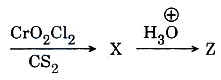
the compound \( Z \) isKCET 2018 Hard - Meso compounds do not show optical activity becauseKCET 2013 Easy
- The offspring produced from a marriage have only O or A blood groups. Of the genotypes given below, the possible genotypes of the parents would beKCET 2009 Hard
- Consider the following 4 electrodes
\(\begin{aligned} & \mathrm{A}: \mathrm{Ag}^{+}(0.0001 \mathrm{M}) / \mathrm{Ag}(s) \\ & \mathrm{B}: \mathrm{Ag}^{+}(0.1 \mathrm{M}) / \mathrm{Ag}(s) \\ & \mathrm{C}: \mathrm{Ag}^{+}(0.01 \mathrm{M}) / \mathrm{Ag}(s) \\ & \mathrm{D}: \mathrm{Ag}^{+}(0.001 \mathrm{M}) / \mathrm{Ag}(s) ; E^{\circ}{ }_{\mathrm{Ag}^{+} / \mathrm{Ag}}=+0.80 \mathrm{~V}\end{aligned}\)
Then reduction potential in volts of the electrodes in the order.KCET 2023 Easy