


KCET · Chemistry · Electrochemistry
Consider the following 4 electrodes
\(\begin{aligned} & \mathrm{A}: \mathrm{Ag}^{+}(0.0001 \mathrm{M}) / \mathrm{Ag}(s) \\ & \mathrm{B}: \mathrm{Ag}^{+}(0.1 \mathrm{M}) / \mathrm{Ag}(s) \\ & \mathrm{C}: \mathrm{Ag}^{+}(0.01 \mathrm{M}) / \mathrm{Ag}(s) \\ & \mathrm{D}: \mathrm{Ag}^{+}(0.001 \mathrm{M}) / \mathrm{Ag}(s) ; E^{\circ}{ }_{\mathrm{Ag}^{+} / \mathrm{Ag}}=+0.80 \mathrm{~V}\end{aligned}\)
Then reduction potential in volts of the electrodes in the order.
- A \(\mathrm{B}>\mathrm{C}>\mathrm{D}>\mathrm{A}\)
- B \(C>D>A>B\)
- C \(A>D>C>B\)
- D \(A>B>C>D\)
Answer & Solution
Correct Answer
(A) \(\mathrm{B}>\mathrm{C}>\mathrm{D}>\mathrm{A}\)
Step-by-step Solution
Detailed explanation

According to this equation, as concentration of metal ion increases, reduction potential of metal electrode also increases i.e \(E \propto\) concentration.
\(\therefore \quad\) B \(>\) C \(>\) D \(>\) A
See the Complete Solution
Get step-by-step explanations for this and 2.5 Lakh+ more JEE, NEET & CET questions.
- Unlock all solutions
- Practice the full chapter
- Track accuracy across PYQs
4.8 rated on Google Play · 14,000+ reviews
More questions from Chemistry
- The correct set of quantum number for the unpaired electrons of chlorine atom isKCET 2017 Medium
- \(0.023 \mathrm{~g}\) of sodium metal is reacted with \(100 \mathrm{~cm}^{3}\) of water. The \(\mathrm{pH}\) of the resulting solution isKCET 2011 Medium
- Which one of the following shows functional isomerism?KCET 2007 Easy
- Which of the following is the strongest base?KCET 2020 Easy
- The activation energy of a chemical reaction can be determined by,KCET 2016 Medium
- A buffer solution contains \(0.1\) mole of sodium acetate dissolved in \(1000 \mathrm{~cm}^{3}\) of \(0.1 \mathrm{M}\) acetic acid. To the above buffer solution, \(0.1\) mole of sodium acetate is further added and dissolved. The \(\mathrm{pH}\) of the resulting buffer isKCET 2011 Hard
More PYQs from KCET
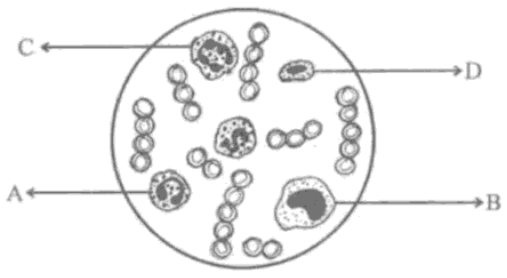
- Study the diagram given below and identify the cells labelled as A, B, C and D, and choose the correct option.
 KCET 2012 Easy
 - If \(\overrightarrow{\mathbf{a}} \cdot \hat{\mathbf{i}}=\overrightarrow{\mathbf{a}} \cdot(\hat{\mathbf{i}}+\hat{\mathbf{j}})=\overrightarrow{\mathbf{a}} \cdot(\hat{\mathbf{i}}+\hat{\mathbf{j}}+\hat{\mathbf{k}})=1\) then \(\overrightarrow{\mathbf{a}}\) is equal toKCET 2008 Medium
- Find the mean number of heads in three tosses of a fair coin.KCET 2022 Medium
- Kranz anatomy can be seen inKCET 2022 Hard
- Which of the following statements is not true?KCET 2025 Easy
- Three conductors draw currents of \(1 \mathrm{~A}, 2 \mathrm{~A}\) and 3 A respectively, when connected in turn across a battery. If they are connected in series and the combination is connected across the same battery, the current drawn will beKCET 2013 Medium