


KCET · Maths · Parabola
The locus of the point of intersection of the tangents drawn at the ends of a focal chord of the parabola \(x^{2}=-8 y\) is
- A \(\mathrm{x}=2\)
- B \(x=-2\)
- C \(\mathrm{y}=2\)
- D \(y=-2\)
Answer & Solution
Correct Answer
(C) \(\mathrm{y}=2\)
Step-by-step Solution
Detailed explanation
Given that, parabola \(\mathrm{x}^{2}=-8 \mathrm{y}\)
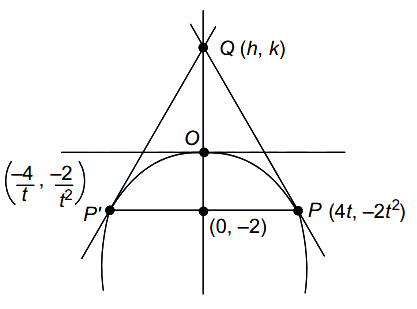
Here, on comparing with \(\mathrm{x}^{2}=4 \mathrm{ay}\)
\(
\Rightarrow \quad 4 \mathrm{a}=-8 \Rightarrow \mathrm{a}=-2
\)
Let the parametric coordinate of parabola \(\mathrm{x}^{2}=-8 \mathrm{y}\) is, \(\mathrm{P} \rightarrow\left(4 \mathrm{t},-2 \mathrm{t}^{2}\right)\)
and the other coordinate of latusrectum is \(\mathrm{P}^{\prime} \rightarrow\left(\frac{-4}{\mathrm{t}}, \frac{-2}{\mathrm{t}^{2}}\right)\)
Now, the equation tangent of parabola \(x^{2}=-8 y\)
At P \(\quad \begin{aligned} \mathrm{x} \cdot \mathrm{x}_{1} &=-4\left(\mathrm{y}+\mathrm{y}_{1}\right) \quad \text{...(i)} \\ \mathrm{x}(4 \mathrm{t}) &=-4\left(\mathrm{y}-2 \mathrm{t}^{2}\right) \\ \mathrm{x} t &=-\mathrm{y}+2 \mathrm{t}^{2} \\ \mathrm{xt} &+\mathrm{y}=2 \mathrm{t}^{2} \quad \text{...(ii)} \end{aligned}\)
At \(\mathrm{P}^{\prime} \quad \mathrm{x}\left(\frac{-4}{\mathrm{t}}\right)=-4\left(\mathrm{y}-\frac{2}{\mathrm{t}^{2}}\right)\)
\(\Rightarrow \quad \frac{x}{t}=y-\frac{2}{t^{2}}\)
\(\Rightarrow \quad x t=\mathrm{yt}^{2}-2\)
\(\Rightarrow \quad \mathrm{xt}-\mathrm{yt}^{2}=-2 \quad \text{...(iii)}\)
On solving Eqs. (i) and (ii)
\(
\begin{aligned}
\mathrm{xt}^{3}+\mathrm{yt}^{2} &=2 \mathrm{t}^{4} \\
\mathrm{xt}-\mathrm{yt}^{2} &=-2 \\
\mathrm{xt}\left(1+\mathrm{t}^{2}\right) &=-2\left(1-\mathrm{t}^{4}\right) \\
\mathrm{xt}\left(1+\mathrm{t}^{2}\right) &=-2\left(1+\mathrm{t}^{2}\right)\left(1-\mathrm{t}^{2}\right) \\
\mathrm{tx} &=-2\left(1-\mathrm{t}^{2}\right) \quad \text{...(iv)}
\end{aligned}
\)
From Eq. (ii)
\(
\begin{aligned}
&-2\left(1-t^{2}\right)+y &=2 t^{2} \\
\Rightarrow & &-2+2 t^{2}+y &=2 t^{2} \\
\Rightarrow & & y &=2
\end{aligned}
\)
Hence, the intersection point of both tangent lying on Q.
ie, \(\mathrm{y}=2\). Which is the required locus.
Here, on comparing with \(\mathrm{x}^{2}=4 \mathrm{ay}\)
\(
\Rightarrow \quad 4 \mathrm{a}=-8 \Rightarrow \mathrm{a}=-2
\)
Let the parametric coordinate of parabola \(\mathrm{x}^{2}=-8 \mathrm{y}\) is, \(\mathrm{P} \rightarrow\left(4 \mathrm{t},-2 \mathrm{t}^{2}\right)\)
and the other coordinate of latusrectum is \(\mathrm{P}^{\prime} \rightarrow\left(\frac{-4}{\mathrm{t}}, \frac{-2}{\mathrm{t}^{2}}\right)\)
Now, the equation tangent of parabola \(x^{2}=-8 y\)
At P \(\quad \begin{aligned} \mathrm{x} \cdot \mathrm{x}_{1} &=-4\left(\mathrm{y}+\mathrm{y}_{1}\right) \quad \text{...(i)} \\ \mathrm{x}(4 \mathrm{t}) &=-4\left(\mathrm{y}-2 \mathrm{t}^{2}\right) \\ \mathrm{x} t &=-\mathrm{y}+2 \mathrm{t}^{2} \\ \mathrm{xt} &+\mathrm{y}=2 \mathrm{t}^{2} \quad \text{...(ii)} \end{aligned}\)
At \(\mathrm{P}^{\prime} \quad \mathrm{x}\left(\frac{-4}{\mathrm{t}}\right)=-4\left(\mathrm{y}-\frac{2}{\mathrm{t}^{2}}\right)\)
\(\Rightarrow \quad \frac{x}{t}=y-\frac{2}{t^{2}}\)
\(\Rightarrow \quad x t=\mathrm{yt}^{2}-2\)
\(\Rightarrow \quad \mathrm{xt}-\mathrm{yt}^{2}=-2 \quad \text{...(iii)}\)
On solving Eqs. (i) and (ii)
\(
\begin{aligned}
\mathrm{xt}^{3}+\mathrm{yt}^{2} &=2 \mathrm{t}^{4} \\
\mathrm{xt}-\mathrm{yt}^{2} &=-2 \\
\mathrm{xt}\left(1+\mathrm{t}^{2}\right) &=-2\left(1-\mathrm{t}^{4}\right) \\
\mathrm{xt}\left(1+\mathrm{t}^{2}\right) &=-2\left(1+\mathrm{t}^{2}\right)\left(1-\mathrm{t}^{2}\right) \\
\mathrm{tx} &=-2\left(1-\mathrm{t}^{2}\right) \quad \text{...(iv)}
\end{aligned}
\)
From Eq. (ii)
\(
\begin{aligned}
&-2\left(1-t^{2}\right)+y &=2 t^{2} \\
\Rightarrow & &-2+2 t^{2}+y &=2 t^{2} \\
\Rightarrow & & y &=2
\end{aligned}
\)
Hence, the intersection point of both tangent lying on Q.
ie, \(\mathrm{y}=2\). Which is the required locus.
See the Complete Solution
Get step-by-step explanations for this and 2.5 Lakh+ more JEE, NEET & CET questions.
- Unlock all solutions
- Practice the full chapter
- Track accuracy across PYQs
4.8 rated on Google Play · 14,000+ reviews
More questions from Maths
- The real part of \( (1-\cos \theta+i \sin \theta)^{-1} \) isKCET 2016 Medium
- \(\sum\limits_{n=1}^{4} (-1)^{2n} \cdot i^{2n} = \)KCET 2026 Easy
- A stone is thrown vertically upwards and the height \(x \mathrm{ft}\) reached by the stone in t seconds is given by \(x=80 t-16 t^{2}\). The stone reaches the maximum height inKCET 2008 Easy
- If \(A\) is a \(3 \times 3\) non-singular matrix and if \(|\mathrm{A}|=3\), then \(\left|(2 \mathrm{~A})^{-1}\right|\) isKCET 2010 Easy
- \(\mathrm{R}\) is a relation on \(\mathrm{N}\) given by \(R=\{(x, y): 4 x+3 y=20\}\). Which of the following belongs to \(R\) ?KCET 2008 Easy
- The interval in which the function \( f(x)=x^{3}-6 x^{2}+9 x+10 \) is increasing inKCET 2019 Easy
More PYQs from KCET
- Ethyl benzene cannot be prepared byKCET 2011 Medium
- A solenoid of inductance \( 2 \mathrm{H} \) carries a current of \( 1 \mathrm{~A} \). What is the magnetic energy stored in a solenoid?KCET 2014 Medium
- The correct statement regarding defect in solids isKCET 2017 Medium
- During an adiabatic process, the cube of the pressure is found to be inversely proportional to the fourth power of the volume. Then the ratio of specific heats isKCET 2007 Medium
- Heroin isKCET 2014 Easy
- Which of the following is not a colligative property?KCET 2016 Easy