


KCET · Maths · Complex Number
The real part of \( (1-\cos \theta+i \sin \theta)^{-1} \) is
- A \( \frac{1}{2} \)
- B (1) \( \frac{1}{1+\cos \theta} \)
- C \( \tan \frac{\theta}{2} \)
- D \( \odot \cot \frac{\theta}{2} \)
Answer & Solution
Correct Answer
(A) \( \frac{1}{2} \)
Step-by-step Solution
Detailed explanation
Given that,
\[
\begin{aligned}
(1-\cos \theta+i \sin \theta)^{-1}=\frac{1}{1-\cos \theta+i \sin \theta} \\
=\frac{1}{2 \sin ^{2} \frac{\theta}{2}+i\left(2 \sin \frac{\theta}{2} \cos \frac{\theta}{2}\right)} \\
=\frac{1}{2 \sin \frac{\theta}{2}} \times \frac{1}{\sin \frac{\theta}{2}+i \cos \frac{\theta}{2}} \\
=\frac{1}{2 \sin \frac{\theta}{2}} \times \frac{\theta}{\sin ^{2} \frac{\theta}{2}+\cos ^{2} \frac{\theta}{2}} \\
=\frac{\sin \frac{\theta}{2}-i \cos \frac{\theta}{2}}{2 \sin \frac{\theta}{2}} \\
=\frac{1}{2}-i\left(\frac{1}{2} \cot \frac{\theta}{2}\right)
\end{aligned}
\]
So, real part of the complex number is \( \frac{1}{2} \)
\[
\begin{aligned}
(1-\cos \theta+i \sin \theta)^{-1}=\frac{1}{1-\cos \theta+i \sin \theta} \\
=\frac{1}{2 \sin ^{2} \frac{\theta}{2}+i\left(2 \sin \frac{\theta}{2} \cos \frac{\theta}{2}\right)} \\
=\frac{1}{2 \sin \frac{\theta}{2}} \times \frac{1}{\sin \frac{\theta}{2}+i \cos \frac{\theta}{2}} \\
=\frac{1}{2 \sin \frac{\theta}{2}} \times \frac{\theta}{\sin ^{2} \frac{\theta}{2}+\cos ^{2} \frac{\theta}{2}} \\
=\frac{\sin \frac{\theta}{2}-i \cos \frac{\theta}{2}}{2 \sin \frac{\theta}{2}} \\
=\frac{1}{2}-i\left(\frac{1}{2} \cot \frac{\theta}{2}\right)
\end{aligned}
\]
So, real part of the complex number is \( \frac{1}{2} \)
See the Complete Solution
Get step-by-step explanations for this and 2.5 Lakh+ more JEE, NEET & CET questions.
- Unlock all solutions
- Practice the full chapter
- Track accuracy across PYQs
4.8 rated on Google Play · 14,000+ reviews
More questions from Maths
- The length of the subtangent to the curve \(x^{2} y^{2}=a^{4}\) at \((-a, a)\) isKCET 2007 Hard
- If \(y=e^{\sqrt{x \sqrt{x} \sqrt{x}} \ldots,} x>1\), then \(\frac{d^2 y}{d x^2}\) at \(x=\log _e 3\) isKCET 2022 Hard
- If \(\mathrm{f}(\mathrm{x})\) is an even function, then \(\mathrm{P}^{\prime}(\mathrm{x})\) isKCET 2012 Easy
- \(\int_1^5(|x-3|+|1-x|) d x=\)KCET 2024 Easy
- If a curve passes through the point \((1,1)\) and at any point \((x, y)\) on the curve, the product of the slope of its tangent and \(x\) coordinate of the point is equal to the \(y\) coordinate of the point, then the curve also passes through the pointKCET 2023 Easy
- \(\log \left(\sin 1^{\circ}\right) \cdot \log \left(\sin 2^{\circ}\right) \cdot \log \left(\sin 3^{\circ}\right)\) \(\ldots \log \left(\sin 179^{\circ}\right)\)KCET 2013 Easy
More PYQs from KCET
- Progestasert is an IUD which makes the uterus unsuitable and cervix hostile to the sperms as they areKCET 2015 Easy
- \(|\mathbf{a} \times \mathbf{b}|^2+|\mathbf{a} \cdot \mathbf{b}|^2=144\) and \(|\mathbf{a}|=4\), then \(|\mathbf{b}|\) is equal toKCET 2023 Easy
- Copper is extracted from copper pyrites byKCET 2020 Easy
- The natural logarithm of the activity \(R\) of a radioactive sample varies with time \(t\) as shown. At \(t=0\), there are \(N_0\) undecayed nuclei. Then, \(N_0\) is equal to [Take \(e^2=7.5\) ]
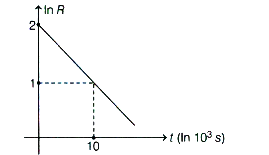 KCET 2024 Easy
 - If \(\overrightarrow{\mathbf{a}} \cdot \overrightarrow{\mathbf{b}}=-|\overrightarrow{\mathbf{a}}||\overrightarrow{\mathbf{b}}|\), then the angle between \(\overrightarrow{\mathbf{a}}\) and \(\vec{b}\) isKCET 2009 Easy
- Ten identical cells each emf \(2 \mathrm{~V}\) and internal resistance \(1 \Omega\) are connected in series with two cells wrongly connected. A resistor of \(10 \Omega\) is connected to the combination. What is the current through the resistor?KCET 2023 Medium