


KCET · Maths · Application of Derivatives
The interval in which the function \( f(x)=x^{3}-6 x^{2}+9 x+10 \) is increasing in
- A \((-\infty, 1] \cup[3, \infty) \)
- B \((-\infty,-1] \cup[3, \infty) \)
- C \( (-\infty, 1) \cup(3, \infty) \)
- D \( [1,3] \)
Answer & Solution
Correct Answer
(A) \((-\infty, 1] \cup[3, \infty) \)
Step-by-step Solution
Detailed explanation
\(\begin{aligned}
&f(x)=x^{3}-6 x^{2}+9 x+10 \\
&f^{\prime}(x)=3 x^{2}-12 x+9 \\
&f^{\prime}(x)=3\left(x^{2}-4 x+3\right) \\
&f^{\prime}(x)=3(x-1)(x-3)
\end{aligned}\)
For \(f(x)\) to be inereasing, we must have
\(\begin{aligned}
& F^{\prime}(x) > 0 \\
\Rightarrow & 3(x-1)(x-3) > 0 \\
\Rightarrow &(x-1)(x-3) > 0 \\
\Rightarrow & x < 1 \text { or } x > 3 \\
\Rightarrow & x \in(-\infty, 1) \cup(3, \infty) \\
& \text { SO, } F(x) \text { is increasing on } x \in(-\infty, 1) \cup(3, \infty) .
\end{aligned}\)
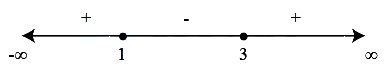
For \(f(x)\) to be decrecsing, we must hare
\(F^{\prime}(x) < 0\)
\(\begin{aligned}
&\Rightarrow 3(x-1)(x-3) < 0 \\
&\Rightarrow(x-1)(x-3) < 0 \\
&\Rightarrow 1 < x < 3 \\
&\Rightarrow x \in(1,3)
\end{aligned}\)
so, \(f(x)\) is decreasing on \(x \in(1,3)\).
&f(x)=x^{3}-6 x^{2}+9 x+10 \\
&f^{\prime}(x)=3 x^{2}-12 x+9 \\
&f^{\prime}(x)=3\left(x^{2}-4 x+3\right) \\
&f^{\prime}(x)=3(x-1)(x-3)
\end{aligned}\)
For \(f(x)\) to be inereasing, we must have
\(\begin{aligned}
& F^{\prime}(x) > 0 \\
\Rightarrow & 3(x-1)(x-3) > 0 \\
\Rightarrow &(x-1)(x-3) > 0 \\
\Rightarrow & x < 1 \text { or } x > 3 \\
\Rightarrow & x \in(-\infty, 1) \cup(3, \infty) \\
& \text { SO, } F(x) \text { is increasing on } x \in(-\infty, 1) \cup(3, \infty) .
\end{aligned}\)
For \(f(x)\) to be decrecsing, we must hare
\(F^{\prime}(x) < 0\)
\(\begin{aligned}
&\Rightarrow 3(x-1)(x-3) < 0 \\
&\Rightarrow(x-1)(x-3) < 0 \\
&\Rightarrow 1 < x < 3 \\
&\Rightarrow x \in(1,3)
\end{aligned}\)
so, \(f(x)\) is decreasing on \(x \in(1,3)\).
See the Complete Solution
Get step-by-step explanations for this and 2.5 Lakh+ more JEE, NEET & CET questions.
- Unlock all solutions
- Practice the full chapter
- Track accuracy across PYQs
4.8 rated on Google Play · 14,000+ reviews
More questions from Maths
- \(\int_{0}^{\pi / 4} \frac{\sin x+\cos x}{3+\sin 2 x} d x\) isKCET 2010 Hard
- If \(A=\left|\begin{array}{ll}x & 1 \\ 1 & x\end{array}\right|\) and \(B=\left|\begin{array}{lll}x & 1 & 1 \\ 1 & x & 1 \\ 1 & 1 & x\end{array}\right|\), then \(\frac{d B}{d x}\) isKCET 2024 Easy
- If \(I_{n}=\int_{0}^{\frac{\pi}{4}} \tan ^{n} x d x\), where \(n\) is positive integer, then \(I_{10}+I_{8}\) is equal toKCET 2021 Hard
- The constant term in the expansion of \( \left(x^{2}-\frac{1}{x^{2}}\right)^{16} \) isKCET 2018 Easy
- If \( P(A \cap B)=\frac{7}{10} \) and \( P(B)=\frac{17}{20} \), where \( P \) stands for probability then \( P(A \mid B) \) is equal to
O examsnet comKCET 2016 Easy - The points \((11,9),(2,1)\) and \((2,-1)\) are the mid-points of the sides of the triangle. Then, the centroid isKCET 2012 Medium
More PYQs from KCET
- The value of \( \int \frac{e^{6 \log x}-e^{5 \log x}}{e^{4 \log x}-e^{3 \log x}} \mathrm{dx} \) is equal toKCET 2016 Easy
- The value of \(\left|\begin{array}{lll}\sin ^2 14^{\circ} & \sin ^2 66^{\circ} & \tan 135^{\circ} \\ \sin ^2 66^{\circ} & \tan 135^{\circ} & \sin ^2 14^{\circ} \\ \tan 135^{\circ} & \sin ^2 14^{\circ} & \sin ^2 66^{\circ}\end{array}\right|\) isKCET 2023 Hard
- Three point charges of \( +2 q,+2 q \) and \( -4 q \) are placed at the corners \( A, B \) and \( C \) of an equilateral triangle \( \mathrm{ABC} \) of side ' \( \mathrm{x} \) '. The magnitude of the electric dipole moment of this system isKCET 2017 Easy
- "Heat cannot be flow itself from a body at lower temperature to a body at higher temperature". This statement corresponds toKCET 2022 Easy
- If \(\int f(x) \sin x \cdot \cos x d x\)
\(=\frac{1}{2\left(b^{2}-a^{2}\right)} \log f(x)+c,\)
where \(c\) is the constant of integration, then \(f(x)\) isKCET 2010 Hard - A radioactive nucleus has specific binding energy \(\mathrm{E}_{1}\). It emits an \(\alpha\)-particle. The resulting nucleus has specific binding energy \(\mathrm{E}_{2}\). ThenKCET 2012 Medium