


KCET · Maths · Differential Equations
The area of the region bounded by the curve \(y^{2}=8 x\) and the line \(y=2 x\) is
- A \(\frac{16}{3}\) sq. units
- B \(\frac{4}{3}\) sq. units
- C \(\frac{3}{4}\) sq. units
- D \(\frac{8}{3}\) sq. units
Answer & Solution
Correct Answer
(B) \(\frac{4}{3}\) sq. units
Step-by-step Solution
Detailed explanation
Given equation of curve,
\(y^{2}=8 x \text { and line } y=2 x\)
Now, intersecting points of given curve and line.
\(\begin{aligned}
&\quad(2 x)^{2}=8 x \\
&\Rightarrow \quad 4 x^{2}=8 x \\
&\Rightarrow \quad x=0,2 \\
&\text { Putting values of } x \text { in } y=2 x \text { then, we get } y=0,4 \\
&\therefore \text { Required area of bounded region. }
\end{aligned}\)
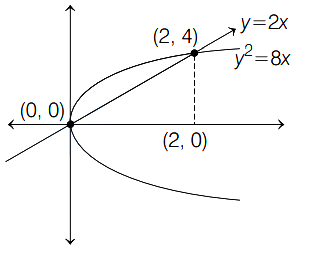
\(=\int_{0}^{2}(\sqrt{8 x}-2 x) d x\)
\(=\int_{0}^{2}\left(2 \sqrt{2} \cdot x^{1 / 2}-2 x\right) d x\)
\(=2 \int_{0}^{2}\left(\sqrt{2} \cdot x^{1 / 2}-x\right) d x\)
\(=2\left[\sqrt{2} \int_{0}^{2} x^{1 / 2} d x-\int_{0}^{2} x d x\right]\)
\(=2\left[\sqrt{2}\left(\frac{x^{3 / 2}}{3 / 2}\right)_{0}^{2}-\left(\frac{x^{2}}{2}\right)_{0}^{2}\right]\)
\(=2\left[\sqrt{2} \cdot \frac{2}{3}(2)^{3 / 2}-2\right]\)
\(=2\left[\frac{8}{3}-2\right]=2\left(\frac{2}{3}\right)=\frac{4}{3}\) sq. units
\(y^{2}=8 x \text { and line } y=2 x\)
Now, intersecting points of given curve and line.
\(\begin{aligned}
&\quad(2 x)^{2}=8 x \\
&\Rightarrow \quad 4 x^{2}=8 x \\
&\Rightarrow \quad x=0,2 \\
&\text { Putting values of } x \text { in } y=2 x \text { then, we get } y=0,4 \\
&\therefore \text { Required area of bounded region. }
\end{aligned}\)
\(=\int_{0}^{2}(\sqrt{8 x}-2 x) d x\)
\(=\int_{0}^{2}\left(2 \sqrt{2} \cdot x^{1 / 2}-2 x\right) d x\)
\(=2 \int_{0}^{2}\left(\sqrt{2} \cdot x^{1 / 2}-x\right) d x\)
\(=2\left[\sqrt{2} \int_{0}^{2} x^{1 / 2} d x-\int_{0}^{2} x d x\right]\)
\(=2\left[\sqrt{2}\left(\frac{x^{3 / 2}}{3 / 2}\right)_{0}^{2}-\left(\frac{x^{2}}{2}\right)_{0}^{2}\right]\)
\(=2\left[\sqrt{2} \cdot \frac{2}{3}(2)^{3 / 2}-2\right]\)
\(=2\left[\frac{8}{3}-2\right]=2\left(\frac{2}{3}\right)=\frac{4}{3}\) sq. units
See the Complete Solution
Get step-by-step explanations for this and 2.5 Lakh+ more JEE, NEET & CET questions.
- Unlock all solutions
- Practice the full chapter
- Track accuracy across PYQs
4.8 rated on Google Play · 14,000+ reviews
More questions from Maths
- \( \int_{0}^{\frac{\pi}{2}} \frac{\sin ^{1000} x d x}{\sin ^{1000} x+\cos ^{1000} x} \) is equal toKCET 2016 Easy
- If \(S_n\) stands for sum to \(n\)-terms of a GP with \(a\) as the first term and \(r\) as the common ratio, then \(S_n: S_{2 n}\) isKCET 2024 Easy
- If \( 1, w, w^{2} \) are three cube roots of unity, then \( \left(1-\omega+\omega^{2}\right)\left(1+\omega-\omega^{2}\right) \) isKCET 2015 Medium
- Area of the region bounded by the curve \( y=\cos x, x=0 \) and \( x=\pi \) isKCET 2017 Easy
- \(\int \frac{\cos ^{n-1} x}{\sin ^{n+1} x} d x(\) where, \(n \neq 0)\) is equal toKCET 2013 Medium
- The system of equations \(4 x+6 y=5\) and \(8 x+12 y=10\) hasKCET 2025 Easy
More PYQs from KCET
- The value of \(\int e^{x}\left[\frac{1+\sin x}{1+\cos x}\right] d x\) is equal toKCET 2021 Hard
- When a sulphur sol is evaporated sulphur is obtained. On mixing with water sulphur sol is not formed. The sol isKCET 2007 Easy
- Decay constants of two radio-active samples A and \(\mathrm{B}\) are \(15 \mathrm{x}\) and \(3 \mathrm{x}\) respectively. They have equal number of initial nuclei. The ratio of the number of nuclei left in \(\mathrm{A}\) and \(\mathrm{B}\) after a time \(\frac{1}{6 \mathrm{x}}\) isKCET 2012 Medium
- The simplified form of \( i^{n}+i^{n+1}+i^{n+2}+i^{n+3} \) isKCET 2016 Easy
- What amount of dioxygen (in gram) contains \( 1.8 \times 10^{22} \) molecules ?KCET 2015 Easy
- The differential equation of the family of straight lines whose slope is equal to \(y\)-intercept isKCET 2007 Medium