


KCET · Maths · Probability
If \( 1, w, w^{2} \) are three cube roots of unity, then \( \left(1-\omega+\omega^{2}\right)\left(1+\omega-\omega^{2}\right) \) is
- A \( 11 \)
- B \( 02 \)
- C \( 03 \)
- D \( 04 \)
Answer & Solution
Correct Answer
(D) \( 04 \)
Step-by-step Solution
Detailed explanation
We have, \(\left(1-\omega+\omega^{2}\right)\left(1+\omega-\omega^{2}\right) \rightarrow(1)\)
We know that, \(1+\omega+\omega^{2}=0\)
\(\Rightarrow 1-\omega+\omega^{2}=-2 \omega\{\) subtracting \(2 \omega\) both the sides \(\}\)
\(\Rightarrow 1+\omega-\omega^{2}=-2 \omega^{2}\left\{\right.\) subtracting \(2 \omega^{2}\) both the sides \(\}\)
So, Eq. (1) becomes
\(=(-2 \omega)\left(-2 \omega^{2}\right)=4 \omega^{3}=4\left\{\right.\) Since,\(\left.\omega^{3}=1\right\}\)
We know that, \(1+\omega+\omega^{2}=0\)
\(\Rightarrow 1-\omega+\omega^{2}=-2 \omega\{\) subtracting \(2 \omega\) both the sides \(\}\)
\(\Rightarrow 1+\omega-\omega^{2}=-2 \omega^{2}\left\{\right.\) subtracting \(2 \omega^{2}\) both the sides \(\}\)
So, Eq. (1) becomes
\(=(-2 \omega)\left(-2 \omega^{2}\right)=4 \omega^{3}=4\left\{\right.\) Since,\(\left.\omega^{3}=1\right\}\)
See the Complete Solution
Get step-by-step explanations for this and 2.5 Lakh+ more JEE, NEET & CET questions.
- Unlock all solutions
- Practice the full chapter
- Track accuracy across PYQs
4.8 rated on Google Play · 14,000+ reviews
More questions from Maths
- If \( y=\left|\begin{array}{ccc}f(x) & g(x) & h(x) \\ l & m & n \\ a & b & c\end{array}\right| \), then \( \frac{d y}{d x} \) is equal toKCET 2017 Hard
- If \(f(x)=\frac{\sin ^{2} x}{1+\cot x}+\frac{\cos ^{2} x}{1+\tan x}\), then \(f^{\prime}\left(\frac{\pi}{4}\right)\) isKCET 2011 Medium
- If \( \sin x+\sin y=\frac{1}{2} \) and \( \cos x+\cos y=1 \), then \( \tan (x+y)= \)KCET 2015 Easy
- If \(A=\left[\begin{array}{ll}\mathrm{k} & 2 \\ 2 & \mathrm{k}\end{array}\right]\) and \(\left|\mathrm{A}^3\right|=125\), then the value of k isKCET 2025 Easy
- \( f(x)=\left\{\begin{array}{cl}3 x-8 & \text { if } x \leq 5 \\ 2 k & \text { if } x>5\end{array}\right. \) is continuous, find \( k . \)KCET 2015 Hard
- If \(\frac{1}{(3-5 x)(2+3 x)}=\frac{A}{3-5 x}+\frac{B}{2+3 x}\), then A : \(B\) isKCET 2010 Easy
More PYQs from KCET
- \(A\) and \(B\) are two infinitely long straight parallel conductors. \(C\) is another straight conductor of length \(1 \mathrm{~m}\) kept parallel to \(A\) and \(B\) as shown in the figure. Then the force experienced by \(C\) is
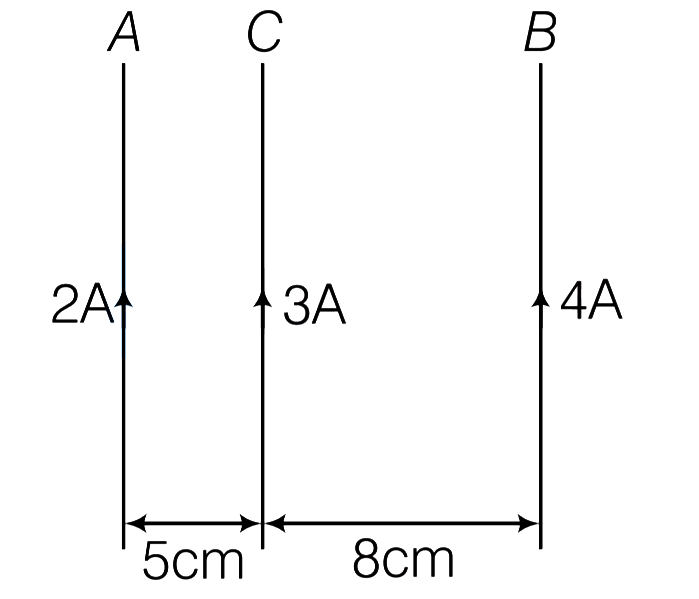 KCET 2007 Hard
 - A rectangular coil of 100 turns and size \(0.1 \mathrm{~m} \mathrm{} \times 0.05 \mathrm{~m}\) is placed perpendicular to a magnetic field of \(0.1 \mathrm{~T}\). If the field drops to \(0.05 \mathrm{~T}\) in \(0.05 \mathrm{~s}\), the magnitude of the e.m.f. iniduced in the coil isKCET 2013 Medium
- Cooking is fast in a pressure cooker, becauseKCET 2009 Easy
- If \(A=\left[\begin{array}{ll}0 & 1 \\ 0 & 0\end{array}\right]\), then \((a I+b A)^n\) is (where \(I\) is the identify matrix of order 2)KCET 2022 Hard
- The coordinates of the point on the \(\sqrt{x}+\sqrt{y}=6\) at which the tangent is equally inclined to the axes isKCET 2022 Hard
- Choose the possible genotype responsible for lightest skin colour in human beings.KCET 2018 Easy