


KCET · Maths · Application of Derivatives
In a Mahakumbh, a drone camera is moving along \(3y = x^3 - 3\). When \(y\)-coordinate changes \(9\) times as fast as \(x\)-coordinate, it captures good quality pictures. Then one of the precise positions of the drone at that instant is
- A \((-3, -8)\)
- B \((3, -8)\)
- C \((3, 8)\)
- D \((-3, 8)\)
Answer & Solution
Correct Answer
(C) \((3, 8)\)
Step-by-step Solution
Detailed explanation
The equation of the curve is given by \(3y = x^3 - 3\).
Differentiating both sides with respect to time \(t\), we get:
\(3 \dfrac{dy}{dt} = 3x^2 \dfrac{dx}{dt}\)
\(\dfrac{dy}{dt} = x^2 \dfrac{dx}{dt}\)
Given that the \(y\)-coordinate changes \(9\) times as fast as the \(x\)-coordinate:
\(\dfrac{dy}{dt} = 9 \dfrac{dx}{dt}\)
Equating the two expressions for \(\dfrac{dy}{dt}\):
\(x^2 \dfrac{dx}{dt} = 9 \dfrac{dx}{dt}\)
Assuming \(\dfrac{dx}{dt} \neq 0\), we get \(x^2 = 9\), which gives \(x = 3\) or \(x = -3\).
For \(x = 3\), substituting into the curve equation gives \(3y = (3)^3 - 3 = 24 \Rightarrow y = 8\). The point is \((3, 8)\).
For \(x = -3\), substituting into the curve equation gives \(3y = (-3)^3 - 3 = -30 \Rightarrow y = -10\). The point is \((-3, -10)\).
Among the given options, \((3, 8)\) is the correct position.
Answer: \((3, 8)\)
Differentiating both sides with respect to time \(t\), we get:
\(3 \dfrac{dy}{dt} = 3x^2 \dfrac{dx}{dt}\)
\(\dfrac{dy}{dt} = x^2 \dfrac{dx}{dt}\)
Given that the \(y\)-coordinate changes \(9\) times as fast as the \(x\)-coordinate:
\(\dfrac{dy}{dt} = 9 \dfrac{dx}{dt}\)
Equating the two expressions for \(\dfrac{dy}{dt}\):
\(x^2 \dfrac{dx}{dt} = 9 \dfrac{dx}{dt}\)
Assuming \(\dfrac{dx}{dt} \neq 0\), we get \(x^2 = 9\), which gives \(x = 3\) or \(x = -3\).
For \(x = 3\), substituting into the curve equation gives \(3y = (3)^3 - 3 = 24 \Rightarrow y = 8\). The point is \((3, 8)\).
For \(x = -3\), substituting into the curve equation gives \(3y = (-3)^3 - 3 = -30 \Rightarrow y = -10\). The point is \((-3, -10)\).
Among the given options, \((3, 8)\) is the correct position.
Answer: \((3, 8)\)
See the Complete Solution
Get step-by-step explanations for this and 2.5 Lakh+ more JEE, NEET & CET questions.
- Unlock all solutions
- Practice the full chapter
- Track accuracy across PYQs
4.8 rated on Google Play · 14,000+ reviews
More questions from Maths
- If \(\alpha=\hat{\mathbf{i}}-3 \hat{\mathbf{j}}, \beta=\hat{\mathbf{i}}+2 \hat{\mathbf{j}}-\hat{\mathbf{k}}\), then express \(\beta\) in the form \(\beta=\beta_1+\beta_2\) where \(\beta_1\) is parallel to \(\alpha\) and \(\beta_2\) is perpendicular to \(\alpha\), then \(\beta_1\) is given byKCET 2022 Medium
- If \(x-y=1\) is a tangent to the hyperbola \(\frac{x^{2}}{4}-\frac{y^{2}}{3}=1\), then the point of contact isKCET 2012 Medium
- If \( A=\frac{1}{\Pi}\left[\begin{array}{ll}\sin ^{-1}(\Pi x) & \tan ^{-1}\left(\frac{x}{I I}\right) \\ \tan ^{-1}\left(\frac{x}{I I}\right) & \cot ^{-1}(\Pi x)\end{array}\right] \) then \( A-B \) isKCET 2017 Medium
- If \(\frac{d y}{d x}+\frac{y}{x}=x^2\), then \(2 y(2)-y(1)=\)KCET 2022 Medium
- Two cards are drawn at random from a pack of \( 52 \) cards. The probability of these two being
'Aces" isKCET 2016 Easy - If \(n(A)=2\) and total number of possible relations from Set A to set B is 1024 , then \(n(B)\) isKCET 2020 Medium
More PYQs from KCET
- Two thin biconvex lenses have focal lengths \(f_{1}\) and \(f_{2}\). A third thin biconcave lens has focal length of \(f_{3}\). If the two biconvex lenses are in contact, then the total power of the lenses is \(P_{1}\). If the first convex lens is in contact with the third lens, then the total power is \(P_{2}\). If the second lens is in contact with the third lens, the total power is \(P_{3}\), thenKCET 2021 Hard
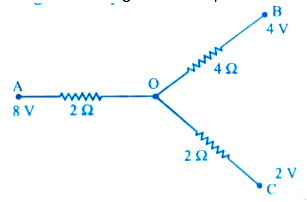
- In the following network potential at 'O'
 KCET 2016 Easy
 - The quantities of heat required to raise the temperatures of two copper spheres of radii \(r_{1}\) and \(r_{2}\left(r_{1}=1.5 r_{2}\right)\) through \(1 \mathrm{~K}\) are in the ratio ofKCET 2011 Medium
- The right hand and left hand limit of the function are respectively.
\(f(x)=\left\{\begin{array}{cc}\frac{e^{1 / x}-1}{e^{1 / x}+1}, & \text { if } x \neq 0 \\ 0, & \text { if } x=0\end{array}\right.\)KCET 2020 Medium - In the reaction; \( \mathrm{F} e(\mathrm{OH})_{3}(\mathrm{~s}) \rightleftharpoons \mathrm{F} e^{3+}(a q)+3 \mathrm{OH}^{-}(a q) \), if the concentration of \( \mathrm{OH}^{-} \)ions is
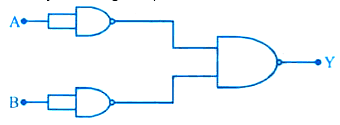
decreased by \( \frac{1}{4} \) times, then the equilibrium concentration of \( F e^{3+} \) will increase by,KCET 2016 Medium - Identify the logic operation carried out by the following circuit.
 KCET 2016 Easy