


KCET · Physics · Ray Optics
Two thin biconvex lenses have focal lengths \(f_{1}\) and \(f_{2}\). A third thin biconcave lens has focal length of \(f_{3}\). If the two biconvex lenses are in contact, then the total power of the lenses is \(P_{1}\). If the first convex lens is in contact with the third lens, then the total power is \(P_{2}\). If the second lens is in contact with the third lens, the total power is \(P_{3}\), then
- A \(P_{1}=\frac{f_{1} f_{2}}{f_{1}-f_{2}}, P_{2}=\frac{f_{1} f_{3}}{f_{3}-f_{1}}\) and \(P_{3}=\frac{f_{2} f_{3}}{f_{3}-f_{2}}\)
- B \(P_{1}=\frac{f_{1}-f_{2}}{f_{1} f_{2}}, P_{2}=\frac{f_{3}-f_{1}}{f_{3}+f_{1}}\) and \(P_{3}=\frac{f_{3}-f_{2}}{f_{2} f_{3}}\)
- C \(P_{1}=\frac{f_{1}-f_{2}}{f_{1} f_{2}}, P_{2}=\frac{f_{3}-f_{1}}{f_{1} f_{3}}\) and \(P_{3}=\frac{f_{3}-f_{2}}{f_{2} f_{3}}\)
- D \(P_{1}=\frac{f_{1}+f_{2}}{f_{1} f_{2}}, P_{2}=\frac{f_{3}-f_{1}}{f_{1} f_{3}}\) and \(P_{3}=\frac{f_{3}-f_{2}}{f_{2} f_{3}}\)
Answer & Solution
Correct Answer
(D) \(P_{1}=\frac{f_{1}+f_{2}}{f_{1} f_{2}}, P_{2}=\frac{f_{3}-f_{1}}{f_{1} f_{3}}\) and \(P_{3}=\frac{f_{3}-f_{2}}{f_{2} f_{3}}\)
Step-by-step Solution
Detailed explanation
According to cartesian sign conversion,
Focal length of first biconvex lens \(=f_{1}\)
Focal length of second biconvex lens \(=f_{2}\)
Focal length of third biconcave lens \(=-f_{3}\)
\(\therefore\) Focal length of combination of first and second lenses is
\(\frac{1}{f}=\frac{1}{f_{1}}+\frac{1}{f_{2}}=\frac{f_{1}+f_{2}}{f_{1} f_{2}}\)
As, power of lens, \(P_{1}=\frac{1}{f}=\frac{f_{1}+f_{2}}{f_{1} f_{2}}\)
Similarly, power of combination of first and third lenses is
\(P_{2}=\frac{1}{f}=\frac{1}{f_{1}}-\frac{1}{f_{3}}=\frac{f_{3}-f_{1}}{f_{1} f_{3}}\)
and for combination of second and third lenses is
\(P_{3}=\frac{1}{f}=\frac{1}{f_{2}}-\frac{1}{f_{3}}=\frac{f_{3}-f_{2}}{f_{2} f_{3}}\)
Focal length of first biconvex lens \(=f_{1}\)
Focal length of second biconvex lens \(=f_{2}\)
Focal length of third biconcave lens \(=-f_{3}\)
\(\therefore\) Focal length of combination of first and second lenses is
\(\frac{1}{f}=\frac{1}{f_{1}}+\frac{1}{f_{2}}=\frac{f_{1}+f_{2}}{f_{1} f_{2}}\)
As, power of lens, \(P_{1}=\frac{1}{f}=\frac{f_{1}+f_{2}}{f_{1} f_{2}}\)
Similarly, power of combination of first and third lenses is
\(P_{2}=\frac{1}{f}=\frac{1}{f_{1}}-\frac{1}{f_{3}}=\frac{f_{3}-f_{1}}{f_{1} f_{3}}\)
and for combination of second and third lenses is
\(P_{3}=\frac{1}{f}=\frac{1}{f_{2}}-\frac{1}{f_{3}}=\frac{f_{3}-f_{2}}{f_{2} f_{3}}\)
See the Complete Solution
Get step-by-step explanations for this and 2.5 Lakh+ more JEE, NEET & CET questions.
- Unlock all solutions
- Practice the full chapter
- Track accuracy across PYQs
4.8 rated on Google Play · 14,000+ reviews
More questions from Physics
- The waves used for line-of-sight (LOS) communication isKCET 2015 Hard
- A sinusoidal voltage produced by an AC generator at any instant t is given by an equation \(\mathrm{V}=311 \sin 314\) t . The rms value of voltage and frequency are respectivelyKCET 2025 Easy
- Three photodiodes \(D_{1}, D_{2}\) and \(D_{3}\) are made of semiconductors having band gaps of \(2.5 \mathrm{eV}, 2 \mathrm{eV}\) and \(3 \mathrm{eV}\), respectively. Which one will be able to detect light of wavelength \(600 \mathrm{~nm}\) ?KCET 2021 Medium
- The period of revolution of an electron in the ground state of hydrogen atom is \( T \). The period of
revolution of the electron in the first excited state isKCET 2018 Medium - An electron enters the space between the plates of a charged capacitor as shown. The charge density on the plate is \(\sigma\). Electric intensity in the space between the plates is E. A uniform magnetic field \(B\) also exists in the space perpendicular to the direction of \(E\)
The electron moves perpendicular to both \(\overrightarrow{\mathrm{E}}\) and \(\overrightarrow{\mathbf{B}}\) without any change in direction. The time taken by the electron to travel a distance \(l\) in the space is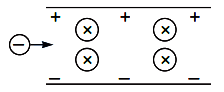 KCET 2010 Hard
 - A radio-active elements has half-life of 15 years. What is the fraction that will decay in 30 years?KCET 2020 Medium
More PYQs from KCET
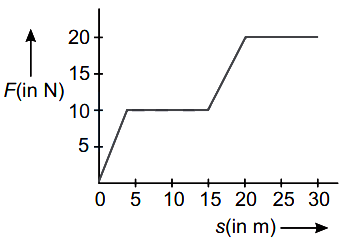
- The work done by a force acting on a body is as shown in the graph. The total work done in covering an initial distance of \(20 \mathrm{~m}\) is
 KCET 2009 Medium
 - Cheilosis and digestive disorders are due to the deficiency ofKCET 2015 Easy
- If \(A\) and \(B\) are two events such that \(P(A)=\frac{1}{2}\), \(P(B)=\frac{1}{2}\) and \(P(A \mid B)=\frac{1}{4}\), then \(P\left(A^{\prime} \cap B^{\prime}\right)\) isKCET 2022 Medium
- The monomer used in Novolac, a polymer usedin paintsKCET 2017 Medium
- A dibromo derivative of an alkane reacts with sodium metal to form an alicyclic hydrocarbon. The derivative isKCET 2010 Medium
- Identify the correctly matched pair/pairs of the germ layers and their derivatives.
A. Ectoderm-Epidermis
B. Endoderm-Dermis
C. Mesoderm-Muscles
D. Mesoderm-Notochord
E. Endoderm-Enamel of teethKCET 2009 Hard