


KCET · BIOLOGY · STD 11 - 5. Morphology of Flowering Plants
Identify the types of aestivation in corolla labelled as 'A', 'B', 'C' and 'D
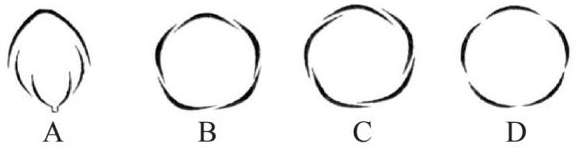
- A A-Vexillary, B-Imbricate, C-Twisted, D-Valvate
- B A-Vexillary, B-Imbricate, C-Valvate, D-Twisted
- C A-Vexillary, B-Twisted, C-Imbricate, D-Valvate
- D A-Imbricate, B-Valvate, C-Vexillary, D-Twisted
Answer & Solution
Correct Answer
(A) A-Vexillary, B-Imbricate, C-Twisted, D-Valvate
Step-by-step Solution
Detailed explanation
See the Complete Solution
Get step-by-step explanations for this and 2.5 Lakh+ more JEE, NEET & CET questions.
- Unlock all solutions
- Practice the full chapter
- Track accuracy across PYQs
4.8 rated on Google Play · 14,000+ reviews
More questions from BIOLOGY
- Which of the following enzymes increases the permeability of the bacterial cell to lactose?KCET 2025 Hard
- Mosses and ferns areKCET 2013 Medium
- Binomial nomenclature is introduced byKCET 2022 Medium
- In RNA interference the dsRNA molecule prevents __________KCET 2020 Hard
- The breakdown of detritus into small particles by detritivores is calledKCET 2015 Hard
- Pteridophytes are called vascular cryptogams, because they are non-seeded plants containingKCET 2012 Hard
More PYQs from KCET
- In which of the following statements, the obtained impure semiconductor is of \(p\)-type?KCET 2013 Easy
- In ruby laser, the stimulated emission is due to transition fromKCET 2009 Medium
- In human females, the number of primary facilities left in each ovary at puberty isKCET 2017 Hard
- The nitrogen base found only in DNA is also calledKCET 2015 Easy
- Match the following Maxwell's equations:
(The symbols used here have their usual meanings)List-I List-II (a) Gauss' law for electrostatics (i) \(\oint \vec{E} \cdot d\vec{A} = \dfrac{Q}{\varepsilon_0}\) (b) Gauss' law for magnetism (ii) \(\oint \vec{B} \cdot d\vec{l} = \mu_0 \left[i_c + \varepsilon_0 \dfrac{d\phi_E}{dt}\right]\) (c) Faraday's law (iii) \(\oint \vec{B} \cdot d\vec{A} = 0\) (d) Ampere-Maxwell's law (iv) \(\oint \vec{E} \cdot d\vec{l} = -\dfrac{d\phi_B}{dt}\) KCET 2026 Easy - If \(2 \sin ^{-1} x-3 \cos ^{-1} x=4, x \in[-1,1]\), then \(2 \sin ^{-1} x+3 \cos ^{-1} x\) is equal toKCET 2024 Medium