


KCET · Maths · Linear Programming
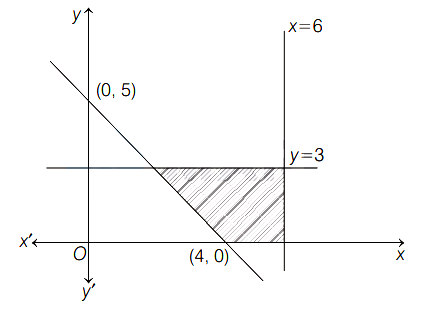
The shaded region is the solution set of the inequalities
- A \(5 x+4 y \geq 20, x \leq 6, y \geq 3, x \geq 0, y \geq 0\)
- B \(5 x+4 y \leq 20, x \leq 6, y \leq 3\), \(x \geq 0, y \geq 0\)
- C \(5 x+4 y \geq 20, x \leq 6, y \leq 3, x \geq 0, y \geq 0\)
- D \(5 x+4 y \geq 20, x \geq 6, y \leq 3, x \geq 0, y \geq 0\)
Answer & Solution
Correct Answer
(C) \(5 x+4 y \geq 20, x \leq 6, y \leq 3, x \geq 0, y \geq 0\)
Step-by-step Solution
Detailed explanation
Lets draw the given shaded region,
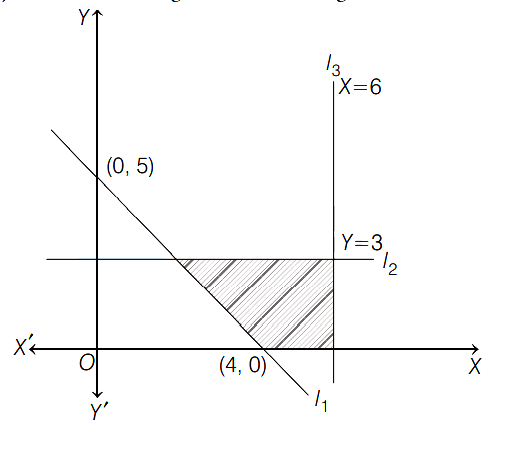
Line \(l_{1} \Rightarrow \frac{x}{4}+\frac{y}{5}=1 \quad\) (intercept form) \(\Rightarrow \quad \frac{5 x+4 y}{4 \times 5}=1\) \(\Rightarrow \quad 5 x+4 y=20\) As, origin is not in the feasible region. \(\therefore \quad 5 x+4 y \geq 20\) Line \(l_{2} \Rightarrow y \leq 3\) (from the graph) Line \(l_{3} \Rightarrow x \leq 6\) (from the graph) and coordinate axes \(x \geq 0, y \geq 0\) Hence, inequalities are \(5 x+4 y \geq 20, y \leq 3, x \leq 6\), \(x \geq 0, y \geq 0 .\)
Line \(l_{1} \Rightarrow \frac{x}{4}+\frac{y}{5}=1 \quad\) (intercept form) \(\Rightarrow \quad \frac{5 x+4 y}{4 \times 5}=1\) \(\Rightarrow \quad 5 x+4 y=20\) As, origin is not in the feasible region. \(\therefore \quad 5 x+4 y \geq 20\) Line \(l_{2} \Rightarrow y \leq 3\) (from the graph) Line \(l_{3} \Rightarrow x \leq 6\) (from the graph) and coordinate axes \(x \geq 0, y \geq 0\) Hence, inequalities are \(5 x+4 y \geq 20, y \leq 3, x \leq 6\), \(x \geq 0, y \geq 0 .\)
See the Complete Solution
Get step-by-step explanations for this and 2.5 Lakh+ more JEE, NEET & CET questions.
- Unlock all solutions
- Practice the full chapter
- Track accuracy across PYQs
4.8 rated on Google Play · 14,000+ reviews
More questions from Maths
- If \(f(x)=\frac{\sin ^{2} x}{1+\cot x}+\frac{\cos ^{2} x}{1+\tan x}\), then \(f^{\prime}\left(\frac{\pi}{4}\right)\) isKCET 2011 Medium
- If \( \vec{a} \) and \( \vec{b} \) are unit vectors then what is the angle between \( \vec{a} \) and \( \vec{b} \) for \( \sqrt{3} \vec{a}-\vec{b} \) to be unit
vector?KCET 2016 Medium - If \(\int \frac{\sqrt{x}}{x(x+1)} d x=k \tan ^{-1} m\), then \((k, m)\) isKCET 2010 Easy
- If the parametric equation of curve is given by \(x=\cos \theta+\log \tan \frac{\theta}{2}\) and \(y=\sin \theta\), then the points for which \(\frac{d y}{d x}=0\) are given byKCET 2021 Medium
- The equation of the plane through the points \((2,1,0),(3,2,-2)\) and \((3,1,7)\) isKCET 2023 Easy
- If \(x+i y=(-1+i \sqrt{3})^{2010}\), then \(x\) isKCET 2010 Easy
More PYQs from KCET
- The angle between the lines \(\sin ^{2} \alpha \cdot y^{2}-2 x y \cdot \cos ^{2} \alpha+\left(\cos ^{2} \alpha-1\right) x^{2}=0\), isKCET 2013 Medium
- When \(\mathrm{FeCl}_3\) is added to excess of hot water gives a sol ' \(X\) '. When \(\mathrm{FeCl}_3\) is added to \(\mathrm{NaOH}(a q)\) solution, gives sol ' \(Y\) ' \(X\) and \(Y\) formed in the above processes respectively areKCET 2023 Hard
- \(\text{C}-\text{Cl}\) bond in methyl chloride compared to \(\text{C}-\text{Cl}\) bond in chlorobenzene isKCET 2026 Medium
- Which among the following was the biggest land dinosaur?KCET 2020 Easy
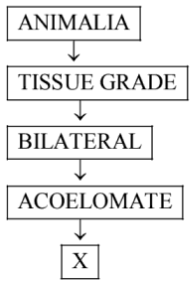
- Identify the Phylum X.
 KCET 2015 Medium
 - If the circle \(\mathrm{x}^{2}+\mathrm{y}^{2}=\mathrm{a}^{2}\) intersects the hyperbola \(\mathrm{xy}=\mathrm{c}^{2}\) in four points \(P\left(x_{1}, y_{1}\right), Q\left(x_{2}, y_{2}\right), R\left(x_{3}, y_{3}\right)\) and \(S\left(x_{4}, y_{4}\right)\), thenKCET 2009 Medium