


KCET · Maths · Differentiation
If the three function \(f(x), g(x)\) and \(h(x)\) are such that
\(h(x)=f(x) \cdot g(x)\) and \(f^{\prime}(x) \cdot g^{\prime}(x)=c\)
where \(c\) is constant, then
\(\frac{f^{\prime \prime}(x)}{f(x)}+\frac{g^{\prime \prime}(x)}{g(x)}+\frac{2 c}{f(x) \cdot g(x)}\)
is equal to
- A \(h^{\prime}(x) \cdot h^{\prime \prime}(x)\)
- B \(\frac{\mathrm{h}(\mathrm{x})}{\mathrm{h}^{\prime \prime}(\mathrm{x})}\)
- C \(\frac{h^{\prime \prime}(x)}{h(x)}\)
- D \(\frac{h(x)}{h^{\prime}(x)}\)
Answer & Solution
Correct Answer
(C) \(\frac{h^{\prime \prime}(x)}{h(x)}\)
Step-by-step Solution
Detailed explanation
Given, \(h(x)=f(x) \cdot g(x)\) and \(f^{\prime}(x) \cdot g^{\prime}(x)=c\)
Now, \(h^{\prime}(x)=f^{\prime}(x) \cdot g(x)+f(x) \cdot g^{\prime}(x)\)
\(h^{\prime \prime}(x)=f^{\prime \prime}(x) \cdot g(x)+f^{\prime}(x) \cdot g^{\prime}(x)\)
\(+f^{\prime}(x) \cdot g^{\prime}(x)+f(x) \cdot g^{\prime \prime}(x)\)
\(h^{\prime \prime}(x)=f^{\prime \prime}(x) \cdot g(x)+f(x) \cdot g^{\prime \prime}(x)\)
\(+2 f^{\prime}(x) \cdot g^{\prime}(x)\)
\(h^{\prime \prime}(x)=f^{\prime \prime}(x) \cdot g(x)+f(x) \cdot g^{\prime \prime}(x)+2 c \quad \ldots\) (i)
Now, we find
\[
\frac{f^{\prime \prime}(x)}{f(x)}+\frac{g^{\prime \prime}(x)}{g(x)}+\frac{2 c}{f(x) \cdot g(x)}
\]
\[
\begin{aligned}
&=\frac{f^{\prime \prime}(x) \cdot g(x)+g^{\prime \prime}(x) \cdot f(x)+2 c}{f(x) \cdot g(x)} \\
&=\frac{h^{\prime \prime}(x)}{h(x)} \quad[\text { from Eq. (i)] }
\end{aligned}
\]
Now, \(h^{\prime}(x)=f^{\prime}(x) \cdot g(x)+f(x) \cdot g^{\prime}(x)\)
\(h^{\prime \prime}(x)=f^{\prime \prime}(x) \cdot g(x)+f^{\prime}(x) \cdot g^{\prime}(x)\)
\(+f^{\prime}(x) \cdot g^{\prime}(x)+f(x) \cdot g^{\prime \prime}(x)\)
\(h^{\prime \prime}(x)=f^{\prime \prime}(x) \cdot g(x)+f(x) \cdot g^{\prime \prime}(x)\)
\(+2 f^{\prime}(x) \cdot g^{\prime}(x)\)
\(h^{\prime \prime}(x)=f^{\prime \prime}(x) \cdot g(x)+f(x) \cdot g^{\prime \prime}(x)+2 c \quad \ldots\) (i)
Now, we find
\[
\frac{f^{\prime \prime}(x)}{f(x)}+\frac{g^{\prime \prime}(x)}{g(x)}+\frac{2 c}{f(x) \cdot g(x)}
\]
\[
\begin{aligned}
&=\frac{f^{\prime \prime}(x) \cdot g(x)+g^{\prime \prime}(x) \cdot f(x)+2 c}{f(x) \cdot g(x)} \\
&=\frac{h^{\prime \prime}(x)}{h(x)} \quad[\text { from Eq. (i)] }
\end{aligned}
\]
See the Complete Solution
Get step-by-step explanations for this and 2.5 Lakh+ more JEE, NEET & CET questions.
- Unlock all solutions
- Practice the full chapter
- Track accuracy across PYQs
4.8 rated on Google Play · 14,000+ reviews
More questions from Maths
- If \(A=\{a, b, c\}\), then the number of binary operations on \(A\) isKCET 2020 Easy
- The general solution of the differential equation \(x^{2} d y-2 x y d x=x^{4} \cos x d x\) isKCET 2020 Easy
- If the conjugate of \((x+i y)(1-2 i)\) is \(1+i\), thenKCET 2012 Hard
- The number \(\left(49^{2}-4\right)\left(49^{3}-49\right)\) is divisible byKCET 2010 Medium
- If \(m\) and \(n\) are order and degree of the differential equation
\(\left(y^{\prime \prime}\right)^{5}+4 \cdot \frac{\left(y^{\prime \prime}\right)^{3}}{y^{\prime \prime \prime}}+y^{\prime \prime \prime}=\sin x\), thenKCET 2013 Medium - The equation of parabola whose focus is \((6,0)\) and directrix is \(x=-6\) isKCET 2024 Easy
More PYQs from KCET
- A rod of length \(2 \mathrm{~m}\) slides with a speed of \(5 \mathrm{~ms}^{-1}\) on a rectangular conducting frame as shown in figure. There exists a uniform magnetic filed of \(0.04 \mathrm{~T}\) perpendicular to the plane of the figure. If the resistance of the rod is \(3 \Omega\). The current through the rod is
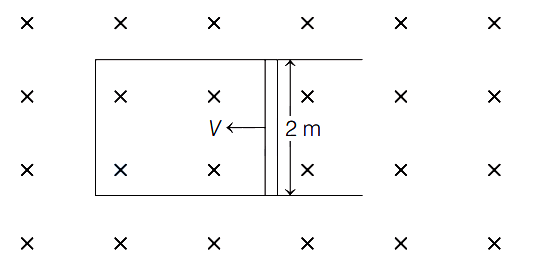 KCET 2020 Hard
 - The total electric flux through a closed spherical surface of radius \(r\) enclosing an electric dipole of dipole moment \(2 a q\) is (Give \(\varepsilon_0=\) permittivity of free space)KCET 2024 Easy
- All colloidal dispersions haveKCET 2012 Medium
- If \( \left(\frac{1+i}{1-i}\right)^{\mathrm{m}} \), then the least positive integralvalue of \( \mathrm{m} \) isKCET 2017 Easy
- \( \int_{-3}^{3} \cot ^{-1} x d x= \)KCET 2019 Medium
- The correct statement with regard to \(\mathrm{H}_{2}^{+}\)and \(\mathrm{H}_{2}^{-}\) isKCET 2009 Easy