


KCET · Maths · Application of Derivatives
If \( \left(\frac{1+i}{1-i}\right)^{\mathrm{m}} \), then the least positive integralvalue of \( \mathrm{m} \) is
- A \( 02 \)
- B \( 13 \)
- C \( 04 \)
- D \( 11 \)
Answer & Solution
Correct Answer
(C) \( 04 \)
Step-by-step Solution
Detailed explanation
Given that, \(\left(\frac{1+i}{1-i}\right)^{m}=1\)
\(\Rightarrow\left(\frac{1+i}{1-i} \times \frac{1+i}{1+i}\right)^{m}=1\)
\(\Rightarrow\left(\frac{(1+i)^{2}}{1-(i)^{2}}\right)^{m}=1\)
\(\Rightarrow\left(\frac{1-1+2 i}{1+1}\right)^{m}=1\)
\(\Rightarrow\left(\frac{2 i}{2}\right)^{m}=1\)
\(\Rightarrow i^{m}=1\)
For \(m=1\), we have \(i=1\), but \(i \neq 1\)
For \(m=2\), we have \(i^{2}=-1=1\), but \(-1 \neq 1\)
For \(m=3\), we have \(i^{3}=-i=1\), but \(-i \neq 1\)
For \(m=4\), we have \(i^{4}=1\)
Therefore, \(m=4\)
\(\Rightarrow\left(\frac{1+i}{1-i} \times \frac{1+i}{1+i}\right)^{m}=1\)
\(\Rightarrow\left(\frac{(1+i)^{2}}{1-(i)^{2}}\right)^{m}=1\)
\(\Rightarrow\left(\frac{1-1+2 i}{1+1}\right)^{m}=1\)
\(\Rightarrow\left(\frac{2 i}{2}\right)^{m}=1\)
\(\Rightarrow i^{m}=1\)
For \(m=1\), we have \(i=1\), but \(i \neq 1\)
For \(m=2\), we have \(i^{2}=-1=1\), but \(-1 \neq 1\)
For \(m=3\), we have \(i^{3}=-i=1\), but \(-i \neq 1\)
For \(m=4\), we have \(i^{4}=1\)
Therefore, \(m=4\)
See the Complete Solution
Get step-by-step explanations for this and 2.5 Lakh+ more JEE, NEET & CET questions.
- Unlock all solutions
- Practice the full chapter
- Track accuracy across PYQs
4.8 rated on Google Play · 14,000+ reviews
More questions from Maths
- If \(2 \sin ^{-1} x-3 \cos ^{-1} x=4, x \in[-1,1]\), then \(2 \sin ^{-1} x+3 \cos ^{-1} x\) is equal toKCET 2024 Medium
- If \( \tan ^{-1} x+\tan ^{-1} y=\frac{4 \pi}{5} \), then \( \cot ^{-1} x+\cot ^{-1} y \) is equal toKCET 2017 Medium
- Let \((g \circ f)(x)=\sin x\) and \(f \circ g(x)=(\sin \sqrt{x})^2\) Then,KCET 2024 Easy
- The corner points of the feasible region of an LPP are \((0,2),(3,0),(6,0),(6,8)\) and \((0,5)\), then the minimum value of \(z=4 x+6 y\) occurs atKCET 2022 Medium
- The value of \(\left|\begin{array}{lll}\sin ^2 14^{\circ} & \sin ^2 66^{\circ} & \tan 135^{\circ} \\ \sin ^2 66^{\circ} & \tan 135^{\circ} & \sin ^2 14^{\circ} \\ \tan 135^{\circ} & \sin ^2 14^{\circ} & \sin ^2 66^{\circ}\end{array}\right|\) isKCET 2023 Hard
- If \(A=\left[\begin{array}{ll}1 & 2 \\ 3 & 4\end{array}\right]\), then \(\mathrm{A}^{-1}\) is equal toKCET 2008 Easy
More PYQs from KCET
- Which of the following forms a colourless solution in aqueous medium?KCET 2007 Easy
- In the circuit shown below, the ammeter and the voltmeter readings are \( 3 \mathrm{~A} \) and \( 6 \mathrm{~V} \) respectively. Then the value of the resistance \( R \) is
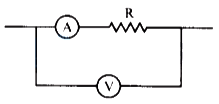 KCET 2015 Medium
 - Bryophytes resemble algae in the following aspectsKCET 2009 Medium
- Which of the following set of polymers are used as fibre?
(i) Teflon
(ii) Starch
(iii) Terylene
(iv) OrlonKCET 2024 Easy - Which of the following compound possesses the " \( \mathrm{C}-\mathrm{H} \) " bond with the lowest bond dissociation
energy?KCET 2015 Easy - In which month of gestation, the first movements of fetus and appearance of hair on its head is observed?KCET 2022 Medium