


KCET · Maths · Complex Number
If \(\alpha\) is a complex number satisfying the equation \(\alpha^{2}+\alpha+1=0\), then \(\alpha^{31}\) is equal to
- A \(\alpha\)
- B \(\alpha^{2}\)
- C 1
- D \(\mathrm{i}\)
Answer & Solution
Correct Answer
(A) \(\alpha\)
Step-by-step Solution
Detailed explanation
Given equation is
\[
\begin{aligned}
\alpha^{2}+\alpha+1 &=0 \\
\therefore \quad \alpha &=\frac{-1 \pm \sqrt{1-4}}{2}=\frac{-1 \pm \sqrt{3} \mathrm{i}}{2}
\end{aligned}
\]
Let it be \(\quad \alpha=\omega, \omega^{2}\)
(1) If \(\alpha=\omega\), then \(\alpha^{31}=(\omega)^{31}=\omega=\alpha\)
(2) If \(\alpha=\omega^{2}\), then \(\alpha^{31}=\left(\omega^{2}\right)^{31}=\omega^{62}=\omega^{2}=\alpha\)
Hence, \(\alpha^{31}\) is equal to \(\alpha\).
\[
\begin{aligned}
\alpha^{2}+\alpha+1 &=0 \\
\therefore \quad \alpha &=\frac{-1 \pm \sqrt{1-4}}{2}=\frac{-1 \pm \sqrt{3} \mathrm{i}}{2}
\end{aligned}
\]
Let it be \(\quad \alpha=\omega, \omega^{2}\)
(1) If \(\alpha=\omega\), then \(\alpha^{31}=(\omega)^{31}=\omega=\alpha\)
(2) If \(\alpha=\omega^{2}\), then \(\alpha^{31}=\left(\omega^{2}\right)^{31}=\omega^{62}=\omega^{2}=\alpha\)
Hence, \(\alpha^{31}\) is equal to \(\alpha\).
See the Complete Solution
Get step-by-step explanations for this and 2.5 Lakh+ more JEE, NEET & CET questions.
- Unlock all solutions
- Practice the full chapter
- Track accuracy across PYQs
4.8 rated on Google Play · 14,000+ reviews
More questions from Maths
- The standard deviation of the numbers 31 , \(32,33 \ldots 46,47\) isKCET 2021 Easy
- The order and degree of the differential equation \(\left[1+\left(\frac{d y}{d x}\right)^{5}\right]^{\frac{1}{3}}=\frac{d^{2} y}{d x^{2}}\) are respectivelyKCET 2007 Easy
- If \(\mathbf{a}, \mathbf{b}\) and \(\mathbf{c}\) are three non-coplanar vectors and \(p, q\) and \(r\) are vectors defined by
\(\mathbf{p}=\frac{\mathbf{a} \times \mathbf{c}}{[\mathbf{a} \mathbf{b} \mathbf{c}]}, \mathbf{q}=\frac{\mathbf{c} \times \mathbf{a}}{[\mathbf{a} \mathbf{b} \mathbf{c}]}, \mathbf{r}=\frac{\mathbf{a} \times \mathbf{b}}{[\mathbf{a} \mathbf{b} \mathbf{c}]}\), then
\((\mathbf{a}+\mathbf{b}) \cdot \mathbf{p}+(\mathbf{b}+\mathbf{c}) \cdot \mathbf{q}+(\mathbf{c}+\mathbf{a}) \cdot \mathbf{r}\) isKCET 2024 Medium - If \( \tan x=\frac{3}{4}, \Pi < x < \frac{3 \Pi}{2} \), then the value of \( \cos \frac{x}{2} \) isKCET 2014 Medium
- The function \(f(x)=\frac{\log (1+a x)-\log (1-b x)}{x}\) is not defined at \(\mathrm{x}=0\). The value which should be assigned to \(\mathrm{f}\) at \(\mathrm{x}=0\) so that it is continuous at \(\mathrm{x}=0\) isKCET 2009 Easy
- A space vector makes the angles \(150^{\circ}\) and \(60^{\circ}\) with the positive direction of \(x\)-and \(y\)-axes. The angle made by the vector with the positive direction \(z\)-axis isKCET 2010 Easy
More PYQs from KCET
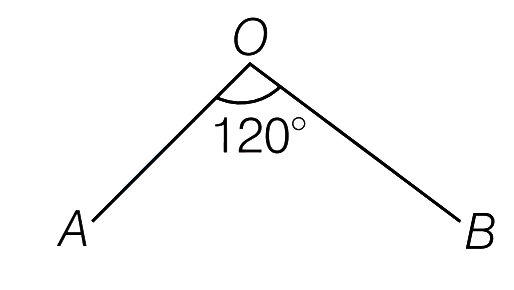
- \(O A\) and \(O B\) are two roads enclosing an angle of \(120^{\circ} . X\) and \(Y\) start from ' \(O\) ' at the same time. \(X\) travels along \(O A\) with a speed of \(4 \mathrm{~km} / \mathrm{h}\) and \(Y\) travels along \(O B\) with a speed of \(3 \mathrm{~km} / \mathrm{h}\). The rate at which the shortest distance between \(X\) and \(Y\) is increasing after \(1 \mathrm{~h}\) is
 KCET 2007 Hard
 - Which of the following statement is incorrect?KCET 2023 Medium
- Pollen grains are generally spherical, measuring aboutKCET 2017 Easy
- All components of the electromagnetic spectrum in vacuum have the sameKCET 2007 Easy
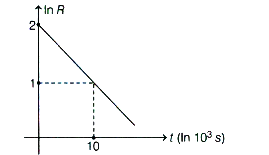
- The natural logarithm of the activity \(R\) of a radioactive sample varies with time \(t\) as shown. At \(t=0\), there are \(N_0\) undecayed nuclei. Then, \(N_0\) is equal to [Take \(e^2=7.5\) ]
 KCET 2024 Easy
 - If \( a, b, c \) are three consecutive terms of an \( A P \) and \( x, y, z \) are three consecutive terms of a G.P.,
then thevalue of \( X^{b-c}, Y^{c-a}, Z^{a-b} \)
isKCET 2018 Easy