


KCET · Maths · Application of Derivatives
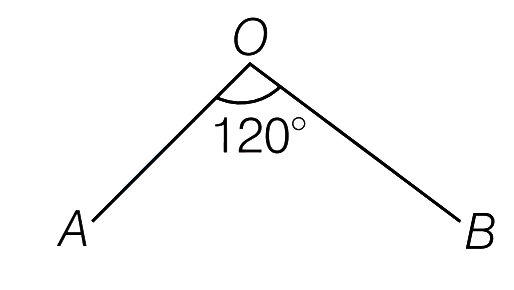
\(O A\) and \(O B\) are two roads enclosing an angle of \(120^{\circ} . X\) and \(Y\) start from ' \(O\) ' at the same time. \(X\) travels along \(O A\) with a speed of \(4 \mathrm{~km} / \mathrm{h}\) and \(Y\) travels along \(O B\) with a speed of \(3 \mathrm{~km} / \mathrm{h}\). The rate at which the shortest distance between \(X\) and \(Y\) is increasing after \(1 \mathrm{~h}\) is
- A \(\sqrt{37} \mathrm{~km} / \mathrm{h}\)
- B \(37 \mathrm{~km} / \mathrm{h}\)
- C \(13 \mathrm{~km} / \mathrm{h}\)
- D \(\sqrt{13} \mathrm{~km} / \mathrm{h}\)
Answer & Solution
Correct Answer
(A) \(\sqrt{37} \mathrm{~km} / \mathrm{h}\)
Step-by-step Solution
Detailed explanation
Given, speed of \(x\) is \(4 \mathrm{~km} / \mathrm{h}\) and \(y\) is \(3 \mathrm{~km} / \mathrm{h}\). After time \(t\) the distance covered by \(x\) is \(4 t\) and \(y\) is \(3 t\).
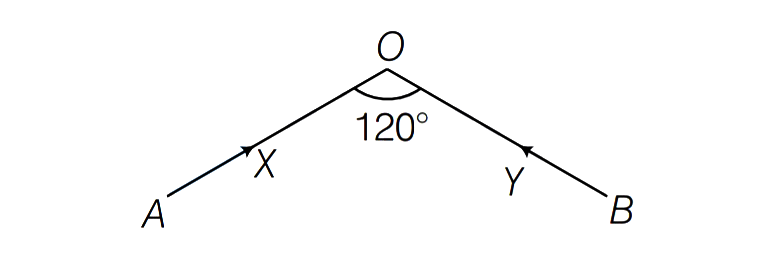
Let shortest distance between \(x\) and \(y=A\).
Then by cosine law
\(\quad A^{2}=(4 t)^{2}+(3 t)^{2}-(4 t)(3 t) 2 \cos 120^{\circ}\) \(\Rightarrow \quad A^{2}=16 t^{2}+9 t^{2}-24 t^{2}\left(-\frac{1}{2}\right)\) \(\Rightarrow \quad A^{2}=25 t^{2}+12 t^{2}\) \(\Rightarrow \quad A^{2}=37 t^{2}\) \(\Rightarrow \quad A=\sqrt{37} t\) If \(\quad t=1 \mathrm{~h}\), then \(\quad A=\sqrt{37} \mathrm{~km}\) Now, differentiating Eq. (i) w.r.t. \(t\), we get \(\quad 2 A A^{\prime}=37(2 t)\) After \(t=1 \mathrm{~h}\), we get \(2 \sqrt{37} A^{\prime}=2(37)\)
After \(t=1 \mathrm{~h}\), we get
\(\Rightarrow \quad A^{\prime}=\sqrt{37}\)
Thus, rate at which shortest distance \(A\) changes with time is \(\sqrt{37} \mathrm{~km} / \mathrm{h}\).
Let shortest distance between \(x\) and \(y=A\).
Then by cosine law
\(\quad A^{2}=(4 t)^{2}+(3 t)^{2}-(4 t)(3 t) 2 \cos 120^{\circ}\) \(\Rightarrow \quad A^{2}=16 t^{2}+9 t^{2}-24 t^{2}\left(-\frac{1}{2}\right)\) \(\Rightarrow \quad A^{2}=25 t^{2}+12 t^{2}\) \(\Rightarrow \quad A^{2}=37 t^{2}\) \(\Rightarrow \quad A=\sqrt{37} t\) If \(\quad t=1 \mathrm{~h}\), then \(\quad A=\sqrt{37} \mathrm{~km}\) Now, differentiating Eq. (i) w.r.t. \(t\), we get \(\quad 2 A A^{\prime}=37(2 t)\) After \(t=1 \mathrm{~h}\), we get \(2 \sqrt{37} A^{\prime}=2(37)\)
After \(t=1 \mathrm{~h}\), we get
\(\Rightarrow \quad A^{\prime}=\sqrt{37}\)
Thus, rate at which shortest distance \(A\) changes with time is \(\sqrt{37} \mathrm{~km} / \mathrm{h}\).
See the Complete Solution
Get step-by-step explanations for this and 2.5 Lakh+ more JEE, NEET & CET questions.
- Unlock all solutions
- Practice the full chapter
- Track accuracy across PYQs
4.8 rated on Google Play · 14,000+ reviews
More questions from Maths
- If \(\overrightarrow{\mathbf{a}}+2 \overrightarrow{\mathbf{b}}+3 \overrightarrow{\mathbf{c}}=\overrightarrow{\mathbf{0}}\), then \(\overrightarrow{\mathbf{a}} \times \overrightarrow{\mathbf{b}}+\overrightarrow{\mathbf{b}} \times \overrightarrow{\mathbf{c}}+\overrightarrow{\mathbf{c}} \times \overrightarrow{\mathbf{a}}\) is equal toKCET 2009 Hard
- If the circles \(x^{2}+y^{2}-2 x-2 y-7=0\) and \(x^{2}+y^{2}+4 x+2 y+k=0\) cut orthogonally, then the length of the common chord of the circles isKCET 2007 Hard
- \(f(x)= \begin{cases}2 a-x & \text { in }-a < x < a \\ 3 x-2 a & \text { in } a \leq x\end{cases}\)
Then, which of the following is true ?KCET 2008 Hard - If \(A\) is a square matrix, such that \(A^2=A\) then \((I+A)^3\) is equal toKCET 2024 Easy
- \(\left|\begin{array}{ccc}\sin \alpha & \cos \alpha & \sin (\alpha+\delta) \\ \sin \beta & \cos \beta & \sin (\beta+\delta) \\ \sin \gamma & \cos \gamma & \sin (\gamma+\delta)\end{array}\right|\) is equal toKCET 2011 Medium
- If \(x-y=1\) is a tangent to the hyperbola \(\frac{x^{2}}{4}-\frac{y^{2}}{3}=1\), then the point of contact isKCET 2012 Medium
More PYQs from KCET
- If the parabola \(x^{2}=4 a y\) passes through the point \((2,1)\), then the length of the latus rectum isKCET 2020 Easy
- A parallel plate capacitor has a uniform electric field '\(E\)' in the space between the plates. If the distance between the plates is '\(d\)' and area of each plate is '\(A\)', the energy stored in the capacitor isKCET 2026 Easy
- If \( \alpha \) and \( \beta \) are the roots of \( x^{2}-a x+b^{2}=0 \), then \( \alpha^{2}+\beta^{2} \) is equal toKCET 2015 Medium
- A rectangular coil of 100 turns and size \(0.1 \mathrm{~m} \mathrm{} \times 0.05 \mathrm{~m}\) is placed perpendicular to a magnetic field of \(0.1 \mathrm{~T}\). If the field drops to \(0.05 \mathrm{~T}\) in \(0.05 \mathrm{~s}\), the magnitude of the e.m.f. iniduced in the coil isKCET 2013 Medium
- The length of a rectangle is five times the breadth. If the minimum perimeter of the rectangle is 180 cm , thenKCET 2024 Easy
- Match List-I and List-II with respect to proteins and their functions and select the correct option.
List-I List-II 1. Collagen p. Fights infectious agents 2. Trypsin q. Hormone 3. Insulin r. Enzyme 4. Antibody s. Intercellular ground substance KCET 2023 Hard