


KCET · Maths · Indefinite Integration
If \( A=\left[\begin{array}{cc}0 & 1 \\ 1 & 0\end{array}\right] \), then \( A^{2} \) equal to
- A \( \left[\begin{array}{ll}0 & 1 \\ 1 & 0\end{array}\right] \)
- B \( \left[\begin{array}{ll}1 & 0 \\ 1 & 0\end{array}\right] \)
- C \( \left[\begin{array}{ll}1 & 0 \\ 0 & 1\end{array}\right] \)
- D \( \left[\begin{array}{ll}0 & 1 \\ 0 & 1\end{array}\right] \)
Answer & Solution
Correct Answer
(C) \( \left[\begin{array}{ll}1 & 0 \\ 0 & 1\end{array}\right] \)
Step-by-step Solution
Detailed explanation
Given that \( A=\left[\begin{array}{ll}0 & 1 \\ 1 & 0\end{array}\right] \)
Now, \( A \cdot A=A^{2}=\left[\begin{array}{ll}0 & 1 \\ 1 & 0\end{array}\right]\left[\begin{array}{ll}0 & 1 \\ 1 & 0\end{array}\right] \)
\( =\left[\begin{array}{ll}0+1 & 0+0 \\ 0+0 & 1+0\end{array}\right]=\left[\begin{array}{ll}1 & 0 \\ 0 & 1\end{array}\right] \)
Therefore \( A^{2}=I \)
Now, \( A \cdot A=A^{2}=\left[\begin{array}{ll}0 & 1 \\ 1 & 0\end{array}\right]\left[\begin{array}{ll}0 & 1 \\ 1 & 0\end{array}\right] \)
\( =\left[\begin{array}{ll}0+1 & 0+0 \\ 0+0 & 1+0\end{array}\right]=\left[\begin{array}{ll}1 & 0 \\ 0 & 1\end{array}\right] \)
Therefore \( A^{2}=I \)
See the Complete Solution
Get step-by-step explanations for this and 2.5 Lakh+ more JEE, NEET & CET questions.
- Unlock all solutions
- Practice the full chapter
- Track accuracy across PYQs
4.8 rated on Google Play · 14,000+ reviews
More questions from Maths
- If \(p\left(\frac{1}{q}+\frac{1}{r}\right), q\left(\frac{1}{r}+\frac{1}{p}\right), r\left(\frac{1}{p}+\frac{1}{q}\right)\) are in \(\mathrm{AP}\), then \(p, q, r\)KCET 2023 Hard
- If \( A \) and \( B \) are mutually exclusive events, given that
\( \mathrm{P}(\mathrm{A})=\frac{3}{5}, P(B)=\frac{1}{5} \), then \( \mathrm{P}(\mathrm{A} \) or \( \mathrm{B}) \) isKCET 2018 Easy - For the probability distribution given by
\(\begin{array}{|c|l|l|l|}
\hline \mathrm{x}=\mathrm{x}_{\mathrm{i}} & 0 & 1 & 2 \\
\hline \mathrm{P}_{\mathrm{i}} & \frac{25}{36} & \frac{5}{18} & \frac{1}{36} \\
\hline
\end{array}\)
the standard deviation \( (\sigma) \) isKCET 2018 Medium - The negation of the statement "All continuous functions are differentiable"KCET 2019 Easy
- A line passes through \((2,2)\) and is perpendicular to the line \(3 x+y=3\). Its \(y\)-intercept isKCET 2023 Easy
- In the expansion of \((1+x)^n\)
\(\frac{C_1}{C_0}+2 \frac{C_2}{C_1}+3 \frac{C_3}{2}+\ldots+n \frac{C_n}{C_{n-1}}\) is equal toKCET 2024 Medium
More PYQs from KCET
- A wheel starting from rest gains an angular velocity of \(10 \mathrm{rad} / \mathrm{s}\) after uniformly accelerated for \(5 \mathrm{~s}\). The total angle through which it has turned isKCET 2020 Easy
- If \(u=\sin ^{-1}\left(\frac{2 x}{1+x^2}\right)\) and \(v=\tan ^{-1}\left(\frac{2 x}{1-x^2}\right)\) then \(\frac{d u}{d v}\) isKCET 2023 Medium
- Which one of the following does not represent Arrhenius equation?KCET 2024 Easy
- Two bodies with kinetic energies in the ratio of \(3:1\) are moving with equal linear momentum. The ratio of their masses isKCET 2026 Easy
- The resultant force on the current loop due to a long current carrying conductor will be
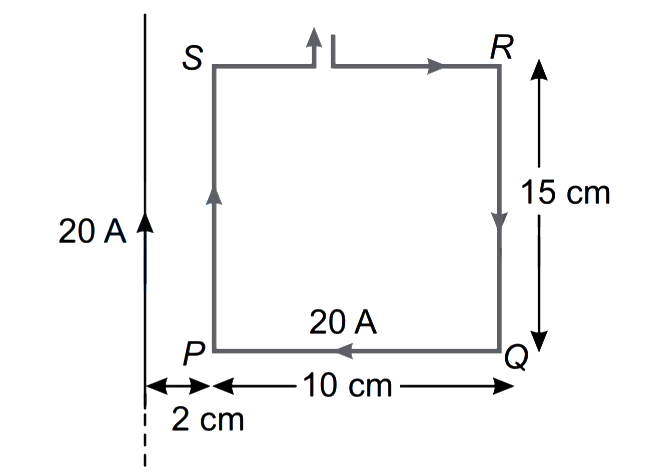 KCET 2008 Hard
 - The trajectory of projectile isKCET 2021 Easy