


KCET · Maths · Determinants
Let \(P(x, y)\) be the mid point of the line joining \((1,0)\) to a point on the curve \(\mathrm{y}^{2}=\left|\begin{array}{ll}\mathrm{x}+1 & \mathrm{x}+2 \\ \mathrm{x}+3 & \mathrm{x}+5\end{array}\right|\). Then, locus of \(\mathrm{P}\) is symmetrical about
- A \(y\)-axis
- B \(x\)-axis
- C \(\mathrm{x}=1\)
- D \(y=1\)
Answer & Solution
Correct Answer
(B) \(x\)-axis
Step-by-step Solution
Detailed explanation
The given curve \(\mathrm{y}^{2}=\left|\begin{array}{ll}\mathrm{x}+1 & \mathrm{x}+2 \\ \mathrm{x}+3 & \mathrm{x}+5\end{array}\right|\)
\(
\begin{aligned}
&\Rightarrow \quad \mathrm{y}^{2}=(\mathrm{x}+1)(\mathrm{x}+5)-(\mathrm{x}+2)(\mathrm{x}+3) \\
&\Rightarrow \quad \mathrm{y}^{2}=\mathrm{x}^{2}+6 \mathrm{x}+5-\mathrm{x}^{2}-5 \mathrm{x}-6 \\
&\quad \mathrm{y}^{2}=\mathrm{x}-1 \text { which is parabola. }
\end{aligned}
\)
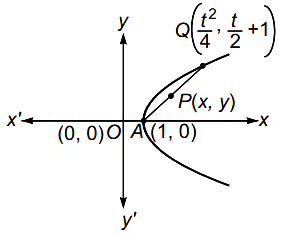
Let the parametric coordinate of parabola is
\(
\mathrm{Q}=\left(\frac{\mathrm{t}^{2}}{4}, \frac{\mathrm{t}}{2}+1\right)
\)
Now, given that \(\mathrm{P}(\mathrm{x}, \mathrm{y})\) is the mid point of \(\mathrm{AQ}\).
\(
P(x, y)=\left[\frac{\frac{t^{2}}{4}+1}{2}, \frac{\frac{t}{2}+1}{2}\right]
\)
\(
\begin{array}{ll}
\Rightarrow & \mathrm{x}=\frac{\mathrm{t}^{2}}{8}+\frac{1}{2} \Rightarrow 8 \mathrm{x}=\mathrm{t}^{2}+4 \\
\text { and } & \mathrm{y}=\frac{\mathrm{t}}{4}+\frac{1}{2} \Rightarrow \mathrm{t}=2(2 \mathrm{y}-1) \\
\Rightarrow & 8 \mathrm{x}=4(2 \mathrm{y}-1)^{2}+4 \\
\Rightarrow & 2 \mathrm{x}=(2 \mathrm{y}-1)^{2}+1 \\
\Rightarrow & (2 \mathrm{y}-1)^{2}=(2 \mathrm{x}-1) \\
\Rightarrow & 4\left(\mathrm{y}-\frac{1}{2}\right)^{2}=2\left(\mathrm{x}-\frac{1}{2}\right) \\
\Rightarrow & \left(\mathrm{y}-\frac{1}{2}\right)^{2}=\frac{1}{2}\left(\mathrm{x}-\frac{1}{2}\right)
\end{array}
\)
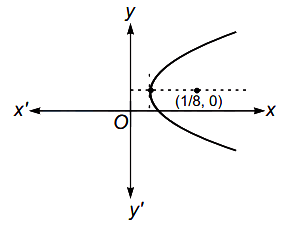
Which is also a parabola.
Hence, the locus of \(\mathrm{P}(\mathrm{x}, \mathrm{y})\) is symmetrical about \(x\)-axis ie, \(\mathrm{y}=0\) from figure.
\(
\begin{aligned}
&\Rightarrow \quad \mathrm{y}^{2}=(\mathrm{x}+1)(\mathrm{x}+5)-(\mathrm{x}+2)(\mathrm{x}+3) \\
&\Rightarrow \quad \mathrm{y}^{2}=\mathrm{x}^{2}+6 \mathrm{x}+5-\mathrm{x}^{2}-5 \mathrm{x}-6 \\
&\quad \mathrm{y}^{2}=\mathrm{x}-1 \text { which is parabola. }
\end{aligned}
\)
Let the parametric coordinate of parabola is
\(
\mathrm{Q}=\left(\frac{\mathrm{t}^{2}}{4}, \frac{\mathrm{t}}{2}+1\right)
\)
Now, given that \(\mathrm{P}(\mathrm{x}, \mathrm{y})\) is the mid point of \(\mathrm{AQ}\).
\(
P(x, y)=\left[\frac{\frac{t^{2}}{4}+1}{2}, \frac{\frac{t}{2}+1}{2}\right]
\)
\(
\begin{array}{ll}
\Rightarrow & \mathrm{x}=\frac{\mathrm{t}^{2}}{8}+\frac{1}{2} \Rightarrow 8 \mathrm{x}=\mathrm{t}^{2}+4 \\
\text { and } & \mathrm{y}=\frac{\mathrm{t}}{4}+\frac{1}{2} \Rightarrow \mathrm{t}=2(2 \mathrm{y}-1) \\
\Rightarrow & 8 \mathrm{x}=4(2 \mathrm{y}-1)^{2}+4 \\
\Rightarrow & 2 \mathrm{x}=(2 \mathrm{y}-1)^{2}+1 \\
\Rightarrow & (2 \mathrm{y}-1)^{2}=(2 \mathrm{x}-1) \\
\Rightarrow & 4\left(\mathrm{y}-\frac{1}{2}\right)^{2}=2\left(\mathrm{x}-\frac{1}{2}\right) \\
\Rightarrow & \left(\mathrm{y}-\frac{1}{2}\right)^{2}=\frac{1}{2}\left(\mathrm{x}-\frac{1}{2}\right)
\end{array}
\)
Which is also a parabola.
Hence, the locus of \(\mathrm{P}(\mathrm{x}, \mathrm{y})\) is symmetrical about \(x\)-axis ie, \(\mathrm{y}=0\) from figure.
See the Complete Solution
Get step-by-step explanations for this and 2.5 Lakh+ more JEE, NEET & CET questions.
- Unlock all solutions
- Practice the full chapter
- Track accuracy across PYQs
4.8 rated on Google Play · 14,000+ reviews
More questions from Maths
- If \(m\) and \(n\) are degree and order of \(\left(1+y_{1}^{2}\right)^{2 / 3}=y_{2}\), then the value of \(\frac{m+n}{m-n}\) isKCET 2011 Easy
- If \(y=e^{\log _{e}\left[1+x+x^{2}+\ldots\right]}\), then \(\frac{d y}{d x}\) is equal toKCET 2012 Easy
- Mean and standard deviation of \( 100 \) items are \( 50 \) and \( 4 \) respectively. The sum of all squares of
the items isKCET 2019 Medium - The value of \( \int_{2}^{8} \frac{\sqrt{10-x}}{\sqrt{x}+\sqrt{10-x}} d x \) isKCET 2016 Medium
- The area of a triangle with vertices \((-3,0)\), \((3,0)\) and \((0, k)\) is 9 sq units, find the value of \(k\) isKCET 2023 Easy
- The value of \( \int_{-\pi / 4}^{\pi / 4} \sin ^{103} x \cdot \cos ^{101} x \mathrm{~d} \mathrm{x} \) isKCET 2016 Easy
More PYQs from KCET
- A stone is thrown vertically upwards and the height \(x \mathrm{ft}\) reached by the stone in t seconds is given by \(x=80 t-16 t^{2}\). The stone reaches the maximum height inKCET 2008 Easy
- Moment of Inertia of a thin uniform rod rotating about the perpendicular axis passing through its centre is \( I \). If the same rod is bent into a ring and its moment of inertia about its diameter is \( I^{\prime} \) then the ratio \( \frac{I}{I^{\prime}} \) isKCET 2015 Easy
- If \( \vec{a}=\hat{i}+\lambda \hat{j}+2 \hat{k} ; \vec{b}=\mu \hat{i}+\hat{j}-\hat{k} \) are orthogonal and \( |\vec{a}|=|\vec{b}| \) then
\( (\lambda, \mu)= \)KCET 2018 Hard - Which of the following gases has the highest value of RMS velocity at \(298 \mathrm{~K}\) ?KCET 2013 Medium
- The species, though insignificant in number, determine the existence of many other species in a given ecosystem. Such species is known asKCET 2010 Medium
- The amino acid which is not optically active isKCET 2007 Medium