


KCET · Maths · Probability
A random experiment has five outcomes \(\mathrm{w}_1, \mathrm{w}_2, \mathrm{w}_3, \mathrm{w}_4\) and \(\mathrm{w}_5\). The probabilities of the occurrence of the outcomes \(\mathrm{w}_1, \mathrm{w}_2, \mathrm{w}_3, \mathrm{w}_4\) and \(\mathrm{w}_5\) are respectively \(\frac{1}{6}, \mathrm{a}, \mathrm{b}\) and \(\frac{1}{12}\) such that \(12 \mathrm{a}+12 \mathrm{~b}-1=0\). Then the probabilities of occurrence of the outcome \(w_3\) is
- A \(\frac{2}{3}\)
- B \(\frac{1}{3}\)
- C \(\frac{1}{6}\)
- D \(\frac{1}{12}\)
Answer & Solution
Correct Answer
(A) \(\frac{2}{3}\)
Step-by-step Solution
Detailed explanation
\(\begin{array}{ll}\mathrm{p}\left(\mathrm{w}_1\right)=\frac{1}{6} & \\ \mathrm{p}\left(\mathrm{w}_2\right)=\mathrm{a} & \Rightarrow \frac{1}{6}+\mathrm{a}+\mathrm{b}+\mathrm{x}+\frac{1}{12}=1 \\ \mathrm{p}\left(\mathrm{w}_3\right)=\mathrm{b} & \Rightarrow 12(\mathrm{a}+\mathrm{b}+\mathrm{x})=9 \\ \mathrm{p}\left(\mathrm{w}_4\right)=\mathrm{c} & \Rightarrow \mathrm{a}+\mathrm{b}+\mathrm{x}=\frac{3}{4} \\ \mathrm{p}\left(\mathrm{w}_5\right)=\frac{1}{12} & \Rightarrow \frac{1}{12}+\mathrm{x}=\frac{3}{4} \Rightarrow \mathrm{x}=\frac{2}{3}\end{array}\)
See the Complete Solution
Get step-by-step explanations for this and 2.5 Lakh+ more JEE, NEET & CET questions.
- Unlock all solutions
- Practice the full chapter
- Track accuracy across PYQs
4.8 rated on Google Play · 14,000+ reviews
More questions from Maths
- The vectors \(\mathbf{A B}=3 \hat{\mathbf{i}}+4 \hat{\mathbf{k}}\) and \(\mathbf{A C}=5 \hat{\mathbf{i}}-2 \hat{\mathbf{j}}+4 \hat{\mathbf{k}}\) are the sides of a \(\triangle A B C\), The length of the median through \(A\) isKCET 2024 Easy
- Let \(P(x, y)\) be the mid point of the line joining \((1,0)\) to a point on the curve \(\mathrm{y}^{2}=\left|\begin{array}{ll}\mathrm{x}+1 & \mathrm{x}+2 \\ \mathrm{x}+3 & \mathrm{x}+5\end{array}\right|\). Then, locus of \(\mathrm{P}\) is symmetrical aboutKCET 2010 Medium
- The function \(f(x)=\left\{\begin{array}{ll}e^x+a x & , x \lt 0 \\ b(x-1)^2 & , \quad x \geq 0\end{array}\right.\) is differentiable at \(x=0\). ThenKCET 2025 Medium
- The set of real values of \(x\) for which \(f(x)=\frac{x}{\log x}\) is increasing, isKCET 2010 Easy
- \(2 \cos ^{-1} x=\sin ^{-1}\left(2 x \sqrt{1-x^2}\right)\) is valid for all values of ' \(x\) ' satisfyingKCET 2025 Medium
- The differential equation of the family of circles passing through the orign and having their centres on the \(x\)-axis isKCET 2009 Medium
More PYQs from KCET
- An aromatic compound ' \( \mathrm{A} \) ' \( \left(\mathrm{C}_{7} \mathrm{H}_{9} \mathrm{~N}\right) \) on reacting with \( \mathrm{NaNO}_{2} / \mathrm{HCl} \) at \( 0^{\circ} \mathrm{C} \) forms benzyl
alcohol and nitrogen gas. The number of isomers possible for the compound ' \( A \) ' isKCET 2014 Easy - In which of the following cases a chemical reaction is possible?KCET 2020 Easy
- For the reversible reaction.
\(\mathrm{A}(\mathrm{s})+\mathrm{B}(\mathrm{g}) \rightleftharpoons \mathrm{C}(\mathrm{g})+\mathrm{D}(\mathrm{g});\)
\(\Delta \mathrm{G}^{\circ}=-350 \mathrm{~kJ}\)
Which one of the following statements is true?KCET 2010 Easy - Identify \({ }^{\prime} C^{\circ}\) in the following
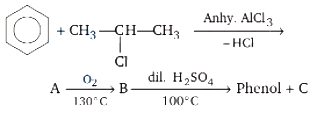 KCET 2012 Medium
 - If \( \mathrm{P}=\left|\begin{array}{ll}x & 1 \\ 1 & x\end{array}\right| \) and \( \mathrm{Q}=\left|\begin{array}{lll}x & 1 & 1 \\ 1 & x & 1 \\ 1 & 1 & x\end{array}\right| \),then \( \frac{d Q}{d x}= \)KCET 2015 Medium
- The diagram given below represents the history of a striped muscle. Label the parts A, B, C, D, E and F.
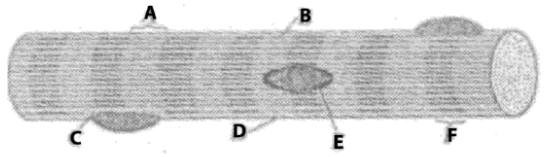 KCET 2011 Easy