


KCET · Maths · Trigonometric Ratios & Identities
\(\sqrt{2+\sqrt{2+\sqrt{2+2 \cos 8 \theta}}}=\)
- A \(\sin 2 \theta\)
- B \(2 \cos \theta\)
- C \(2 \sin \theta\)
- D \(2 \cos \frac{\theta}{2}\)
Answer & Solution
Correct Answer
(B) \(2 \cos \theta\)
Step-by-step Solution
Detailed explanation
Let \(y=\sqrt{2+\sqrt{2+\sqrt{2+2 \cos 8 \theta}}}\)
We know, \(1+\cos 2 A=2 \cos ^2 A\)
Therefore, \(y=\sqrt{2+\sqrt{2+\sqrt{2 \cdot(1+\cos 8 \theta)}}}\)
\[
\begin{aligned}
& =\sqrt{2+\sqrt{2+\sqrt{2 \cdot 2 \cos ^2 4 \theta}}} \\
& =\sqrt{2+\sqrt{2+2 \cos 4 \theta}}=\sqrt{2+\sqrt{2 \cdot 2 \cos ^2 2 \theta}} \\
& =\sqrt{2+2 \cos 2 \theta}=\sqrt{2 \cdot 2 \cos ^2 \theta}=2 \cos \theta
\end{aligned}
\]
We know, \(1+\cos 2 A=2 \cos ^2 A\)
Therefore, \(y=\sqrt{2+\sqrt{2+\sqrt{2 \cdot(1+\cos 8 \theta)}}}\)
\[
\begin{aligned}
& =\sqrt{2+\sqrt{2+\sqrt{2 \cdot 2 \cos ^2 4 \theta}}} \\
& =\sqrt{2+\sqrt{2+2 \cos 4 \theta}}=\sqrt{2+\sqrt{2 \cdot 2 \cos ^2 2 \theta}} \\
& =\sqrt{2+2 \cos 2 \theta}=\sqrt{2 \cdot 2 \cos ^2 \theta}=2 \cos \theta
\end{aligned}
\]
See the Complete Solution
Get step-by-step explanations for this and 2.5 Lakh+ more JEE, NEET & CET questions.
- Unlock all solutions
- Practice the full chapter
- Track accuracy across PYQs
4.8 rated on Google Play · 14,000+ reviews
More questions from Maths
- If \(\overrightarrow{\mathbf{a}} \cdot \overrightarrow{\mathbf{b}}=-|\overrightarrow{\mathbf{a}}||\overrightarrow{\mathbf{b}}|\), then the angle between \(\overrightarrow{\mathbf{a}}\) and \(\vec{b}\) isKCET 2009 Easy
- Match the following:
In the following, \([\mathrm{x}]\) denotes the greatest integer less than or equal to x .
\begin{array}{|l|l|l|l|}\hline & \text{Column - I} & & \text{Column - II} \\\hline \text{a}. & \mathrm{x}|\mathrm{x}| & \text{(i)} & \text {continuous in (-1, 1)} \\\hline \text{b.} & \sqrt{|\mathrm{x}|} & \text{(ii)} & \text{differentiable in (-1, 1)} \\\hline \text{c.} & \mathrm{x}+[\mathrm{x}] & \text{(iii)} & \text{strictly increasing in (-1, 1)} \\\hline \text{d.} & |\mathrm{x}-1|+|\mathrm{x}+1| & \text{(iv)} & \text{not differentiable at, at least one point in (-1, 1)} \\\hline\end{array}KCET 2025 Medium - \(\int \frac{\mathrm{dx}}{\mathrm{x}^2\left(\mathrm{x}^4+1\right)^{3 / 4}}\) equalsKCET 2025 Medium
- The value of \(\mid \frac{1+i \sqrt{3}}{\left(1+\frac{1}{i+1}\right)^{2}}\) isKCET 2011 Medium
- If \(f(x)=\left|\begin{array}{ccc}x^{3}-x & a+x & b+x \\ x-a & x^{2}-x & c+x \\ x-b & x-c & 0\end{array}\right|\), thenKCET 2020 Medium
- If the standard deviation of the numbers -1 , \(0,1, k\) is \(\sqrt{5}\) where \(k>0\), then \(k\) is equal toKCET 2022 Easy
More PYQs from KCET
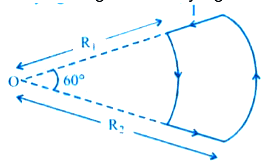
- A conducting wire carrying current is arranged as shown. The magnetic field at ' \( O \) '
 KCET 2016 Hard
 - The value of \( \int \frac{e^{x}(1+x) d x}{\cos ^{2}\left(e^{x} \cdot x\right)} \) is equal toKCET 2016 Medium
- The radius of the Earth is \( 6400 \mathrm{~km} \). If the height of the antenna is \( 500 \mathrm{~m} \) then its range isKCET 2018 Easy
- A gas can be taken from A to B via two different paths ACB and ADB.

When path ACB is used, \(60\) J of heat flows into the system and \(30\) J of work is done by the system. If path ADB is used, work done by the system is \(10\) J.
The heat flow into the system in path ADB isKCET 2026 Medium - In a typical heart, if EDV is 120 mL of blood and ESV is 50 mL of blood, the stroke volume (SV) isKCET 2011 Easy
- In the ionic equation
\(-\mathrm{BiO}_{3}^{-}+6 \mathrm{H}^{+}+x e^{-} \longrightarrow \mathrm{Bi}^{3+}+3 \mathrm{H}_{2} \mathrm{O}, \quad\) the values of \(x\) isKCET 2007 Easy