


KCET · Chemistry · Coordination Compounds
Which one of the following is wrongly matched?
- A \(\left[\mathrm{Cu}\left(\mathrm{NH}_{3}\right)_{4}\right]^{2+} \quad-\) Square planar
- B \(\left[\mathrm{Ni}(\mathrm{CO})_{4}\right] \quad-\) Neutral ligand
- C \(\left[\mathrm{Fe}\left(\mathrm{CN}_{6}\right)^{3-}\right] \quad-\mathrm{sp}^{3} \mathrm{~d}^{2}\)
- D \(\left[\mathrm{Co}(\mathrm{en})_{3}\right]^{3+} \quad-\) Follows EAN rule
Answer & Solution
Correct Answer
(C) \(\left[\mathrm{Fe}\left(\mathrm{CN}_{6}\right)^{3-}\right] \quad-\mathrm{sp}^{3} \mathrm{~d}^{2}\)
Step-by-step Solution
Detailed explanation
(a) In \(\left[\mathrm{Cu}\left(\mathrm{NH}_{3}\right)_{4}\right]^{2+}, \mathrm{Cu}\) is present as \(\mathrm{Cu}^{2+}\)
\(
\mathrm{Cu}^{2+}=[\mathrm{Ar}] 3 \mathrm{~d}^{9} 4 \mathrm{~s}^{0}
\)
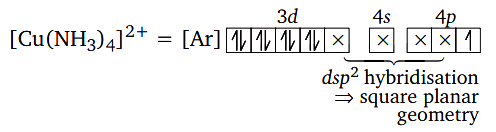
\(\left(\mathrm{NH}_{3}\right.\) being a strong field ligand shifts one electron from \(3 \mathrm{~d}\) orbital to \(4 \mathrm{p}\) orbital.)
(b) \(\mathrm{In}\left[\mathrm{Ni}(\mathrm{CO})_{4}\right], \mathrm{CO}\) is a neutral ligand.
(c) \(\mathrm{In}\left[\mathrm{Fe}(\mathrm{CN})_{6}\right]^{3-}\), Fe is present as \(\mathrm{Fe}^{3+}\).
\(
\begin{aligned}
&\mathrm{Fe}^{3+}=[\mathrm{Ar}] 3 \mathrm{~d}^{5} 4 \mathrm{~s}^{0} \\
&{\left[\mathrm{Fe}(\mathrm{CN})_{6}\right]^{3-}=[\mathrm{Ar}]}
\end{aligned}
\)
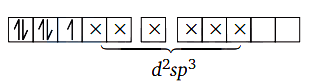
Thus, its hybridisation is \(\mathrm{d}^{2} \mathrm{sp}^{3}\) not \(\mathrm{sp}^{3} \mathrm{~d}^{2}\), ie, it is an inner orbital complex.
(d) \(\left[\operatorname{Co}(\mathrm{en})_{3}\right]^{3+}\) contains total 36 electrons, ie, follows EAN rule.
\(
\mathrm{Cu}^{2+}=[\mathrm{Ar}] 3 \mathrm{~d}^{9} 4 \mathrm{~s}^{0}
\)
\(\left(\mathrm{NH}_{3}\right.\) being a strong field ligand shifts one electron from \(3 \mathrm{~d}\) orbital to \(4 \mathrm{p}\) orbital.)
(b) \(\mathrm{In}\left[\mathrm{Ni}(\mathrm{CO})_{4}\right], \mathrm{CO}\) is a neutral ligand.
(c) \(\mathrm{In}\left[\mathrm{Fe}(\mathrm{CN})_{6}\right]^{3-}\), Fe is present as \(\mathrm{Fe}^{3+}\).
\(
\begin{aligned}
&\mathrm{Fe}^{3+}=[\mathrm{Ar}] 3 \mathrm{~d}^{5} 4 \mathrm{~s}^{0} \\
&{\left[\mathrm{Fe}(\mathrm{CN})_{6}\right]^{3-}=[\mathrm{Ar}]}
\end{aligned}
\)
Thus, its hybridisation is \(\mathrm{d}^{2} \mathrm{sp}^{3}\) not \(\mathrm{sp}^{3} \mathrm{~d}^{2}\), ie, it is an inner orbital complex.
(d) \(\left[\operatorname{Co}(\mathrm{en})_{3}\right]^{3+}\) contains total 36 electrons, ie, follows EAN rule.
See the Complete Solution
Get step-by-step explanations for this and 2.5 Lakh+ more JEE, NEET & CET questions.
- Unlock all solutions
- Practice the full chapter
- Track accuracy across PYQs
4.8 rated on Google Play · 14,000+ reviews
More questions from Chemistry
- Which of the following pair contains \( 2 \) lone pair of electrons on the central atom?KCET 2019 Easy
- Which of the following will not act as an oxidising agent?KCET 2026 Medium
- Cryolite isKCET 2015 Hard
- The heating of phenyl methyl ether with HI produces an aromatic compound \(A\) which on treatment with conc. \(\mathrm{HNO}_3\) gives \(B . A\) and \(B\) respectively areKCET 2023 Medium
- Which of the following is not a biodegradablepolymer?KCET 2017 Hard
- Which among the following has highest \(\mathrm{pH}\) ?KCET 2022 Easy
More PYQs from KCET
- The ratio of minimum wavelengths of Lyman and Balmer series will beKCET 2008 Medium
- If \(\mathbf{a}=2 \hat{\mathbf{i}}+3 \hat{\mathbf{j}}-\hat{\mathbf{k}}, \mathbf{b}=\hat{\mathbf{i}}+2 \hat{\mathbf{j}}-5 \mathbf{k}\), \(\mathbf{c}=3 \hat{\mathbf{i}}+5 \hat{\mathbf{j}}-\hat{\mathbf{k}}\), then a vector perpendicular to \(\mathbf{a}\) and in the plane containing \(\mathbf{b}\) and \(\mathbf{c}\) isKCET 2007 Hard
- The TCA cycle starts with the condensation of acetyl group withKCET 2025 Hard
- In the following equation of Verhulst-Pearl logistic growth, the letter 'r' denotes __________
\(\frac{ dN }{ dt }= rN \left[\frac{ K - N }{ K }\right]\)KCET 2020 Hard - \(\left(\mathrm{NH}_4\right)_2 \mathrm{Cr}_2 \mathrm{O}_7\) on heating liberates a gas. The same gas will be obtained byKCET 2022 Hard
- The \(\mathrm{pH}\) of \(10^{-8} \mathrm{M} \mathrm{HCl}\) solution isKCET 2013 Hard