


KCET · Chemistry · Redox Reactions
Which of the following statement is correct?
- A \( \mathrm{F}_{2} \) oxidises \( \mathrm{H}_{2} \mathrm{O} \) to \( \mathrm{O}_{2} \) but \( \mathrm{Cl}_{2} \) does not
- B Fluoride is a good oxidizing agent
- C \( \mathrm{Cl}_{2} \) oxidises \( \mathrm{H}_{2} \mathrm{O} \) to \( \mathrm{O}_{2} \) but \( \mathrm{F}_{2} \) does not
- D \( \mathrm{Cl}_{2} \) is a stronger oxidizing agent than \( \mathrm{F}_{2} \)
Answer & Solution
Correct Answer
(A) \( \mathrm{F}_{2} \) oxidises \( \mathrm{H}_{2} \mathrm{O} \) to \( \mathrm{O}_{2} \) but \( \mathrm{Cl}_{2} \) does not
Step-by-step Solution
Detailed explanation
(A)
\[
\begin{array}{l}
2 \mathrm{~F}_{2(g)}+2 \mathrm{H}_{2} \mathrm{O}_{(1)} \rightarrow 4 \mathrm{H}_{(a q)}+4 \mathrm{~F}_{(a q)}{ }^{-}+\mathrm{O}_{2(g)} \\
\mathrm{X}_{2(g)}+\mathrm{H}_{2} \mathrm{O}_{(l)} \rightarrow \mathrm{HX}_{(a q)}+\mathrm{HOX}_{(a q)}
\end{array}
\]
\[
\begin{array}{l}
2 \mathrm{~F}_{2(g)}+2 \mathrm{H}_{2} \mathrm{O}_{(1)} \rightarrow 4 \mathrm{H}_{(a q)}+4 \mathrm{~F}_{(a q)}{ }^{-}+\mathrm{O}_{2(g)} \\
\mathrm{X}_{2(g)}+\mathrm{H}_{2} \mathrm{O}_{(l)} \rightarrow \mathrm{HX}_{(a q)}+\mathrm{HOX}_{(a q)}
\end{array}
\]
See the Complete Solution
Get step-by-step explanations for this and 2.5 Lakh+ more JEE, NEET & CET questions.
- Unlock all solutions
- Practice the full chapter
- Track accuracy across PYQs
4.8 rated on Google Play · 14,000+ reviews
More questions from Chemistry
- Which of the following is not a green house gas?KCET 2020 Easy
- In the detection of II group acid radical, the salt containing chloride is treated with concentrated sulphuric acid, the colourless gas is liberated. The name of the gas isKCET 2021 Medium
- 1 mole of \(\mathrm{HI}\) is heated in a closed container of capacity of \(2 \mathrm{~L}\). At equilibrium half a mole of \(\mathrm{HI}\) is dissociated.
The equilibrium constant of the reaction isKCET 2022 Medium - Which formula and its name combination is incorrect?KCET 2025 Medium
- Benzene carbaldehyde is reacted with concentrated \( \mathrm{NaOH} \) solution to give the products \( \mathrm{A} \) and
B. The product \( A \) can be used food preservative and the product \( B \) is an aromatic hydroxy
compound where \( \mathrm{OH} \) gorup is linked to \( s p^{3} \) hybridised carbon atom next to Benzene ring. The
products \( A \) and \( B \) are respectively,KCET 2016 Hard - Which complex cannot ionise in solution?KCET 2007 Easy
More PYQs from KCET
- Evaluate \(\int_2^3 x^2 d x\) as the limit of a sumKCET 2022 Easy
- For spontaneity of a cell, which is correct?KCET 2022 Easy
- In Wheatstones network \( P=2 \Omega, Q=2 \Omega, R=2 \Omega \) and \( S=3 \Omega \). The resistance with which \( S \) is to shunted in order that the bridge may be balanced isKCET 2015 Medium
- Figure shows three points \(A, B\) and \(C\) in a region of uniform electric field \(\mathbf{E}\). The line \(A B\) is perpendicular and \(B C\) is parallel to the field lines. Then, which of the following holds good ? \(\left(V_{A}, V_{B}\right.\) and \(V_{C}\) represent the electric potential at points \(A, B\) and \(C\), respectively)
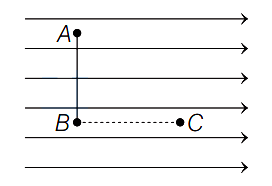 KCET 2020 Easy
 - The sine of the angle between the straight line \(\frac{x-2}{2}=\frac{y-3}{4}=\frac{4-z}{2}\) are the plane \(2 x-2 y+z=5\) isKCET 2024 Easy
- Which one of the following gives amine on heating with amide?KCET 2013 Medium