


KCET · Chemistry · d and f Block Elements
Identify the set of paramagnetic ions among the following.
- A \(\mathrm{V}^{2+}, \mathrm{Co}^{2+}, \mathrm{Ti}^{4+}\)
- B \(\mathrm{Ni}^{2+}, \mathrm{Cu}^{2+}, \mathrm{Zn}^{2+}\)
- C \(\mathrm{Ti}^{2+}, \mathrm{Cu}^{2+}, \mathrm{Mn}^{3+}\)
- D \(\mathrm{Sc}^{3+}, \mathrm{Ti}^{3+}, \mathrm{V}^{3+}\)
Answer & Solution
Correct Answer
(C) \(\mathrm{Ti}^{2+}, \mathrm{Cu}^{2+}, \mathrm{Mn}^{3+}\)
Step-by-step Solution
Detailed explanation
Out of the given four options, the following set of ions is paramagnetic : \(\mathrm{Ti}^{2+}, \mathrm{Cu}^{2+}, \mathrm{Mn}^{3+}\) \(\mathrm{Ti} \rightarrow 4 s^{2}, 3 d^{2}\) (ground state) \(\mathrm{Ti}^{2+} \rightarrow 3 d^{2} \rightarrow\) 2 unpaired electrons.
\(\mathrm{Cu} \rightarrow 4 s^{1}, 3 d^{10}\) (ground state) \(\mathrm{Cu}^{2+} \rightarrow 3 d^{9} \rightarrow\) 1 unpaired electrons.
\(\mathrm{Mn} \rightarrow 4 s^{2}, 3 d^{5}\) (ground state) \(\mathrm{Mn}^{3+} \rightarrow 3 d^{4} \rightarrow\) 4 unpaired electrons.
A substance is called paramagnetic if it contains at least one unpaired electron.
\(\mathrm{Cu} \rightarrow 4 s^{1}, 3 d^{10}\) (ground state) \(\mathrm{Cu}^{2+} \rightarrow 3 d^{9} \rightarrow\) 1 unpaired electrons.
\(\mathrm{Mn} \rightarrow 4 s^{2}, 3 d^{5}\) (ground state) \(\mathrm{Mn}^{3+} \rightarrow 3 d^{4} \rightarrow\) 4 unpaired electrons.
A substance is called paramagnetic if it contains at least one unpaired electron.
See the Complete Solution
Get step-by-step explanations for this and 2.5 Lakh+ more JEE, NEET & CET questions.
- Unlock all solutions
- Practice the full chapter
- Track accuracy across PYQs
4.8 rated on Google Play · 14,000+ reviews
More questions from Chemistry
- In the sequence of following reactions :

the sarting compound ' \( P \) ' isKCET 2015 Hard - The statement that is NOT correct isKCET 2014 Hard
- Which one of the following gases converts haemoglobin into carboxy haemoglobin?KCET 2023 Easy
- The highest oxidation state of manganese in fluoride is \(+4\) (\(\text{MnF}_4\)), but the highest oxidation state in oxides is \(+7\) (\(\text{Mn}_2\text{O}_7\)), becauseKCET 2026 Medium
- The order of stability of metal oxides isKCET 2009 Easy
- A complex compound in which the oxidation number of a metal is zero isKCET 2008 Easy
More PYQs from KCET
- If is a complex number such that \(\mathrm{z}=-\overline{\mathrm{z}}\), thenKCET 2008 Easy
- In the following network potential at 'O'
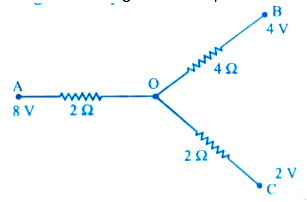 KCET 2016 Easy
 - If \(f(\mathrm{l})=1, f^{\prime}(\mathrm{l})=3\), then the derivative of \(f(f(f(x)))+(f(x))^2\) at \(x=1\) isKCET 2022 Hard
- In the reaction,
\(\begin{aligned} 2 \mathrm{FeSO}_{4}+\mathrm{H}_{2} \mathrm{SO}_{4}+\mathrm{H}_{2} \mathrm{O}_{2} & \longrightarrow \\ & \mathrm{Fe}_{2}\left(\mathrm{SO}_{4}\right)_{3}+2 \mathrm{H}_{2} \mathrm{O} \end{aligned}\)
the oxidising agent isKCET 2013 Medium - If a ball is thrown vertically upwards and the height ' \(\mathrm{s}\) ' reached in time ' \(\mathrm{t}\) ' is given by \(s=22 t-11 t^{2}\), then the total distance travelled by the ball isKCET 2012 Easy
- The probability of solving a problem by three persons \(A, B\) and \(C\) independently is \(\frac{1}{2}, \frac{1}{4}\) and \(\frac{1}{3}\) respectively. Then the probability of the problem is solved by any two of them isKCET 2020 Medium