


KCET · Chemistry · Electrochemistry
How many coulombs are required to oxidise 0.1 mole of \(\mathrm{H}_2 \mathrm{O}\) to oxygen?
- A \(1.93 \times 10^5 \mathrm{C}\)
- B \(1.93 \times 10^4 \mathrm{C}\)
- C \(3.86 \times 10^4 \mathrm{C}\)
- D \(9.65 \times 10^3 \mathrm{C}\)
Answer & Solution
Correct Answer
(B) \(1.93 \times 10^4 \mathrm{C}\)
Step-by-step Solution
Detailed explanation
The reaction involved is a follows
\(\mathrm{H}_2 \mathrm{O} \longrightarrow \mathrm{H}_2+\frac{1}{2} \mathrm{O}_2+2 e^{-}\)
So, from the equation it is clear that 1 mole of \(\mathrm{H}_2 \mathrm{O}\) required 2 Faradays \(=2 \times 96500 \mathrm{C}\)
So, 0.1 mole of \(\mathrm{H}_2 \mathrm{O}\) will require \(=\frac{2 \times 96500 \times 0.1}{1}\)
\(\begin{aligned} & =19300 \mathrm{C} \\ & =1.93 \times 10^4 \mathrm{C}\end{aligned}\)
\(\mathrm{H}_2 \mathrm{O} \longrightarrow \mathrm{H}_2+\frac{1}{2} \mathrm{O}_2+2 e^{-}\)
So, from the equation it is clear that 1 mole of \(\mathrm{H}_2 \mathrm{O}\) required 2 Faradays \(=2 \times 96500 \mathrm{C}\)
So, 0.1 mole of \(\mathrm{H}_2 \mathrm{O}\) will require \(=\frac{2 \times 96500 \times 0.1}{1}\)
\(\begin{aligned} & =19300 \mathrm{C} \\ & =1.93 \times 10^4 \mathrm{C}\end{aligned}\)
See the Complete Solution
Get step-by-step explanations for this and 2.5 Lakh+ more JEE, NEET & CET questions.
- Unlock all solutions
- Practice the full chapter
- Track accuracy across PYQs
4.8 rated on Google Play · 14,000+ reviews
More questions from Chemistry
- Critical Micelle concentration for a soap solution is \( 1.5 \times 10^{-4} \mathrm{~mol} L^{-1} \). Micelle formation is
possible only when the concentration of soap solution in \( \mathrm{mol} L^{-1} \) isKCET 2019 Medium - Out of the compounds below the vapour pressure of (B) at a particular temperature is
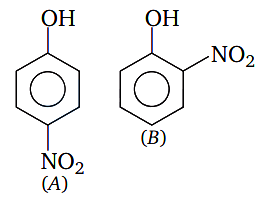 KCET 2010 Medium
 - Consider the following gaseous equilibria with equilibrium constants \(\mathrm{K}_{1}\) and \(\mathrm{K}_{2}\) respectively.
\(\begin{aligned} \mathrm{SO}_{2}(\mathrm{~g})+& \frac{1}{2} \mathrm{O}_{2}(\mathrm{~g}) \rightleftharpoons \mathrm{SO}_{3}(\mathrm{~g}) \\ 2 \mathrm{SO}_{3}(g) & \rightleftharpoons 2 \mathrm{SO}_{2}(g)+\mathrm{O}_{2}(g) \end{aligned}\)
The equilibrium constants are related asKCET 2010 Medium - The IUPAC name of \(\left[\mathrm{Co}\left(\mathrm{NH}_{3}\right)_{5} \mathrm{ONO}\right]^{2+}\) ion isKCET 2009 Easy
- Adenosine is an example ofKCET 2015 Easy
- The enthalpy of vaporization of benzene is \(+35.3 \mathrm{~kJ} / \mathrm{mol}\) at its boiling point, \(80^{\circ} \mathrm{C}\). The entropy change in the transition of vapour to liquid at its boiling point isKCET 2011 Medium
More PYQs from KCET
- A car is moving in a circular horizontal track of radius \(10 \mathrm{~m}\) with a constant speed of \(10 \mathrm{~ms}^{-1}\). A bob is suspended from the roof of the car by a light wire of length \(1.0 \mathrm{~m}\). The angle made by the wire with the vertical is (in rad)KCET 2022 Medium
- A physical quantity \( \mathrm{Q} \) is found to depend on observable \( \mathrm{x}, \mathrm{y} \) and \( \mathrm{z} \), obeying relation \( Q=\frac{x^{3} y^{2}}{z} \). The percentage error in the measurements of \( x, y \) and \( z \) are \( 1 \%, 2 \% \) and \( 4 \% \) respectively. What is percentage error in the quantity \( \mathrm{Q} \) ?KCET 2014 Medium
- Amplitude modulation hasKCET 2015 Easy
- Which of the following has the lowest boiling point?KCET 2020 Medium
- \(7^{2 \log _{7} 5}\) is equal toKCET 2007 Easy
- A dietician has to develop a special diet using two foods \(X\) and \(Y\). Each packet (containing \(30 \mathrm{~g}\) ) of food. \(X\) contains 12 units of calcium, 4 units of iron, 6 units of cholesterol and 6 units of vitamin A. Each packet of the same quantity of food \(Y\) contains 3 units of calcium, 20 units of iron, 4 units of cholesterol and 3 units of vitamin A. The diet requires at least 240 units of calcium, atleast 460 units of iron and atmost 300 units of cholesterol. The corner points of the feasible region areKCET 2022 Hard