


KCET · Chemistry · Electrochemistry
Given: \( E_{M n^{+7}}^{0} \mid M n^{+2}=1.5 \mathrm{~V} \) and \( E_{M n^{+4}}^{0} \mid M n^{+2}=1.2 \mathrm{~V} \), then \( E_{M n^{+7}}^{0} \mid M n^{+4} \) is
- A \( 1.7 \mathrm{~V} \)
- B \( 2.1 \mathrm{~V} \)
- C \( 0.3 \mathrm{~V} \)
- D \( 0.1 \mathrm{~V} \)
Answer & Solution
Correct Answer
(A) \( 1.7 \mathrm{~V} \)
Step-by-step Solution
Detailed explanation
(A)
\(M n^{+7}+5 e^{-} \rightarrow M n^{2+}\)
\(\Delta G^{0}=-n \mathrm{FE}^{0} \Rightarrow \Delta \mathrm{G}^{0}=-5 \mathrm{~F} 1.5\)
\(M n^{+4}+2 e^{-} \rightarrow M n^{2+}\)
\(\Delta \mathrm{G}^{0}=-2 \mathrm{~F} 1.2\)
Required equation
\(M n^{+7}+3 e^{-} \rightarrow M n^{4+}\)
\(\Delta \mathrm{G}^{0}=-3 \mathrm{FE}^{0}\)
\(\therefore-3 \mathrm{FE}^{0}=-7.5 \mathrm{~F}+2.4 \mathrm{~F}\)
\(\therefore \mathrm{E}^{0}=1.7 \mathrm{~V}\)
\(M n^{+7}+5 e^{-} \rightarrow M n^{2+}\)
\(\Delta G^{0}=-n \mathrm{FE}^{0} \Rightarrow \Delta \mathrm{G}^{0}=-5 \mathrm{~F} 1.5\)
\(M n^{+4}+2 e^{-} \rightarrow M n^{2+}\)
\(\Delta \mathrm{G}^{0}=-2 \mathrm{~F} 1.2\)
Required equation
\(M n^{+7}+3 e^{-} \rightarrow M n^{4+}\)
\(\Delta \mathrm{G}^{0}=-3 \mathrm{FE}^{0}\)
\(\therefore-3 \mathrm{FE}^{0}=-7.5 \mathrm{~F}+2.4 \mathrm{~F}\)
\(\therefore \mathrm{E}^{0}=1.7 \mathrm{~V}\)
See the Complete Solution
Get step-by-step explanations for this and 2.5 Lakh+ more JEE, NEET & CET questions.
- Unlock all solutions
- Practice the full chapter
- Track accuracy across PYQs
4.8 rated on Google Play · 14,000+ reviews
More questions from Chemistry
- Which of the following is a network crystalline solid?KCET 2019 Easy
- Compounds \(P\) and \(R\) in the following reaction are
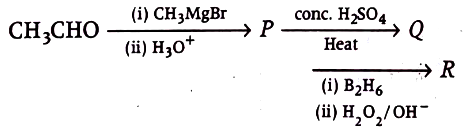 KCET 2023 Hard
 - Consider the following gaseous equilibria with equilibrium constants \(K_{1}\) and \(K_{2}\) respectively,
\[
\begin{aligned}
&\mathrm{SO}_{2}(g)+\frac{1}{2} \mathrm{O}_{2}(g) \rightleftharpoons \mathrm{SO}_{3}(g) \\
&2 \mathrm{SO}_{3}(g) \rightleftharpoons 2 \mathrm{SO}_{2}(g)+\mathrm{O}_{2}(g)
\end{aligned}
\]
The equilibrium constants are related asKCET 2011 Easy - The order of stability of metal oxides isKCET 2009 Easy
- Which of the following is not a colligative property?KCET 2016 Easy
- Phenol can be distinguished from ethanol by the reagentKCET 2018 Easy
More PYQs from KCET
- Three resistances \( 2 \Omega, 3 \Omega \) and \( 4 \Omega \) are connected in parallel. The ratio of currents passing through them when a potential difference is applied across its ends will beKCET 2015 Easy
- The number of ATP produced when a molecule of glucose undergoes fermentation isKCET 2011 Easy
- The hydrolysis of optically active \( 2 \)-bromobutane with aqueous \( \mathrm{NaOH} \) result in the formation ofKCET 2015 Easy
- The ratio of hydraulic stress to the corresponding strain is known asKCET 2015 Easy
- Match List-I with List-II and select the correct option:
\begin{array}{|l|l|l|l|}\hline & \text{List-I (Molecule / ion} & & \text{List-II (Bond order)} \\\hline \text{1}. & \text{NO} & \text{(i)} & \text {15} \\\hline \text{2.} & \text{CO} & \text{(ii)} & \text{2.0} \\\hline \text{3.} & \mathrm{O}_2^{-} & \text{(iii)} & \text{2.5} \\\hline \text{4.} & \mathrm{O}_2 & \text{(iv)} & \text{3.0} \\\hline\end{array}KCET 2025 Medium - If \(\overrightarrow{\mathbf{a}} \cdot \hat{\mathbf{i}}=\overrightarrow{\mathbf{a}} \cdot(\hat{\mathbf{i}}+\hat{\mathbf{j}})=\overrightarrow{\mathbf{a}} \cdot(\hat{\mathbf{i}}+\hat{\mathbf{j}}+\hat{\mathbf{k}})=1\) then \(\overrightarrow{\mathbf{a}}\) is equal toKCET 2008 Medium