


KCET · Chemistry · Chemical Kinetics
For a 1st order change \(R \rightarrow P\), the concentration of Reactant R changes from \(0.1\) M to \(0.025\) M in \(40\) minutes. The rate of reaction when the concentration of R is \(0.01\) M is ____
- A \(1.73 \times 10^{-5}\text{ M min}^{-1}\)
- B \(3.47 \times 10^{-4}\text{ M min}^{-1}\)
- C \(3.47 \times 10^{-5}\text{ M min}^{-1}\)
- D \(1.73 \times 10^{-4}\text{ M min}^{-1}\)
Answer & Solution
Correct Answer
(B) \(3.47 \times 10^{-4}\text{ M min}^{-1}\)
Step-by-step Solution
Detailed explanation
The concentration of the reactant changes from \(0.1\text{ M}\) to \(0.025\text{ M}\), which is \(\dfrac{1}{4}\) of the initial concentration.
This corresponds to \(2\) half-lives.
\(2 t_{1/2} = 40\text{ min} \Rightarrow t_{1/2} = 20\text{ min}\)
The rate constant \(k\) for a first-order reaction is:
\(k = \dfrac{0.693}{t_{1/2}} = \dfrac{0.693}{20} = 0.03465\text{ min}^{-1}\)
The rate of reaction when \([R] = 0.01\text{ M}\) is:
\(\text{Rate} = k[R]\)
\(\text{Rate} = 0.03465 \times 0.01 = 3.465 \times 10^{-4}\text{ M min}^{-1}\)
\(\text{Rate} \approx 3.47 \times 10^{-4}\text{ M min}^{-1}\)
Answer: \(3.47 \times 10^{-4}\text{ M min}^{-1}\)
This corresponds to \(2\) half-lives.
\(2 t_{1/2} = 40\text{ min} \Rightarrow t_{1/2} = 20\text{ min}\)
The rate constant \(k\) for a first-order reaction is:
\(k = \dfrac{0.693}{t_{1/2}} = \dfrac{0.693}{20} = 0.03465\text{ min}^{-1}\)
The rate of reaction when \([R] = 0.01\text{ M}\) is:
\(\text{Rate} = k[R]\)
\(\text{Rate} = 0.03465 \times 0.01 = 3.465 \times 10^{-4}\text{ M min}^{-1}\)
\(\text{Rate} \approx 3.47 \times 10^{-4}\text{ M min}^{-1}\)
Answer: \(3.47 \times 10^{-4}\text{ M min}^{-1}\)
See the Complete Solution
Get step-by-step explanations for this and 2.5 Lakh+ more JEE, NEET & CET questions.
- Unlock all solutions
- Practice the full chapter
- Track accuracy across PYQs
4.8 rated on Google Play · 14,000+ reviews
More questions from Chemistry
-
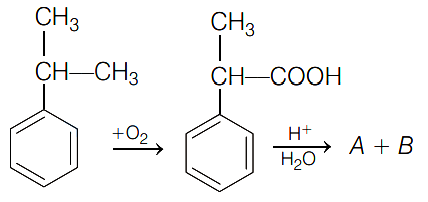
The product ' \(A\) ' gives white precipitate when treated with bromine water. The product ' \(B\) ' is treated with barium hydroxide to give the product \(C\). The compound \(C\) is heated strongly to form product \(D\). The product \(D\) isKCET 2021 Medium - A solution of \( 1.25 \mathrm{~g} \) of ' \( \mathrm{P} \) ' in \( 50 \mathrm{~g} \) of water lowers freezing point by \( 0.3{ }^{\circ} \mathrm{C} \). Molar mass of ' \( \mathrm{P} \) ' is
94. \( K_{\mathrm{f}(\text { water })}=1.86 \mathrm{Kg} \mathrm{mol}^{-1} \). The degree of association of ' \( \mathrm{P} \) ' in water isKCET 2014 Easy - On heating potassium permanganate, one of the following compound is not obtained:KCET 2015 Medium
- Bactericidal antibiotics among the following isKCET 2017 Hard
- In the manufacture of hydrogen from water gas \( \left(\mathrm{CO}+\mathrm{H}_{2}\right) \), which of the following is correct
statement?KCET 2017 Hard - Water softening by Clark's process usesKCET 2015 Easy
More PYQs from KCET
- The value of \({ }^{16} C_{9}+{ }^{16} C_{10}-{ }^{16} C_{6}-{ }^{16} C_{7}\) isKCET 2020 Easy
- Which one of the following conformations of cyclohexane is the least stable?KCET 2010 Medium
- Continuous emission spectrum is produced byKCET 2009 Easy
- If \(A=\{a, b, c\}\), then the number of binary operations on \(A\) isKCET 2020 Easy
- A stretched string is vibrating in the second overtone, then the number of nodes and antinodes between the ends of the string are respectivelyKCET 2015 Hard
- If
\(y=\tan ^{-1}\left(\frac{1}{1+x+x^{2}}\right)+\tan ^{-1}\left(\frac{1}{x^{2}+2 x+3}\right)\)
\(+\tan ^{-1}\left(\frac{1}{x^{2}+5 x+7}\right)+\ldots+n\) terms, then \(y^{\prime}(0)\) isKCET 2012 Hard